1,000 Advisors, $28 Trillion in AUM, and Only 1 Crypto Panel

I spent this week at Wealth Management EDGE in Boca Raton with roughly a thousand advisors and wealth managers. Collectively, this group represents about $28 trillion in collective assets under management and is the largest gathering of senior RIAs in the country, held at one of the nicest resorts in Florida.
I didn’t go to talk about crypto. I went to talk about the future of finance, and that distinction matters more than ever. This conference proved it.
Here’s what I saw, what I heard, and what I think it means.
The Room Has Changed
Last year, digital assets had a main stage slot at EDGE. Multiple firms showed up and there was solid crypto energy.
This year? One panel. One booth. That was the entire digital asset footprint at a conference with over 250 speakers.
You can read that two ways.
The bearish read says the market is in a slump, prices are down, and advisor interest evaporated with the chart. Fair enough. The audience questions at the lone crypto panel mostly boiled down to “why is Bitcoin down?” That tells you where heads are at.
The bullish read, and the one I left with, is that the conversation didn’t shrink so much as change shape. Crypto as an asset class got quieter while tokenization as infrastructure got louder. (More on that at the end.)
The RIA of the Future Runs on Private Markets & AI
The dominant themes of the week were unmistakable: Private markets and AI.
Every summit track, every vendor booth, every hallway conversation orbited one of those two suns.
The opening keynote from Sanctuary Wealth’s Patrick McGowan walked through H1 2026 capital flows from the wealth channel into private assets including private equity, private credit, real estate, infrastructure.
The framework on screen said it plainly: rotation, risk, reset, re-entry.
Advisors aren’t asking whether to allocate to private markets anymore.
They’re asking how to do it operationally.
That operational question is real. One session laid out the hidden time burden with no spin. Private markets aren’t “Schwab click and drop.” Enhancements to the process were related to automated subscription docs, capital call management, cash reserves, ongoing monitoring, and reporting across multiple custodians with different formats and data quality.
The vendors filling that gap, names like Arch, InvestCloud, and Gridline, had real traffic at their booths.
On the AI side, sessions on designing the AI-enabled firm of the future made one thing clear: AI is no longer an experiment in wealth management; it’s becoming the operating layer.
Firms are making governance and data decisions now that will determine who compounds advantage over the next decade. Zoe Financial’s Andres Garcia-Amaya made the case that AI supercharges operational efficiency and personalizes the client experience for growing RIAs.
I agree, and this is the thesis I run my own businesses on. AI as the orchestration layer, not the replacement layer. The firms that get this will pull away, while the firms that wait will spend the next five years explaining why their margins shrank.
Puerto Rico Stole the Show for Me
The session that hit closest to home was a presention on Puerto Rico as the best tax jurisdiction available to U.S. citizens.
For my geographically challenged readers, here is where Puerto Rico is on a map. And yes, it’s part of the United States, uses the U.S. Dollar and only requires an ID to enter.
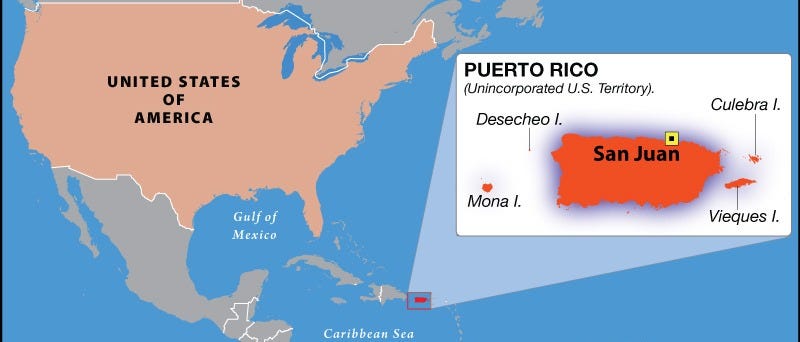
This topic resonated deeply with me as it’s something I’m working to build right now with Colton Alexander Advisers, a new Puerto Rico-based registered investment adviser designed around the island’s structural advantages. I sat in that room with more than professional curiosity.
The numbers aren’t subtle.
Act 60 provides a maximum 4% tax on interest, dividends, and capital gains for bona fide resident investors. There’s also a 4% corporate rate on exported services, which covers asset management, law, software, and consulting, with dividends from those activities tax free. In March, Act 60 was extended through 2055. That’s thirty years of tax certainty, signed into law.
Compare the rates. Roughly 4% in Puerto Rico versus about 41% in Florida and 52% in New York City. The presentation ran the compounding math, and I recreated it below because numbers you can check beat adjectives.
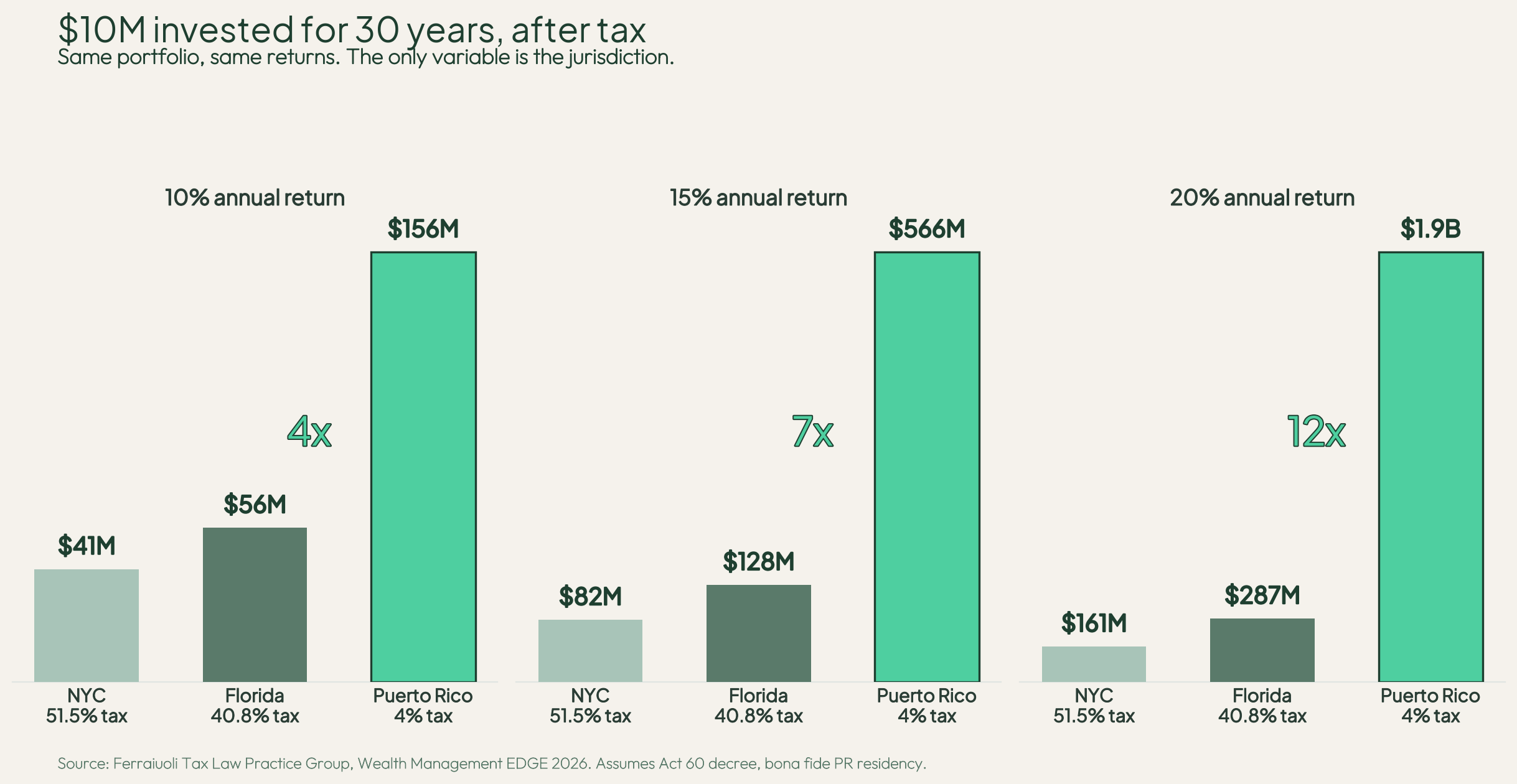
A $10 million portfolio growing at 20% for 30 years becomes roughly $1.9 billion after tax in Puerto Rico. The same portfolio in New York City ends around $161 million. That’s a $1.8 billion difference. Even against zero-income-tax Florida, the gap is about $1.7 billion.
Here’s the part people miss. None of this is offshore, because Puerto Rico is a U.S. territory with federal courts and FDIC banking in dollars. No passport changes, no expatriation tax, no currency risk, no renunciation of citizenship. It’s the only jurisdiction on earth that offers this treatment to U.S. citizens who keep their passport.
I think Puerto Rico is the most underpriced opportunity in American wealth management. The advisors in that room were paying attention, and the smart ones will act.
Tokenized Real Estate and the Happy Hour Test
Some of the best conversations at any conference happen off the agenda - especially when there is a yacht club involved…
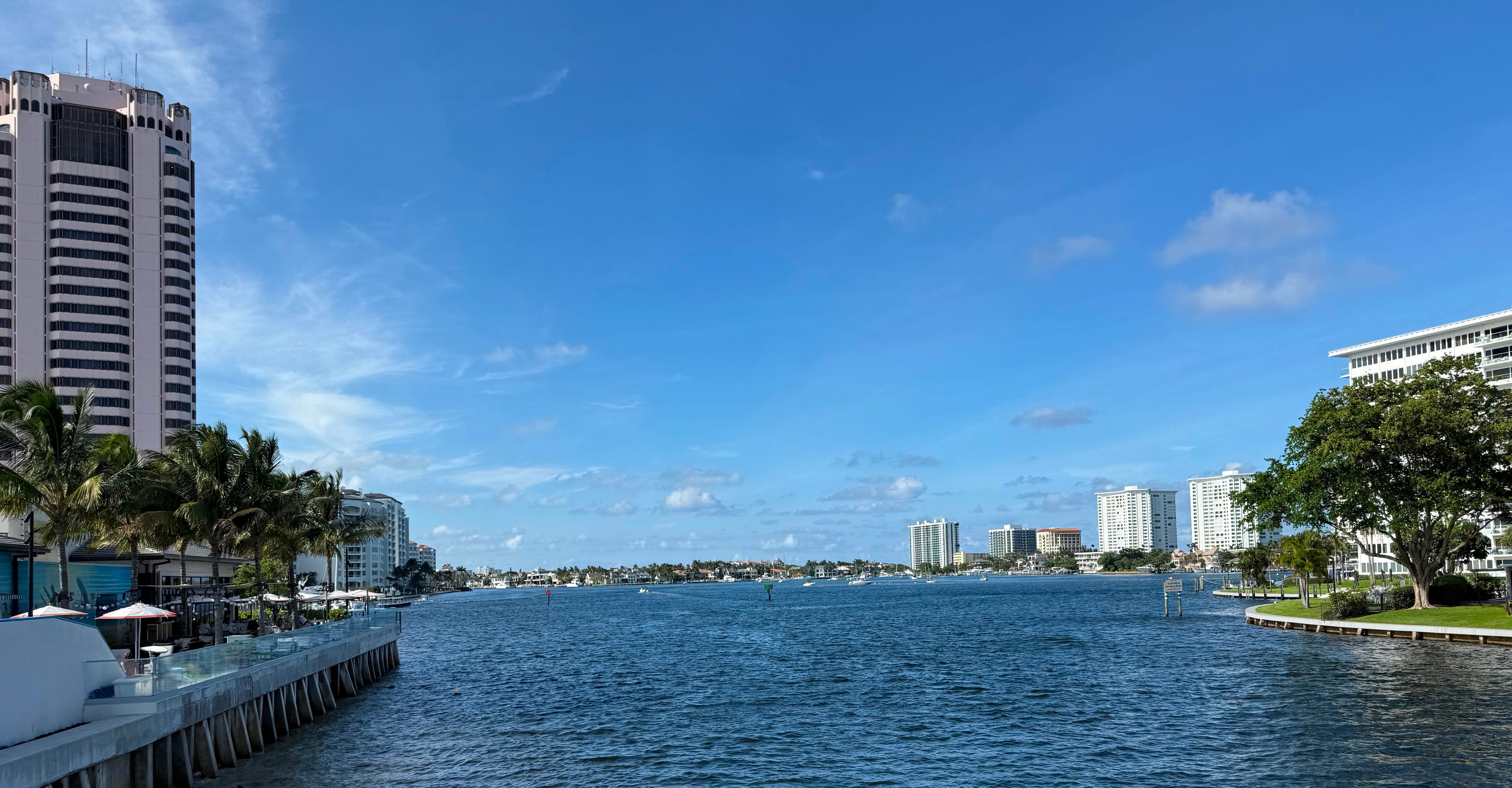
Revitalization Unlimited hosted a happy hour where I met operators deeply aligned on tokenizing real estate and packaging alternative investments into accessible vehicles.
This is where I road-tested some of what we’re building at Colton Alexander Advisers. The reception was telling. When you frame Puerto Rico plus tokenization plus alternatives as a single integrated offering, people lean in, and they lean in because it solves real problems rather than because it sounds exotic. Access, tax efficiency, and operational simplicity in one structure.
That’s the test I apply to any idea. Does it survive a conversation with a skeptical practitioner holding a drink? This one did, repeatedly.
The Lone Crypto Panel, and the Down-Only Problem
Credit where due. James McConaghy of Eaglebrook and Michael Kosoff of Mariner ran the only dedicated digital asset session at the entire conference, and they did it well.
The framing was right: crypto is no longer a fringe conversation. The real question is how RIAs capture held-away assets, implement tax-loss harvesting, and position for the next generation of wealth.
But the room told its own story. Sparse digital asset presence, and audience questions fixated on price.
Then there was the CoinShares booth, one of the only digital asset firms exhibiting. Their diversified alt-asset ETF, holding a basket of staked altcoin products like Solana, Cardano, Cosmos, and Toncoin, is down roughly 70% at NAV since its October 2025 inception. Net assets sit just over a million dollars, and the correlation to Bitcoin is 0.96.
The real kick in the teeth…is that they charge almost 1% as a fee. 🙄
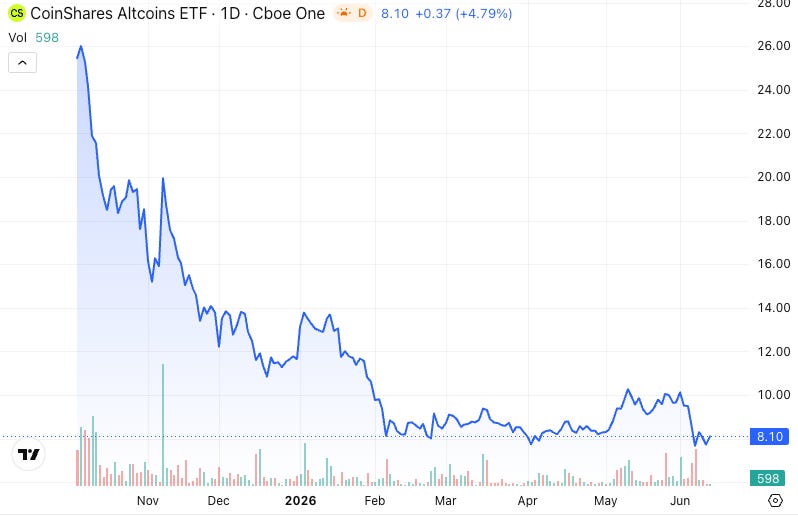
Think about what that means.
You get full Bitcoin correlation with dramatically worse drawdowns and no diversification benefit. So the question every advisor in that hall was implicitly asking: how is an RIA supposed to allocate client capital to products that have been down-only? Under a fiduciary standard, they really can’t, and until the industry builds products that solve for fiduciary reality instead of crypto-native enthusiasm, that capital stays on the sidelines.
This is the altcoin problem in one exhibit booth. It’s also why my framework has always separated Bitcoin from everything else. Bitcoin is a store-of-value asset class while altcoins are speculative tech bets, and funds that blend the two into a basket inherit the volatility of both and the credibility of neither.
The Hougan Takeaway
Matt Hougan put words to what I felt all week. He’s had an incredible number of conversations with advisors, and they’re genuinely interested in digital assets, just not in coins.
The interest is in stablecoins and tokenization.
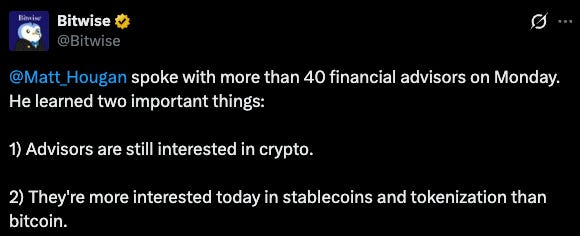
The future of wealth management won’t be built on “crypto” as advisors understood it in 2021. It will be built on stablecoin yield and tokenized assets, especially in private markets and alternatives. The same private markets that dominated every stage at EDGE. The rails are blockchain, but the product is access, yield, and efficiency. Nobody in Boca Raton was speculating on dog coins, yet plenty of people were asking how to tokenize a real estate fund.
This is the convergence I’ve been writing about for years. Traditional finance doesn’t adopt crypto. It absorbs the useful parts and discards the rest, and tokenization is the useful part.
The Bottom Line
EDGE was a great event with a great team behind it, and I’ll be back in the fall. But the signal was clear. The wealth management industry has moved past the question of whether digital assets matter and is now sorting out which parts matter. Stablecoins, tokenization, and tax-advantaged structures are winning. Speculative altcoin baskets are losing.
Until next time fam!
Matthew Snider is the founder of Block3 Strategy Group, author of “Warren Buffett in a Web3 World,” and publisher of the BitFinance newsletter. He holds a Series 65 and MBA, and has been an active participant in digital asset markets since 2015. This article is for educational purposes only and should not be considered financial advice. Always consult with a qualified professional before making investment decisions.