The Quiet Pivot Happening Inside Ripple

Las Vegas was unusually busy this week. Bitcoin 2026 closed Tuesday night, XRP Las Vegas opened Thursday morning, and as expected - the audiences differed immensely. Different rooms. Different investment theses. Same (dry!) city.
I walked the floor today. Ripple’s “Raise the Standard” billboard towering over the Strip is the kind of advertising spend that doesn’t happen unless a company has decided it’s done apologizing. They painted the entire strip with their logo and vision of a unique developing ecosystem.
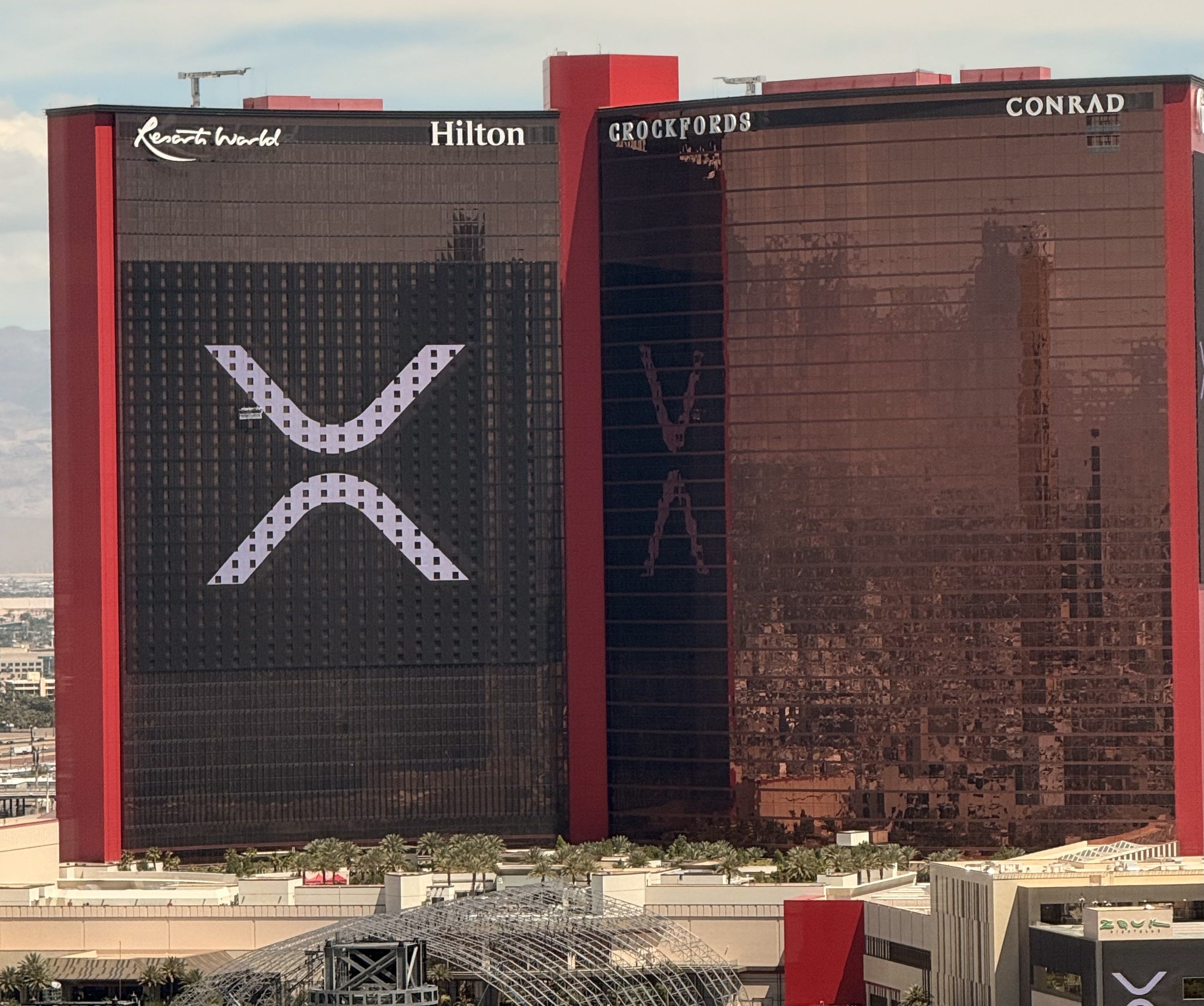
The conference itself read more like a fintech summit than a token meetup. Brad Garlinghouse, David Schwartz, Matt Hougan from Bitwise, John Deaton on the legal panel. The conversation around me was focused on institutional progress around prime brokerage, post-trade settlement, and a stablecoin custodied at BNY Mellon. ($RLUSD)
Most of the financial press still writes about Ripple the way they wrote about it in 2022:
A token company.
A lawsuit.
A CEO doing media tours about regulatory clarity.
That mental model is now badly out of date.
Here’s what’s actually happening, and why it matters for anyone trying to size XRP as part of a real portfolio.
The Thesis in One Sentence
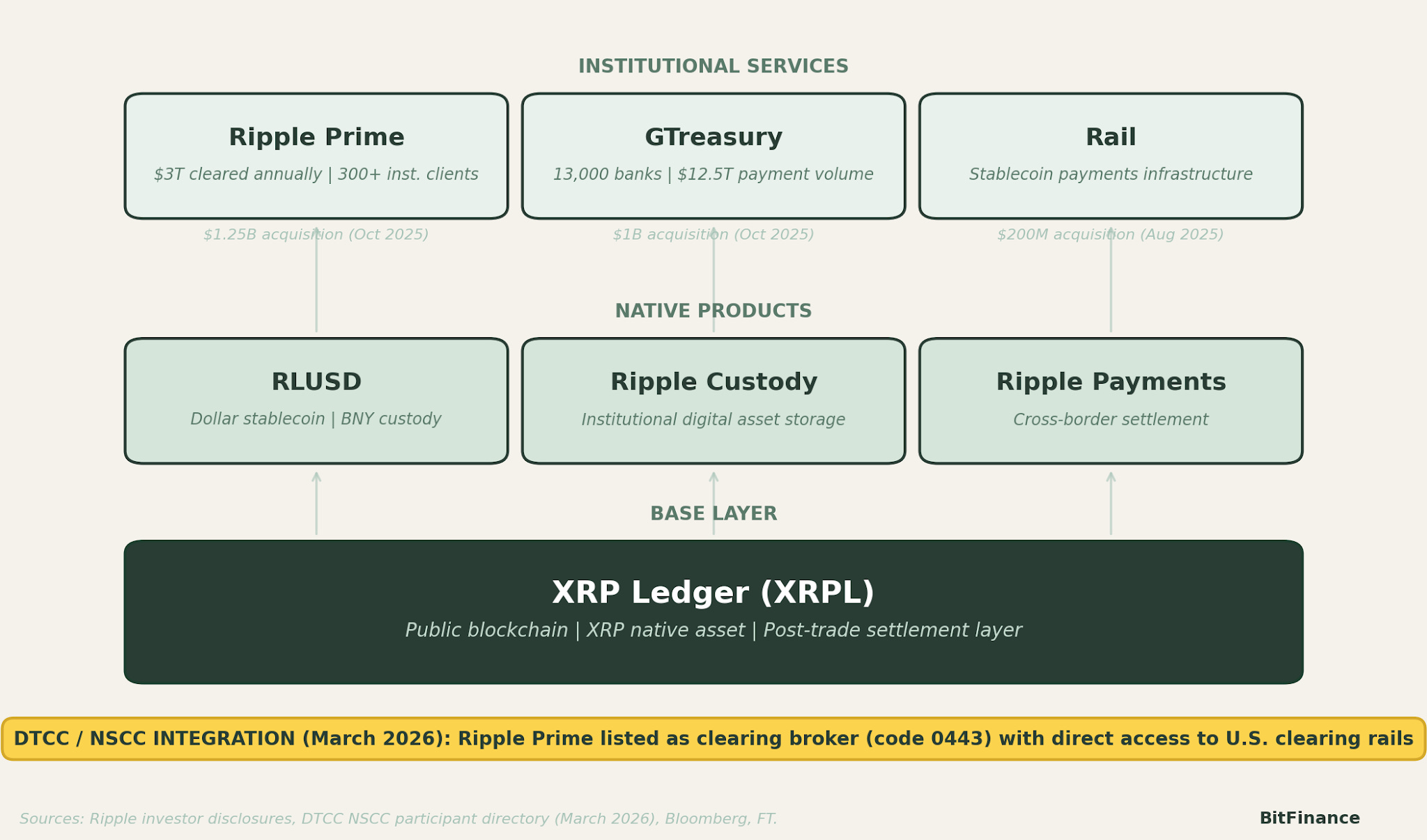
Ripple in 2026 is a full-stack institutional finance company with a token attached, not a token company building infrastructure on the side. The token is one piece of a system that now includes prime brokerage, treasury management, custody, a stablecoin, and direct integration into U.S. clearing rails. That reframe changes the question every allocator should be asking.
Stop asking whether XRP is going to pump. Start asking what a $4 billion bet on owning institutional plumbing is actually building toward.
The Pivot Behind the Pivot
Three deals tell the story.
Ripple Prime (the rebranded Hidden Road acquisition, $1.25B, closed October 2025) clears roughly $3 trillion annually across foreign exchange, derivatives, fixed income, and digital assets for over 300 institutional customers. Ripple is now the first crypto company to own and operate a global multi-asset prime broker.
GTreasury ($1B, October 2025) brings 13,000 banks and over $12.5 trillion in annual payment volume. Real corporate clients. American Airlines, Goodyear, Volvo. This is enterprise treasury infrastructure, not a crypto experiment.
Rail ($200M, August 2025) adds Toronto-based stablecoin payment rails for cross-border transfers.
The three acquisitions stack. Each one extends Ripple deeper into regulated financial infrastructure, with XRP and RLUSD threaded through every layer. RLUSD now sits as collateral inside Ripple Prime’s brokerage products, with derivatives clients increasingly choosing to hold balances in RLUSD rather than other stablecoins.
The Receipts Most Coverage Missed
The single most consequential story for XRP in 2026 wasn’t the ETF launches or any price move. It was a March 2 entry in a clearinghouse directory.
Ripple Prime was added to the DTCC’s National Securities Clearing Corporation participant directory on March 2, 2026, assigned clearing broker code 0443.
The NSCC processes over $2 quadrillion in transactions annually. (yes, quadrillion)
For the first time, XRP-linked infrastructure has direct access to U.S. clearing rails used by traditional prime brokerages. DTCC’s 2025 patent filings had already named Ripple and XRPL alongside Bitcoin and Ethereum as compatible architecture for tokenized post-trade settlement. The March 2 listing made that architecture live.
DTCC is targeting tokenization of Russell 1000 stocks, major ETFs, and U.S. Treasuries within roughly 50 weeks of late March 2026. Ripple Prime is the prime broker that’s already inside the system, ready to clear the flows.
Add the rest of the data points and the story becomes a glaring opportunity.
Goldman Sachs disclosed a $154 million spot XRP ETF position in its Q4’25 13F.
Brad Garlinghouse announced a $500 million institutional investment from Fortress, Citadel, Pantera, Galaxy, Brevan Howard, and Marshall Wace.
Seven U.S. spot XRP ETFs are now trading with $1.29 billion in cumulative inflows since November 2025.
This is not a retail story anymore.
The Disconnect
Here’s the part that should interest anyone who actually does diligence.
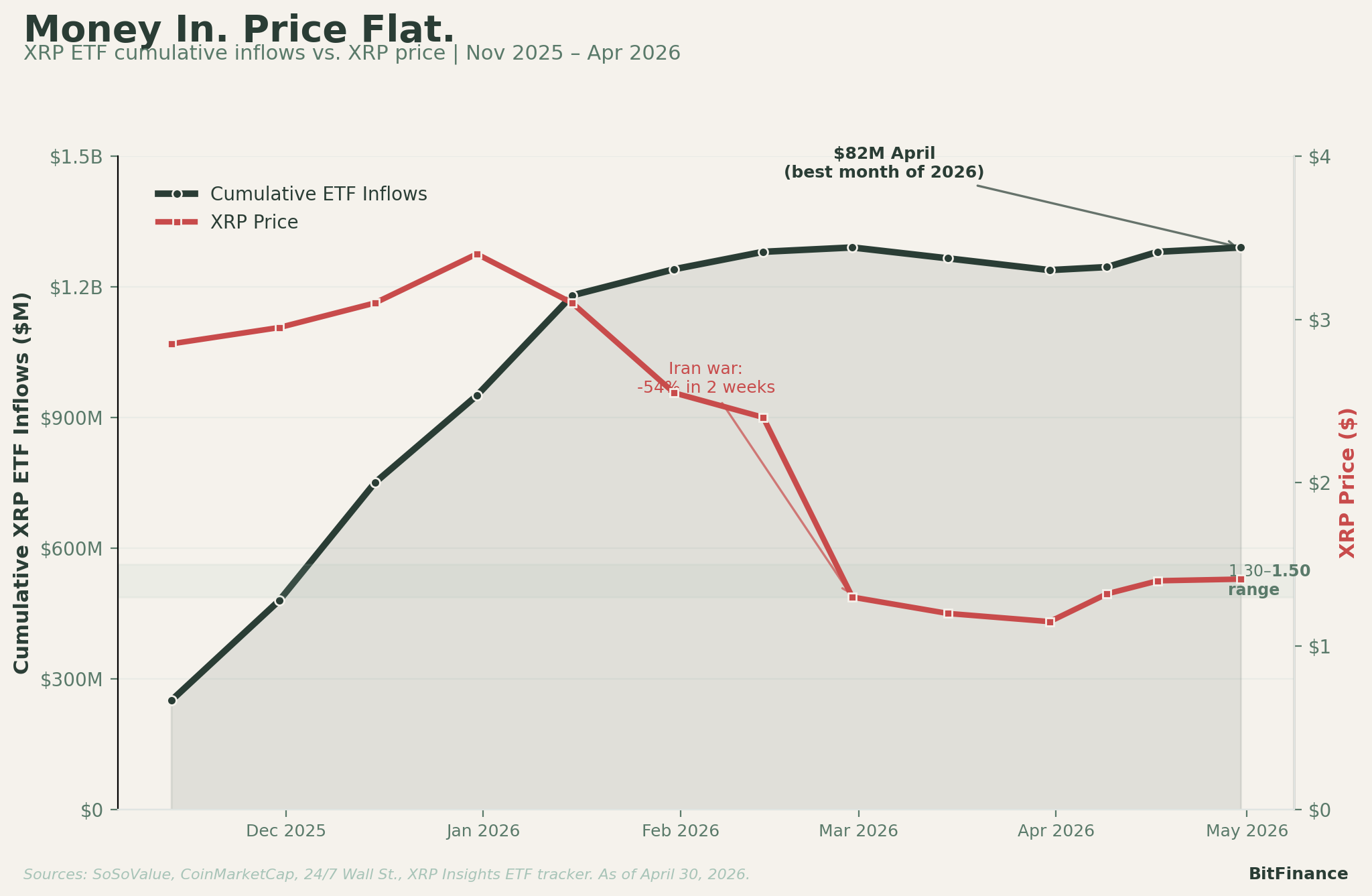
XRP ETFs pulled in $82 million in April, the best month of 2026, fully erasing March’s $31 million outflow. Bitwise just overtook Canary as the largest XRP ETF, signaling institutional money replacing the retail flows that drove the November launch. XRP is trading at $1.41, locked inside the same $1.30 to $1.50 range it’s been in since February.
Money in. Price flat.
Two reasons. Roughly 60% of XRP’s circulating supply was bought near $1.44 and sells into every rally, creating a structural sell wall. Bitcoin is winning the macro rotation, with BTC ETFs pulling in $996 million in a single week in mid-April. The institutional buying is real but it’s being absorbed at a high rate.
Worth noting: a divergence between sustained ETF inflows and flat price action usually resolves in one direction. Once supply is absorbed, the next catalyst tends to move price faster than people expect.
Why I Hold Both
I own Bitcoin and I own XRP. There I said it.
They’re not the same bet, and I don’t pretend they are.
Bitcoin is a monetary asset. The thesis is monetary debasement, sovereign reserve adoption, the fixed supply story. Saylor’s keynote in Vegas this week made the case better than I can.
XRP is a bet on a payments and post-trade infrastructure company. The thesis is institutional rails, regulated stablecoin adoption, and the value that accrues to a token threaded through a system that’s actively integrating into U.S. clearing infrastructure.
Owning Coca-Cola doesn’t preclude owning Apple. Buffett didn’t refuse to buy American Express because he already owned Bank of America. Tribal investing is an emotion, not a framework. Each holding has to earn its place in a portfolio on its own merits, and the merits here don’t compete.
The XRP and Bitcoin communities have spent a decade treating each other as substitutes. The data says they aren’t.
What to Watch
Three catalysts worth tracking.
The CLARITY Act Senate Banking Committee markup before the May 21 recess. If it lands, XRP gets structured as a digital commodity in settled law and the $4B+ in institutional infrastructure gets a regulated runway. Polymarket has 2026 passage at roughly 47%, down from 82% in February.
The DTCC tokenization rollout. Russell 1000 stocks, ETFs, and Treasuries inside a 50-week window starting late March 2026. Ripple Prime is already wired in. This is the integration that turns “XRPL is enterprise-grade” from a marketing line into a settlement reality.
Bitwise’s price scenarios. The firm leads issuer rankings in XRP ETF inflows and just published a 32-page investment case with a $4.94 base case for end-2026, $6.53 max case. Standard Chartered models $7 if CLARITY passes plus ETF inflows scale to $4-8B.
The Frame I’d Use
XRP isn’t a payments altcoin anymore. It’s the equity-adjacent exposure to a company that has spent four billion dollars buying its way into U.S. clearing infrastructure, with a token that captures value as the system scales. Whether the thesis vindicates depends on legislation, integration timelines, and supply absorption. Whether the company has built something genuinely new is, at this point, a question with receipts.
I walked out of the conference with the same conclusion I walked in with. The most interesting story in XRP isn’t on the price chart. It’s in the directory entries, the acquisition list, and the institutional cap table.
Matthew Snider is the founder of Block3 Strategy Group, author of “Warren Buffett in a Web3 World,” and publisher of the BitFinance newsletter. He holds a Series 65 and MBA, and has been an active participant in digital asset markets since 2015. This article is for educational purposes only and should not be considered financial advice. Always consult with a qualified professional before making investment decisions.