Consensus 2026: What Allocators Are Actually Buying

There’s a strange disconnect between what Consensus 2026 looked like on Twitter and what it felt like on the floor. On Twitter you saw mega-fund announcements, a $4.2B acquisition, an agent bank launch, and Saylor doing Saylor things. On the floor you mostly heard people asking each other if there’s any opportunity left in crypto that isn’t actually an AI trade in disguise.
Both things are true. Sentiment was tepid, the deals were enormous, and the themes that mattered were specific. Here are five worth your time.
1. Agentic banking stopped being a thought experiment
Anchorage Digital’s Nathan McCauley used the mainstage to launch what he’s calling an agent bank. The pitch is that we’re heading into a trillion-dollar industry where agents pay each other, agents pay merchants, and agents get paid.
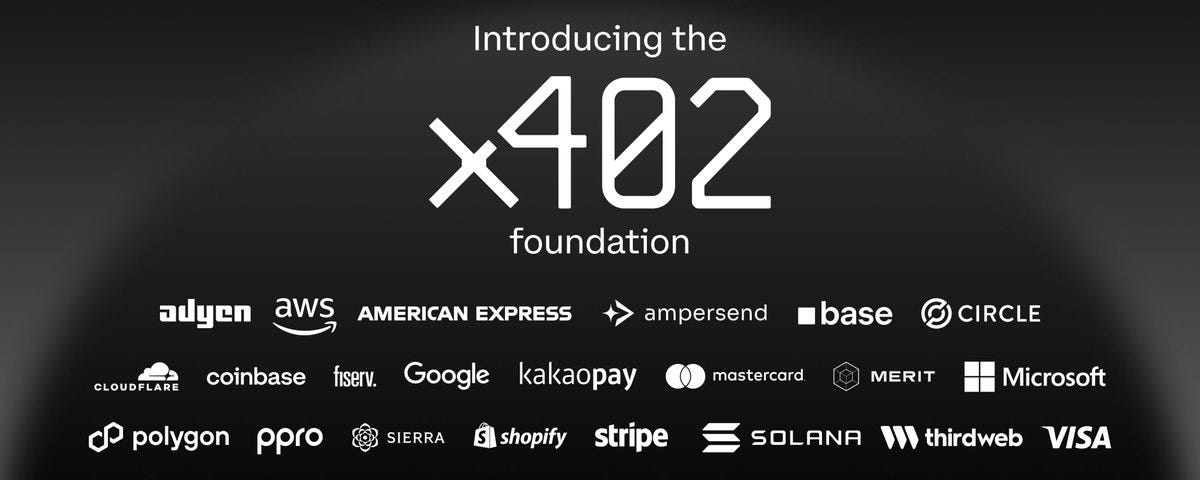
Then Coinbase introduced the x402 Foundation, now governed by the Linux Foundation as of April, with Adyen, AWS, American Express, Circle, Cloudflare, Fiserv, Google, Mastercard, Microsoft, Polygon, Shopify, Stripe, Solana, and Visa as inaugural members. The name comes from RFC 7231, section 6.5.2: HTTP status code 402, “Payment Required,” which the IETF reserved in 2014 “for future use.” That future arrived this week.
The numbers behind the launch are truly impressive and intriguing.
x402 had already processed over 50 million transactions before the foundation announcement, and stablecoin volumes on the related rails now exceed $11 billion in circulation with 200 million-plus transactions per month.
AWS chose this week to launch Amazon Bedrock AgentCore Payments in preview, with native x402 support. Galaxy Research estimates agentic commerce could represent $3 to $5 trillion in B2C revenue by 2030.
The opportunity for allocators is the layer underneath that figure: API micropayments, compute provisioning, and machine-to-machine settlement, the boring rails the agents need to function. If you’re advising clients on the AI buildout, the payments infrastructure is no longer hypothetical. It’s being assembled by the same firms that already process most of the world’s transaction volume.
2. Tokenization quietly turned into M&A
Bullish announced it’s acquiring Equiniti for $4.2B.
Equiniti is the system of record for nearly 3,000 issuer clients, processes around $500 billion in annual payments, and serves over 20 million verified shareholders.
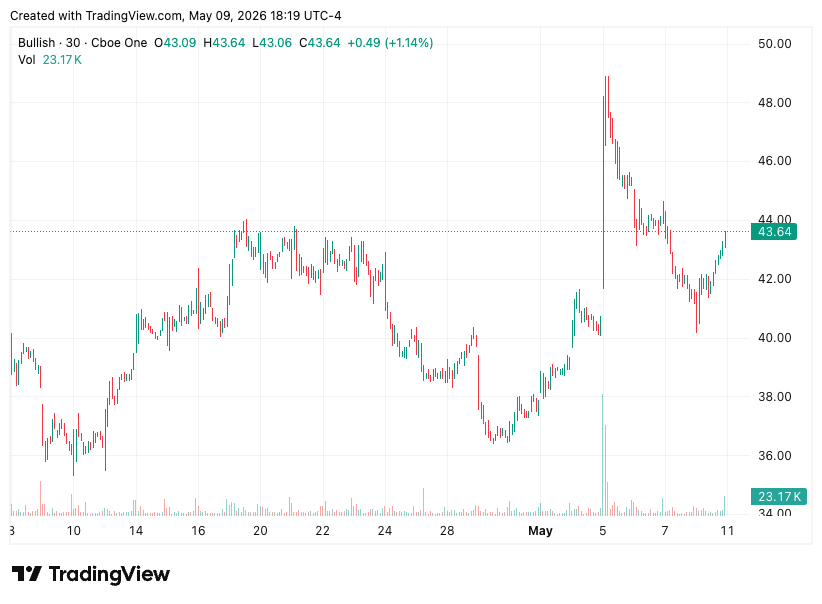
Their issuer roster includes Berkshire Hathaway, Rolls-Royce, and Moody’s. Pro forma, the combined company expects roughly $1.3 billion in adjusted revenue and over $500 million in adjusted EBITDA less Capex in 2026, with 20% projected revenue growth from tokenization through 2029. BLSH shares climbed 17% in morning trading. Clear Street kept a Buy with a $50 target, calling it the gap-filler in Bullish’s tokenization thesis.
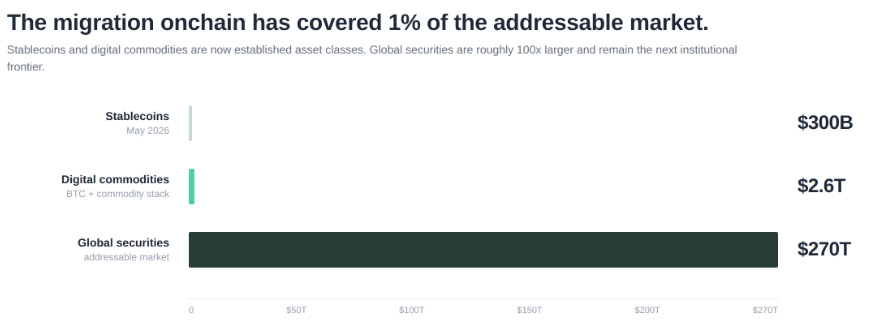
The framing held up across the conference. Stablecoins (now $300 billion in market cap and roughly $10 trillion in annual payments volume) and digital commodities have already migrated onchain.
Global securities are a $270 trillion-plus market, and the institutional players have moved past pitching the idea and started buying the plumbing. Securitize and Computershare are now publicly working to bring parts of the $70 trillion U.S. equities market onchain, which means the Bullish deal looks less like an outlier and more like the first large move in what will be a quieter wave of consolidation.
Crypto M&A in 2025 already hit roughly 260 deals totaling $8.6 billion, about four times the prior year, per Pitchbook data, and the Bullish-Equiniti transaction by itself is half that 2025 total.
3. The chain conversation converged onto Canton
Nearly every chain conversation I had ended up at one way or another falling to Canton Network.
Partners building on it, institutions evaluating it, very little chatter about the alternatives. If you’ve been holding a strict “permissionless will win” thesis, this conference was a counterargument worth taking seriously.
It doesn’t mean Canton wins, but it does mean the institutional buyer is more comfortable with a permissioned chain than the crypto-native investor expects them to be. Canton’s pitch leans on a privacy-first architecture and the Daml smart contract language, which is roughly what every regulated counterparty I spoke to said they needed from a settlement layer before they’d even take a meeting.
For allocators with broad public market exposure, the real question is which infrastructure stack each tokenization corridor settles on, and whether your existing custody and prime relationships are positioned to ride those rails when they go live.
4. Tradfi is no longer benchmarking against Tradfi
The most repeated competitive frame I heard from traditional brokerages: their direct competitors are Coinbase, Kraken, and Robinhood, not each other.
The “Old Money, New Assets” panel with Morgan Stanley’s Jed Finn and Zerohash’s Edward Woodford was the cleanest version of the argument. The wealth management seat at the table now includes someone whose product roadmap looks a lot like a crypto exchange.
Mastercard and Visa illustrated the same dynamic from the issuer side, with Mastercard focused on B2B payments expansion and Visa on agentic commerce. For RIAs, the platforms your clients use are converging, and the advisor who can speak both languages is going to look very different five years from now than the advisor who picked one side.
5. The mood was bearish in a way the headlines hid
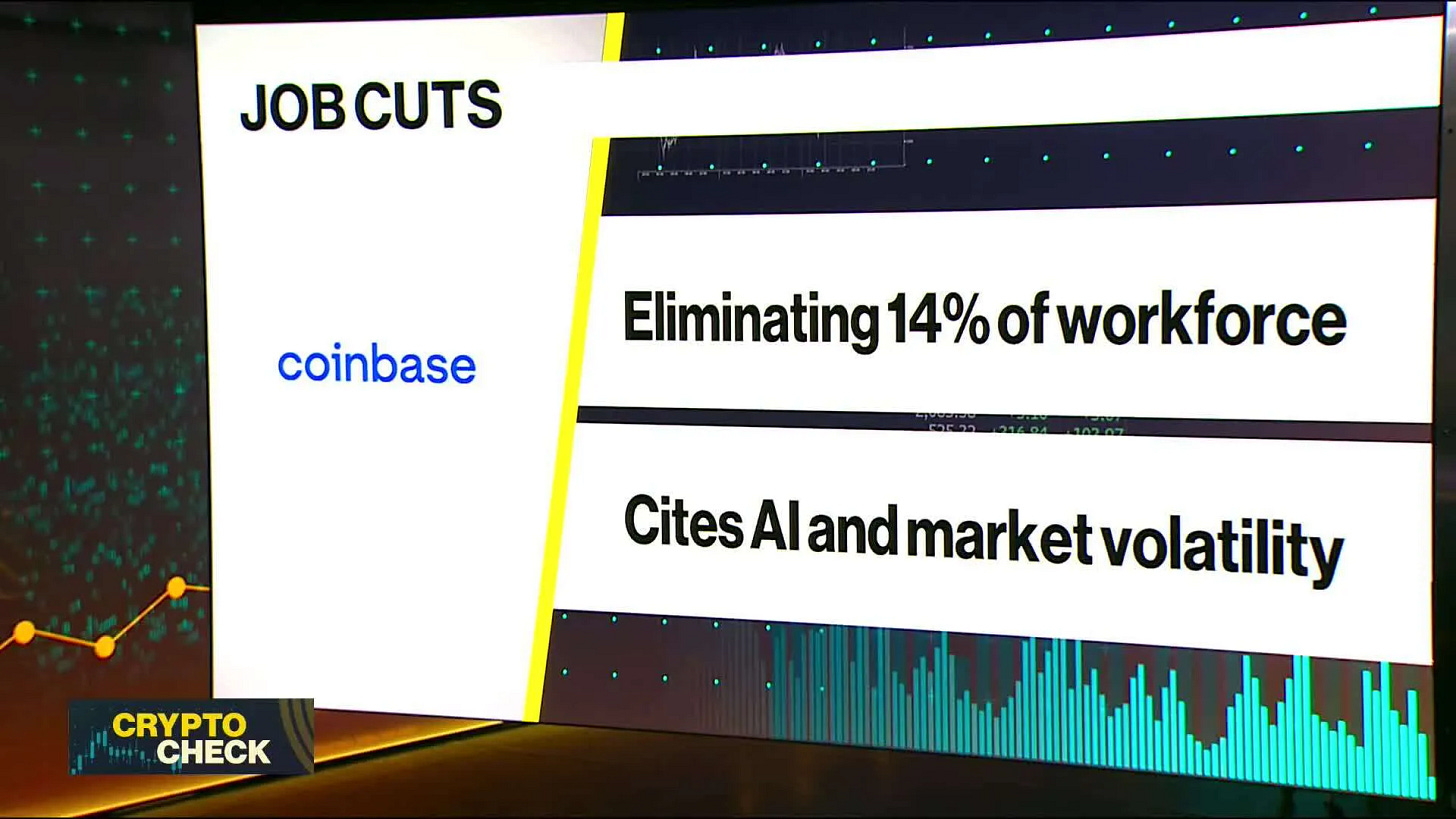
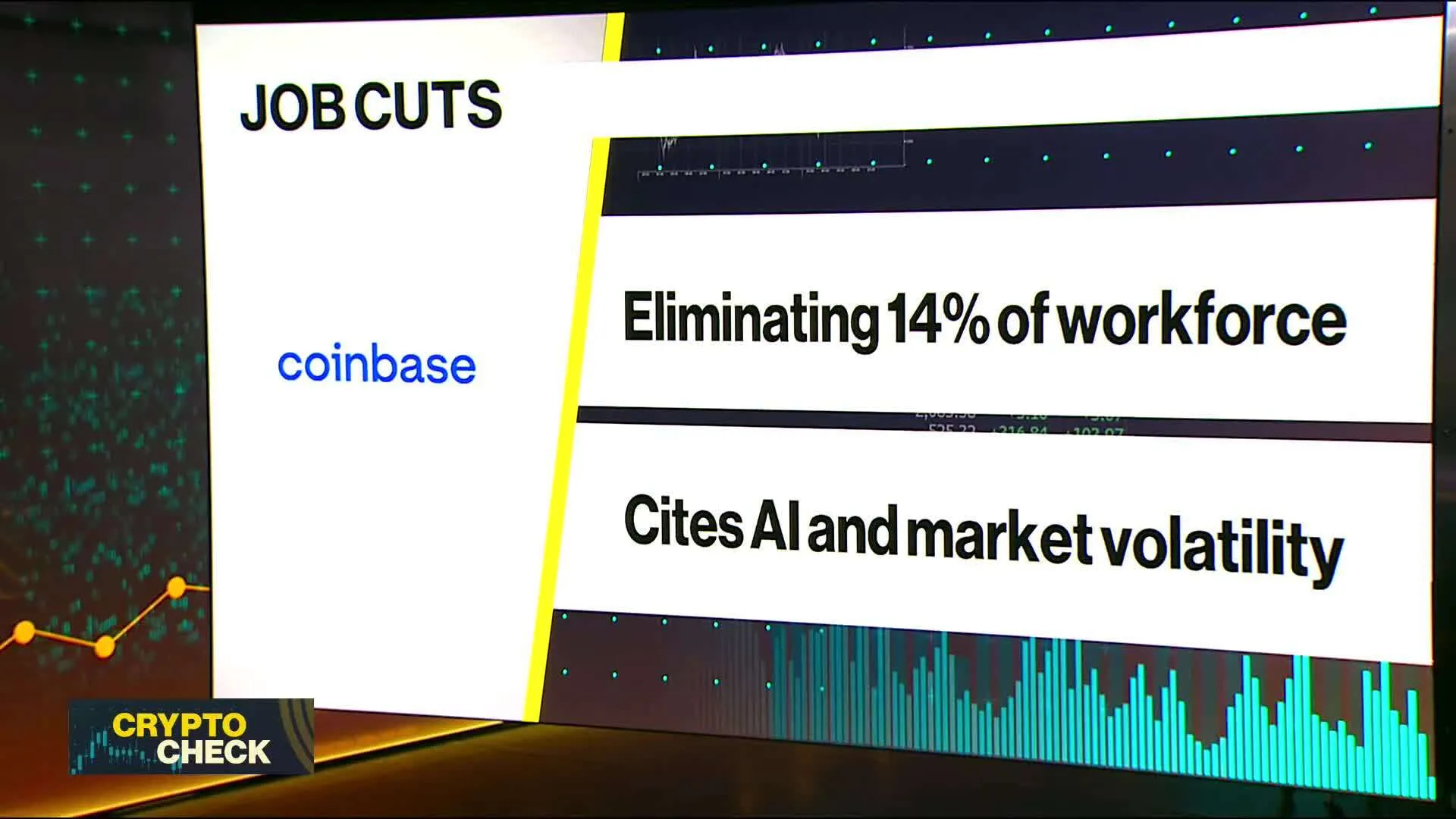
Coinbase laid off 14% of its workforce the same morning a16z announced its $2.2B Crypto Fund 5. Crypto VC funding hit $662M in April 2026, its lowest point since May 2025 and down 74% year over year. Most former crypto VCs now describe themselves as crypto and AI VCs. Several funds I talked to are raising but not deploying.
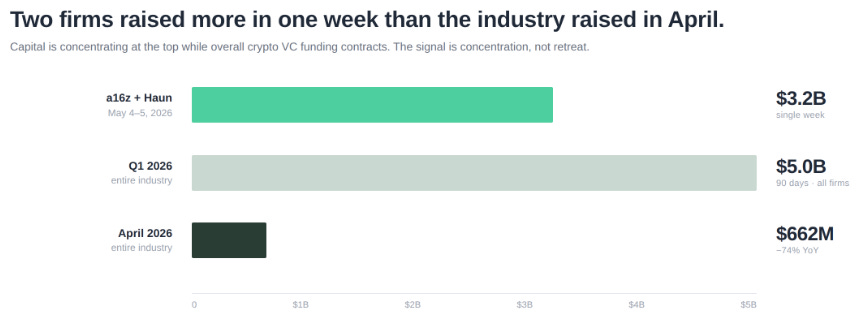
Yet a16z and Haun Ventures pulled in $3.2 billion combined in a single week, and both centered the same three themes: stablecoins, tokenization, and the agentic economy. a16z’s new fund is half the size of its 2022 vehicle, which tells you these firms are sizing for discipline rather than froth. The signal is concentration, not retreat. Capital is being repositioned for the next cycle, and the people repositioning it aren’t broadcasting the moves yet. Per several policy folks I spoke with, the Clarity Act could pass as early as end of May, which would change the calculus for a lot of the dry powder currently waiting on the sideline. Looking forward to next year.
Final Consensus: If you only read the headlines, you got one story. If you spent the week on the floor, you got a different one. Both are real. Holding both in your head is the work.
🛑 REMINDER 🛑
Quick reminder of what we’re building. Live indicators. The research behind them. The methodology taught alongside the signal. A small room where you leave knowing how the work actually gets done
I’m building the early cohort for when the Discord opens and the first indicators ship. If you want a seat, this is where to claim one.
Interested? Fill out the 30-second interest form here. 👈
This Week In 2 Mins

Buffett Just Compared Markets to a Church with a Casino Attached (May 5)
At Saturday’s Berkshire meeting, Buffett described markets as a church with a casino attached, and noted the casino has gotten very attractive. Monday morning gave us both halves on the same news cycle.
GameStop’s $11B market cap made an unsolicited $55B hostile bid for eBay with no answer for the math (casino).
DTCC quietly confirmed July production timelines to tokenize a slice of its $114 trillion in real-world assets under custody, with 50 firms in the group (church).
Burry exited GameStop within 48 hours when the data changed. The casino had every camera in the building. The church had a press release.

Five Layers Down: The Investable Stack Behind the Steroid Olympics (May 8)
Enhanced Games (the Steroid Olympics) prices its IPO on Friday at a $1.2B valuation. Three sports, four days at Resorts World Las Vegas, with athletes openly using FDA-approved performance enhancers under medical supervision.
The Games themselves are the marketing engine.
The real investment thesis is the consumer health stack underneath: TRT, peptides, GLP-1 derivatives, longitudinal diagnostics.
The longevity market is projected to grow from $65B in 2023 to $314B by 2030 at a 25% CAGR, with or without the swim meet. Five layers worth tracking, from the SPAC itself down to prediction markets like Kalshi.
The Games are the ad campaign. The portfolio sits one or two layers below.
Winners🏆
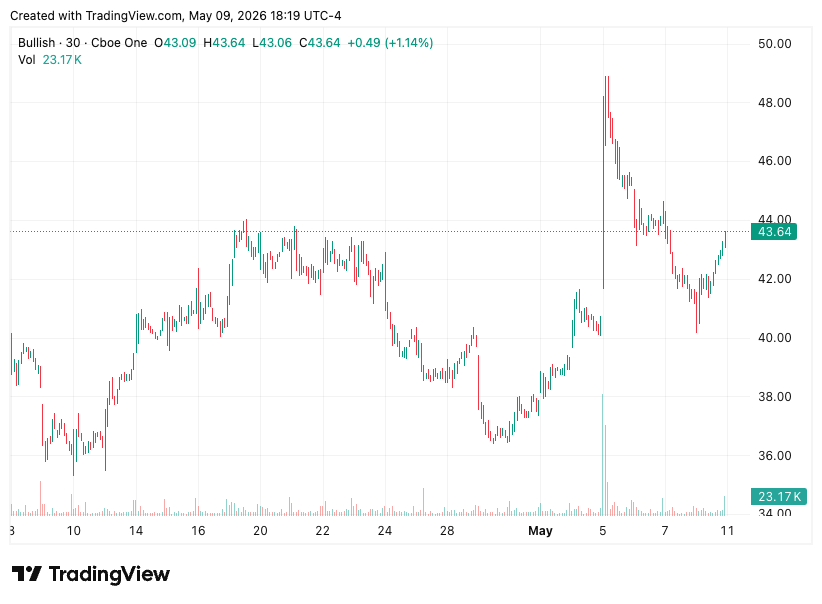
Bullish (BLSH) - (who now owns CoinDesk & Consensus). Shares climbed 17% in morning trading on the Equiniti announcement. Clear Street kept a Buy rating with a $50 price target, calling the deal the gap-filler in the firm’s tokenization thesis.
Created with TradingView Berkshire Hathaway shareholders. Equiniti is BRK’s transfer agent, which means Buffett’s 4 million-plus shareholders are about to be among the first to sit on tokenization-ready issuer infrastructure, whether or not BRK ever opts in.
Stablecoin issuers and infrastructure. All three of the largest VC announcements of the week (a16z’s $2.2B, Haun’s $1B, and the Bullish deal) centered stablecoin rails as the durable adoption signal. Annual payments volume is now $10 trillion.
Losers📉
Coinbase headcount. The 14% reduction in force landed mid-conference and reset the mood across the floor. The release came the same morning the firm’s biggest VC backer announced a fresh $2.2B fund.
Strategy (MSTR). Q1 earnings missed EPS expectations even as the firm continued aggressive bitcoin accumulation, including a 34,164 BTC purchase in April for $2.54 billion. Shares dipped after-hours.
DeFi total value locked. TVL fell from a monthly high of $99.5B to $84.3B in April after exploits at KelpDAO and Drift, a 15% drawdown that’s worth tracking against the broader risk-on narrative.
Watch this week (May 11 to 15)
Tuesday: April CPI. Headline expected at 0.6% MoM and 3.7% YoY, with core at 0.3% MoM and 2.7% YoY. The print lands while a new Fed chair confirmation works through the Senate. Watch the rate path repricing.
Bullish (BLSH) Q1 print. First read on tokenization revenue mix since the Equiniti announcement. The sustainable revenue question is the real test of whether the thesis holds beyond crypto trading volumes.
Clarity Act floor vote watch. Policy contacts I spoke with at Consensus believe end-of-May is realistic. A passage signal would re-rate everything in the digital asset compliance stack.
AWS AgentCore Payments adoption. With AWS launching native x402 support on May 7, watch which large enterprises announce pilots first. Early adoption will tell you whether agentic commerce is a 2027 story or a 2026 one.
🛑 REMINDER 🛑
Quick reminder of what we’re building. Live indicators. The research behind them. The methodology taught alongside the signal. A small room where you leave knowing how the work actually gets done
I’m building the early cohort for when the Discord opens and the first indicators ship. If you want a seat, this is where to claim one.
Interested? Fill out the 30-second interest form here. 👈
Matthew Snider is the founder of Block3 Strategy Group, author of “Warren Buffett in a Web3 World,” and publisher of the BitFinance newsletter. He holds a Series 65 and MBA, and has been an active participant in digital asset markets since 2015. This article is for educational purposes only and should not be considered financial advice. Always consult with a qualified professional before making investment decisions.