Stop Prompting Your AI. Start Looping It.

There’s an gap between knowing something and being able to use it.
I passed the SIE last week, the entry-level securities exam, and this coming week I start drilling for the Series 7.
Option strategies are a heavy part of that exam, and they’re the part where reading only carries you so far. You can memorize every definition and still hesitate when it’s time to build a position under live conditions. The vocabulary comes from study, while the instinct comes from doing the thing again and again. That’s true of most skills worth having, and it’s the reason I keep looking for ways to turn study into practice.
So instead of grinding another stack of flashcards, I built something that lets me practice on real setups. It runs every morning, proposes trades, and shows me how each one would play out with profit and loss analysis.
Studying for the exam was the reason I started, though the build turned into something more useful than test prep.
This article isn’t a piece about options, and you don’t need to care about options to take something from it. The thing I built and wanted to share with y’all is called an agentic loop, and loops are quietly becoming one of the more useful ways to work.

The shape of a lot of jobs is already changing around this, and the people who learn to build loops now get to shape their own work instead of waiting to see what it turns into - so let’s dive in!
What an AI Loop Is
A loop is a system that runs on its own schedule, reads its own data, proposes something, waits for you to say yes, then acts and reports back. The shape is the whole point.
A chatbot sits idle until you prompt it, while a loop wakes up on its own, does the legwork, and hands you a decision instead of a blank box. It’s a small difference to describe and a large one to live with.
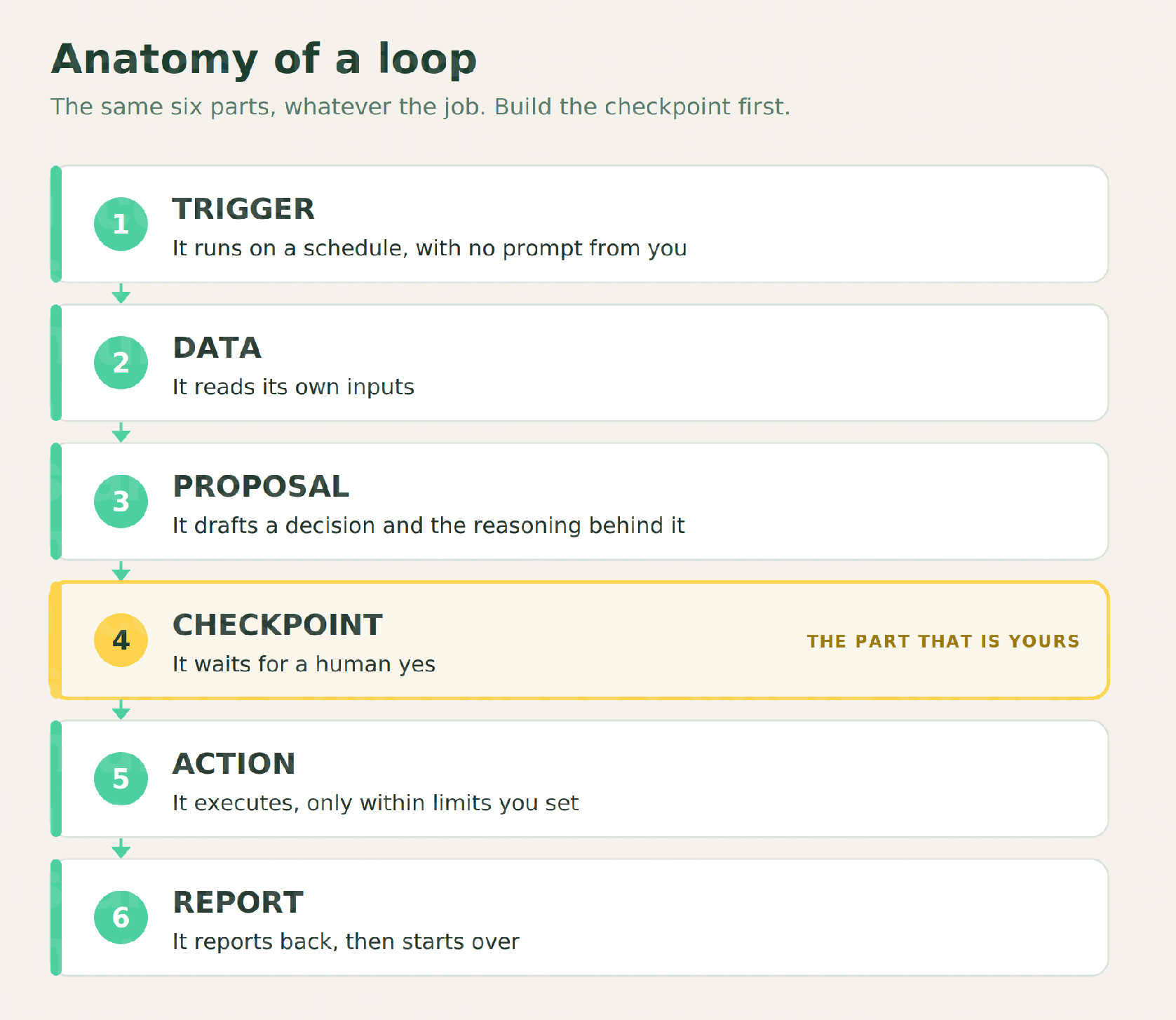
Most of the value comes from that inversion. You stop initiating the work and start reviewing it, which frees your attention for the one part that needs a human.
How Mine Runs
Here’s how I run the set up today.
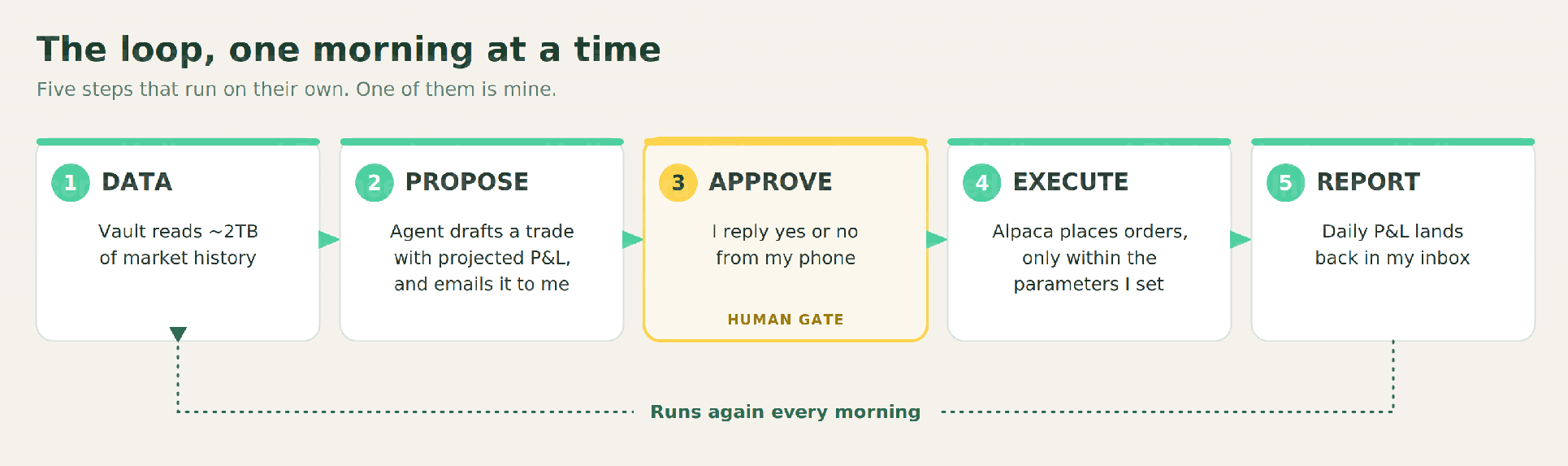
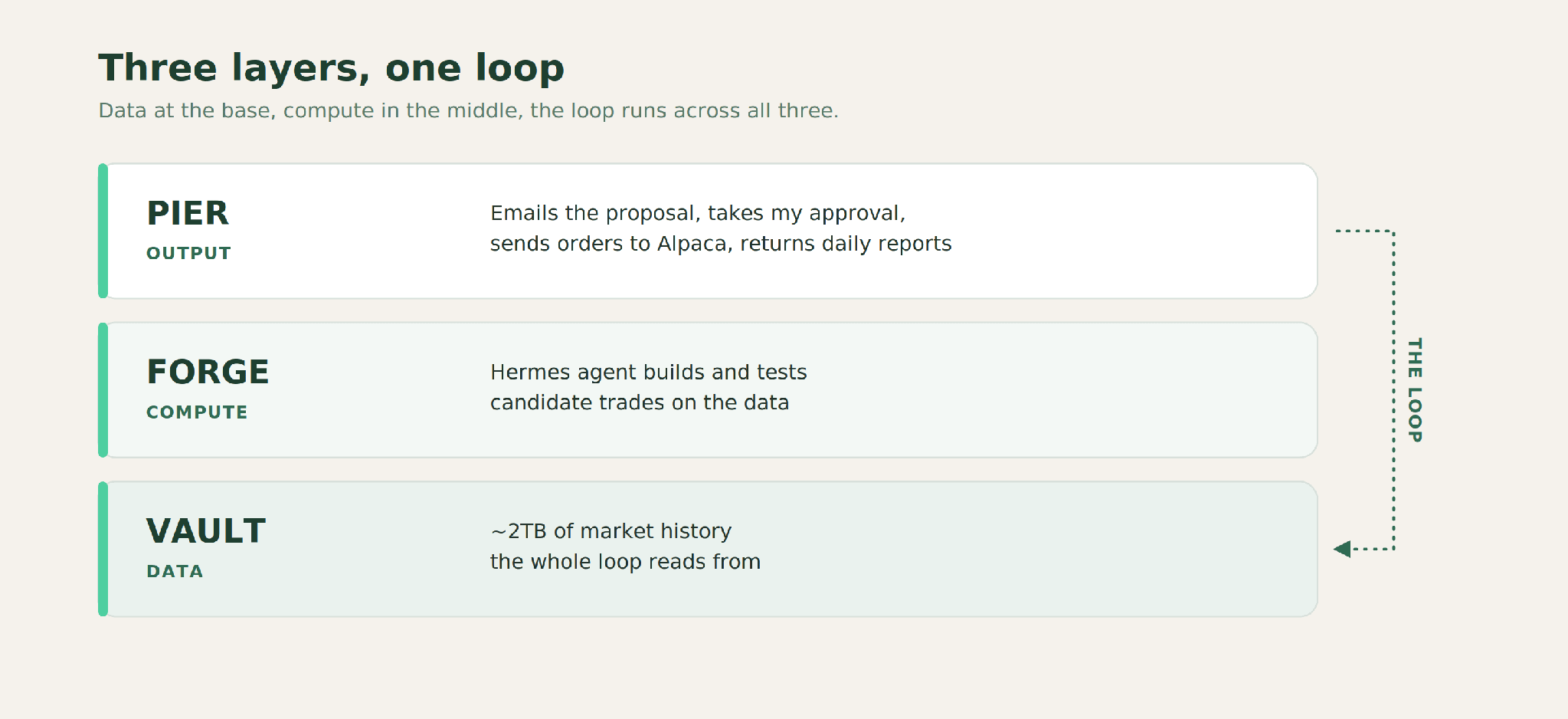
I gave an agent access to a research vault holding roughly two terabytes of market data that I purchased through a data provider. It also has access to real time / recent data via Alpaca’s API.
Every morning it reads that data, builds candidate trades across a fixed list of equities, and writes me an email. The message lays out the proposed trade, the reasoning behind it, and the projected profit and loss. It places nothing on its own, and it waits.
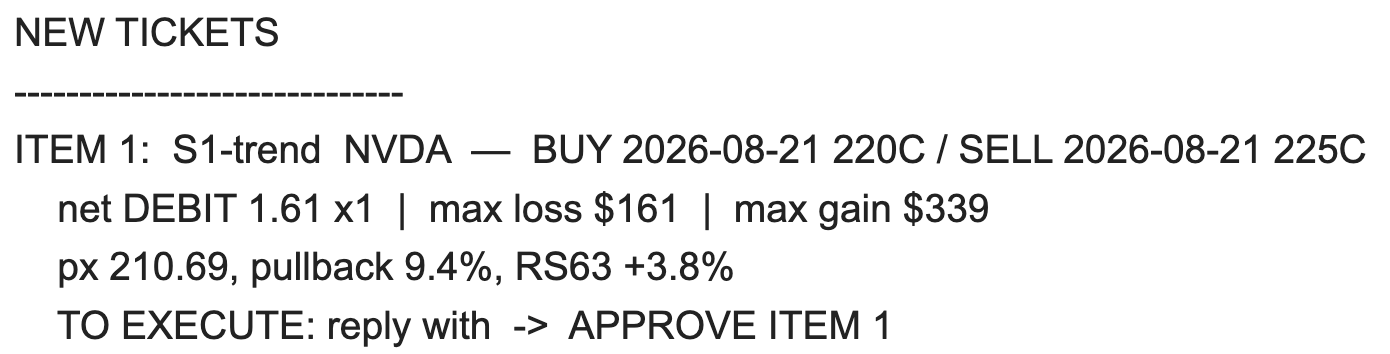
That email is the entire control surface, which is deliberate. I read it on my phone, and if the setup holds up, I reply to approve, while a weak one gets a reply to pass.
Once I approve, the loop routes the order to Alpaca, the brokerage API I use for paper trading, and sets the limit orders, but only when the trade falls inside the parameters I defined in advance.
Anything outside those guardrails never reaches the market. From there it tracks the position, and the next morning a fresh report tells me how every open trade is moving. None of it requires me to sit at a desk, which is the part that still surprises me. I’ve cleared a morning’s worth of decisions from my phone before finishing my coffee.
The current list runs across SPY, QQQ, NQ, and about two dozen names from the S&P 500. The terabytes of history sitting behind it are what separate a real suggestion from a guess dressed up to look like one.
2 Jobs; 1 System
The build earns its place by doing two things at once.
It drills me on trade structures every day, which is the Series 7 practice I need. At the same time, it’s a live test of a paper-trading strategy and the system underneath it. If the suggestions hold up, I’m validating something I can build on, and if they’re weak, I’m finding that out on paper rather than with real capital. The exam prep and the system test feed each other, since every structure I review for the Series 7 doubles as a data point on whether the underlying strategy deserves to survive.
That’s two problems handled by one piece of plumbing.
The longer game is repetition. By the time I add more indicators and move toward anything live, I’ll have run this same process hundreds, maybe thousands of times, with enough of a record to know it’s repeatable rather than lucky.
When the day comes to add live strategies, the question won’t be whether the process works, since I’ll have watched it work across a long record. It’s the same engine I’ve written about before, the autonomous research running on the Forge, and the loop is how that research turns into reps I can trust.
Why Loops Are the Next Phase
The reason I walked you through a trading loop has little to do with trading. Loops are becoming the way capable operations run, and most people haven’t noticed yet.
The spending tells part of the story.
Gartner projects AI agent software will draw around $206.5 billion in 2026, up 139% from the year before, the fastest-growing slice of enterprise software.
At a recent agentic finance gathering, the argument that traveled furthest was that reliability doesn’t come from a bigger model, but from the harness you build around it, the schedule and the checks and the memory, assembled first before anything clever gets layered on.
The new term of endearment on the street is “loop engineering”.
The opening sits in the gap between interest and execution. One readiness study found that only about 15% of organizations are fully prepared to run agents in production, even as nearly 60% say they’re already spending millions on them.
The bottleneck is rarely the money, and far more often the plumbing.
The people and firms that pull ahead over the next few years will be the ones who wired up a working loop with a human checkpoint while everyone else kept typing prompts into a chat window one request at a time.
So I invite you to take a moment and reflect on your own typical week.
I bet, with a little intention, you could find a task that’s repetitive, bounded, and tied to a rhythm:
the report you rebuild every Monday,
the inbox you sort before noon, or
the figures you check ahead of the same recurring decision.
There’s a loop in there waiting to exist if only you can recognize and build it.
A weekly client update can pull its own numbers, draft itself, and land in your inbox waiting for a yes, leaving you to edit rather than assemble from scratch.
Start with the checkpoint, the moment where you approve or decline, then design everything else around keeping a person standing there. The model is the cheap part, and the harness around it is the skill worth developing now, because the efficiency gap between people who can build these and people who can’t is going to keep widening.
BUFFETT FRAMEWORK QUESTION:
Would Warren Buffett hand his decisions to a machine?He’d never give up the judgment, though he spent a career building systems that enforce a checklist and keep a person accountable for every call. A loop with a human gate is that same idea written in software, clearing away the busywork while protecting the one decision that matters.
Keep Yourself in the Loop
The pun was intentional and the caution to using these tools is real. The same autonomy that makes a loop useful is what makes a fully unattended one risky.
The Atlantic Council recently described agentic AI in markets as a contested battlespace, where autonomous systems can probe and exploit weaknesses faster than people can respond.
A loop with no one watching can be gamed, or it can compound a small error into a large one before anyone looks up. The discipline isn’t in trusting the machine to run free, but in designing the one place where you keep a hand on the wheel.
That’s the shift worth watching, the move from AI that answers when you ask to AI that works on a schedule and waits for you to decide. Mine is carrying me through the Series 7 and hardening a trading system at the same time, and the version you build will look nothing like it.
Building it is the skill that counts.
Until next time fam!
🛑 SIGN UP TO BE PART OF WHAT WE’RE BUILDING! 🛑
I’m building the early cohort for when the Discord opens and the first indicators ship. If you want a seat, this is where to claim one.
Interested? Fill out the 30-second interest form here. 👈
This Week In 2 Minutes

BlackRock’s new Bitcoin Income ETF Sells the Only Days That Matter (June 24)
BlackRock's new BITA fund hands Bitcoin holders a 15 to 25% yield by selling covered calls every month, which sounds great until you notice what a covered call caps: the up days.
Bitcoin keeps almost its entire annual return in about ten sessions, so strip those out and a +90% year flips to -25%, meaning you're trading away the rare bursts you bought Bitcoin to catch. The first generation already ran this experiment and lost, with the original covered-call ETF down near 28% while plain IBIT held its ground. You also pay more in fees and get taxed sooner for the privilege.
The income is real, but on Bitcoin you're usually funding it with your own best days.

How (and Why) I Own Quantum Tech Without Having to Pick the Winner (Jun 26)
Quantum stocks are posting numbers that look like typos, like Rigetti running almost 4,800% in a year on roughly $7 million in sales, while the entire sector booked about a billion against a projected $2.7 trillion prize.
The trap is treating quantum as one bet, buying IonQ or Rigetti and praying the physics works, when it's really a five-layer stack and the money sits in knowing which layer you're holding. One layer already has revenue and a federal deadline forcing the buying, one gets paid whoever wins the machine race, and one is the giants who can fund a decade of losses out of petty cash.
I own the whole stack through one ETF, stay bullish on the build-out and cautious on the price, and keep the lottery tickets small enough to survive the 50% drop that tends to come.
🏆 Market Winners
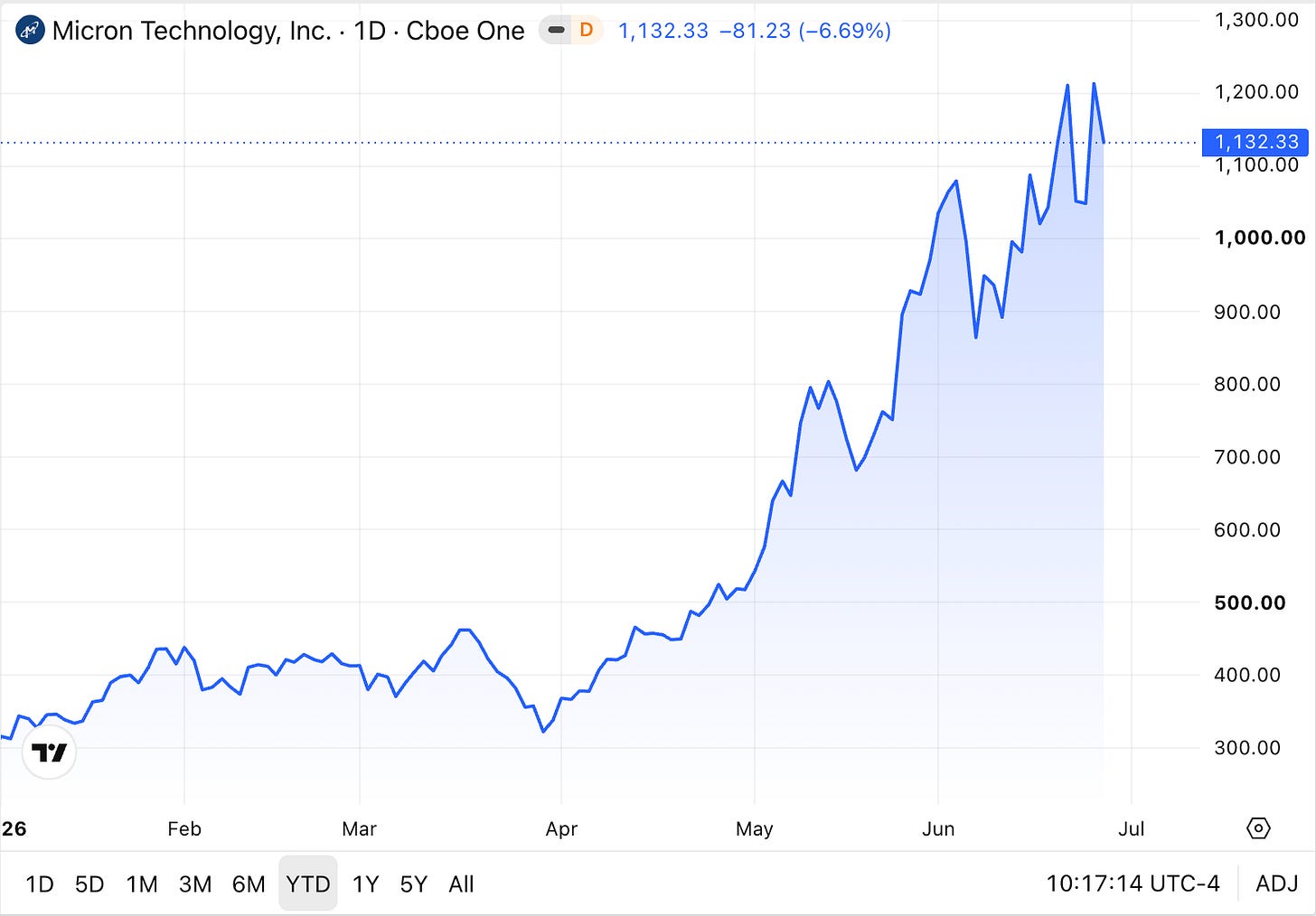
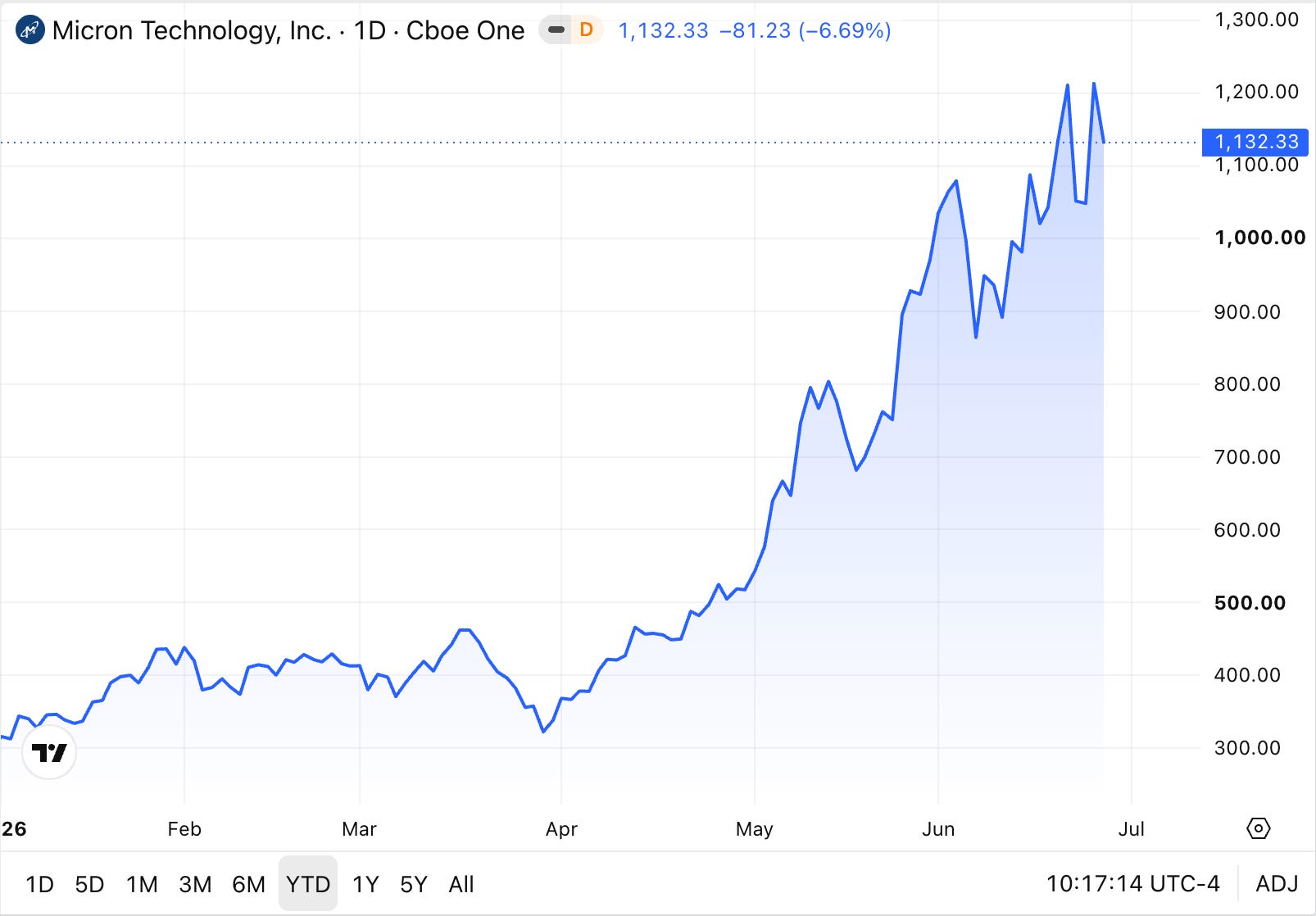
Micron Technology (MU): Micron surged after delivering another strong earnings beat and raising forward guidance, reinforcing the view that demand for AI memory remains exceptionally strong. While investors have become more selective around AI spending, Micron’s results suggested infrastructure demand is still healthy and enterprise customers continue expanding deployments.
(not bad YTD…)
Eli Lilly (LILY) was among the week’s strongest performers as healthcare rotated back into favor. Investors continued rewarding companies with durable earnings growth and defensive characteristics while many high-growth technology names experienced profit taking.
Bitcoin (BTC) stabilized near the $60,000 level despite weakness across many technology stocks. Its relative resilience during a volatile equity week suggests institutional buyers continue viewing Bitcoin as a strategic allocation rather than purely a speculative asset.
Large U.S. Banks: Several major U.S. banks outperformed after successfully passing the Federal Reserve’s annual stress tests. The results cleared the way for higher dividends and share repurchase programs, boosting investor confidence in the sector’s capital strength.
📉 Market Losers
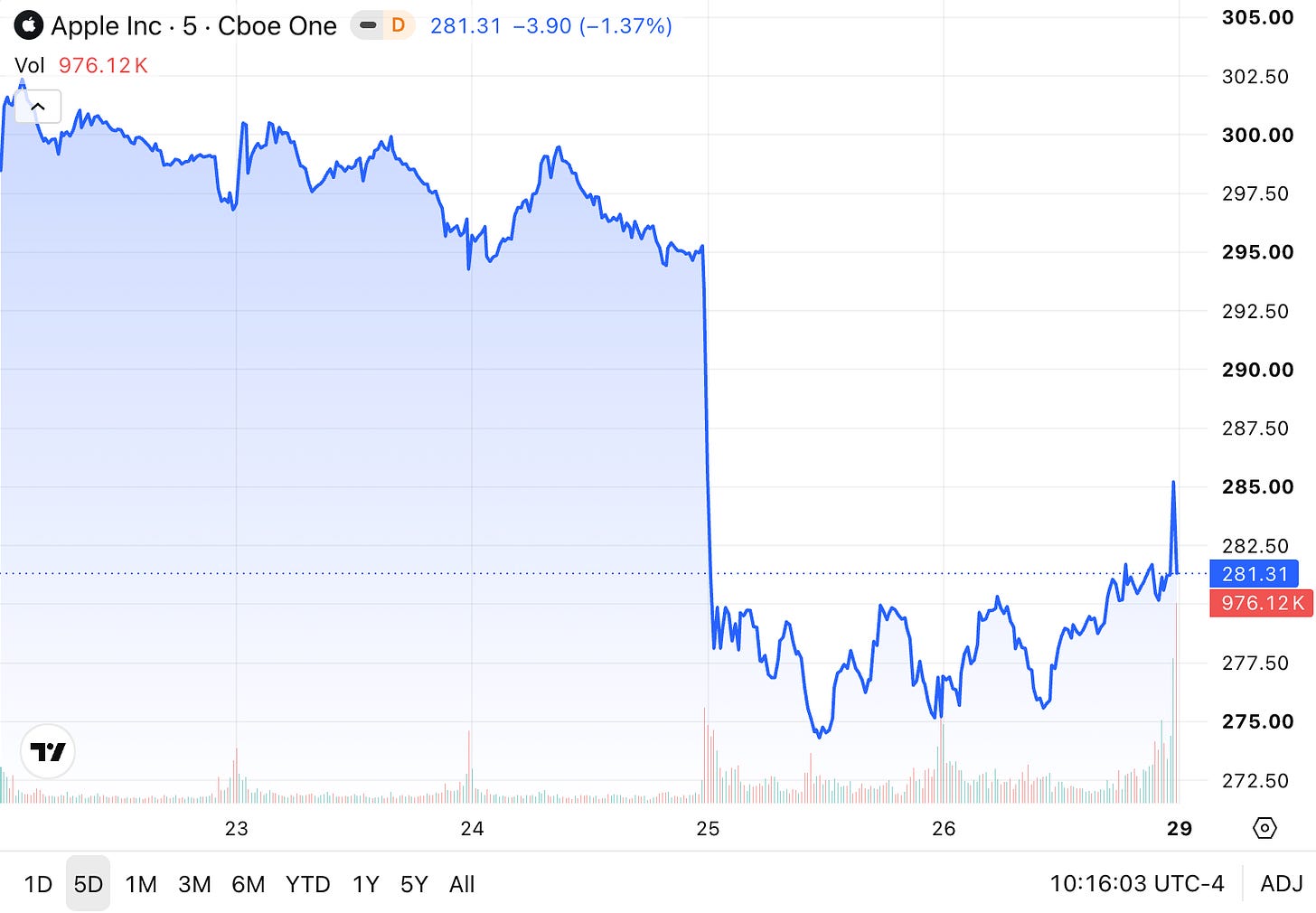
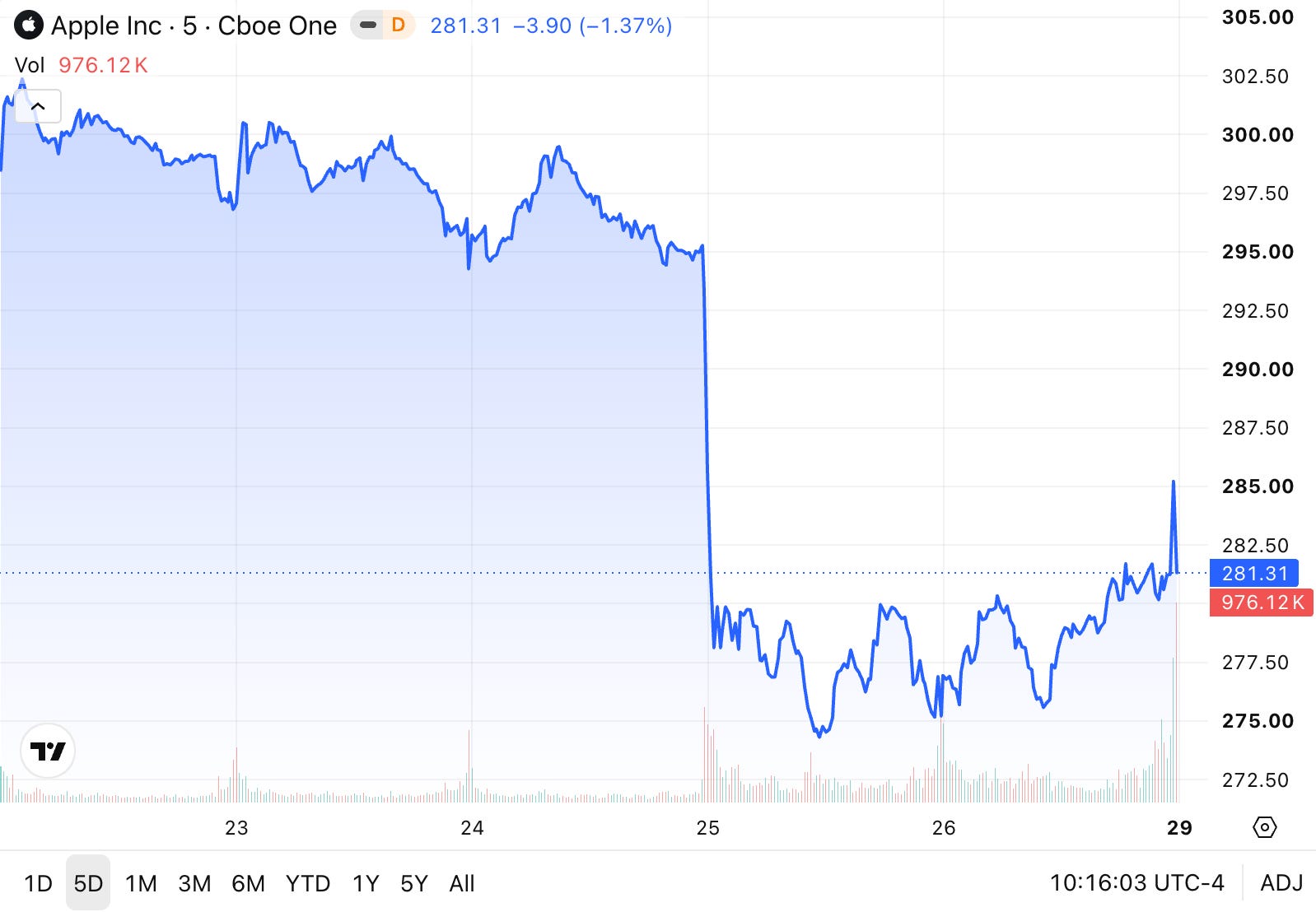
1. Apple (AAPL): Apple came under pressure after announcing price increases tied to rising memory costs. Investors worried that passing higher component expenses to consumers could weigh on hardware demand during the coming quarters.
Semiconductor Stocks: The semiconductor sector experienced broad selling as investors questioned whether AI-related capital spending has become overheated. Even high-quality chip companies saw sharp declines as traders locked in gains following an extended rally.
Carnival Corporation (CCL) fell after reporting disappointing revenue trends and issuing weaker-than-expected guidance. The results renewed concerns that consumer travel demand may be moderating despite a generally resilient economy.
AI Hardware Suppliers: Several AI infrastructure and electronics suppliers sold off as investors questioned whether the massive wave of AI investment can continue at its current pace. The rotation reflected valuation concerns more than deteriorating fundamentals, but it marked one of the weakest weeks for the group in months.
👀 What to Watch This Week
U.S. Jobs Report: The June employment report will likely be the week’s biggest macro catalyst. A stronger-than-expected print could shift expectations for Federal Reserve policy and increase market volatility.
Federal Reserve Rate Expectations: Investors will continue parsing economic data for clues about whether policymakers remain on track for additional tightening or can pause later this year.
Technology Leadership: After a difficult week for semiconductors and AI stocks, traders will be watching whether buyers step back into the sector or whether leadership continues rotating toward healthcare, financials, and software.
Early Earnings Season Signals: As second-quarter earnings season approaches, investors will focus on corporate guidance more than headline results, particularly commentary around AI spending, enterprise demand, and consumer strength.
Matthew Snider is the founder of Block3 Strategy Group, author of “Warren Buffett in a Web3 World,” and publisher of the BitFinance newsletter. He holds a Series 65 and MBA, and has been an active participant in digital asset markets since 2015. This article is for educational purposes only and should not be considered financial advice. Always consult with a qualified professional before making investment decisions.
Article Sources