I Found a Way to Invest in the Robot Boom on the Nasdaq

A new challenger has entered the arena…and it’s loaded with robots! 🤖
A reader sent me a ticker this week with a simple question. What is this, and should I be watching it? The ticker was $BOT, and the further I dug, the more it became the kind of thing I enjoy taking apart here. The robots make the headline. The wrapper they sit inside is the real story, and it borrows its design straight from a playbook that crypto investors already know well.
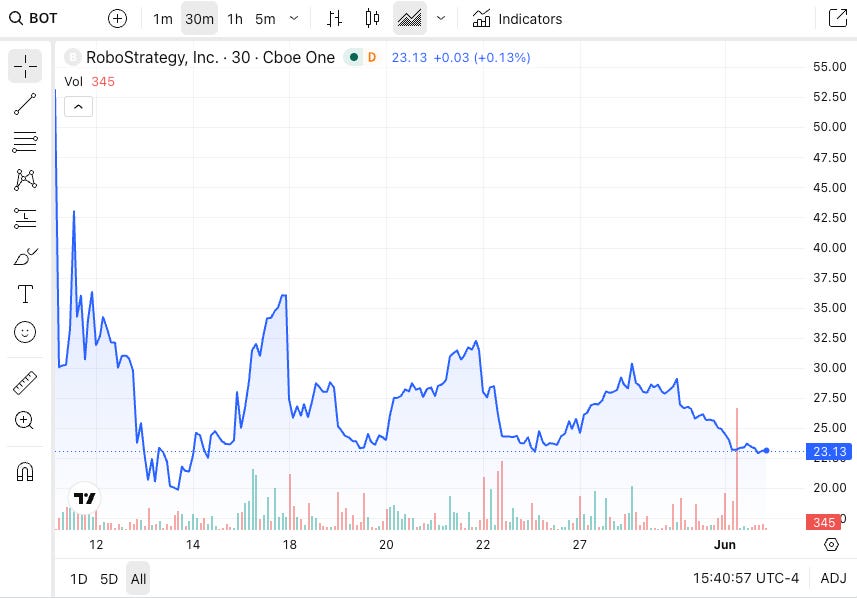
Let me walk you through what it is, why I think it is worth watching, where the opportunity sits, and the part I would slow down on before doing anything.
What RoboStrategy Really Is
RoboStrategy, Inc. began trading on the Nasdaq under the ticker $BOT on May 11, 2026. Its stock had never traded publicly before that day, so this is a genuinely new instrument rather than a rebrand of something older.
The company is a closed-end management investment company.
In plain terms, it is a fund with a fixed share count that trades like a stock. What makes it unusual is the mandate.
RoboStrategy is the first public closed-end fund built specifically to give ordinary investors exposure to a portfolio of private, pre-IPO, and public robotics and physical-AI companies.
The kind of access that has historically been gated behind venture capital now sits behind a ticker you can buy in a brokerage account.
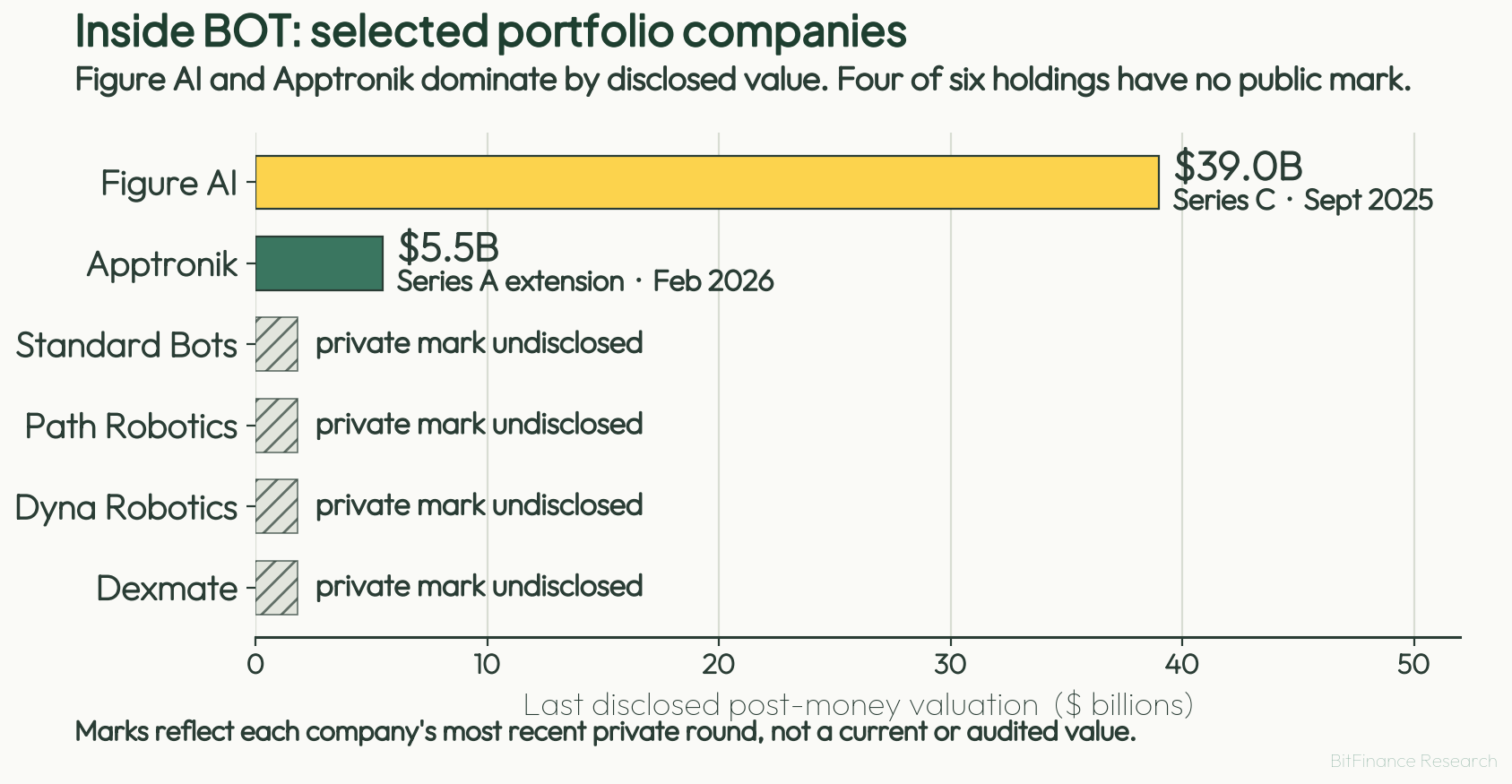
The portfolio is concentrated and recognizable. It includes Figure AI, Apptronik, Dyna Robotics, Standard Bots, Dexmate, and Path Robotics, with reported average check sizes around $7 million dollars per round. Figure and Apptronik dominate by disclosed value, and most of the rest carry private marks that have not been made public.
The fund is run by Andrew Kang, a former crypto investor who co-founded Mechanism Capital and has backed Figure directly. It launched with a $200 million dollar equity commitment and up to $2 billion dollars in committed financing. The capital is permanent, which means the fund is not forced to return money on a venture timeline and can hold its positions for as long as it wants.
That permanent-capital structure is the tell. RoboStrategy describes itself as inspired by the model that Strategy, formerly MicroStrategy, used to hold bitcoin. Once you see that lineage, the whole thing reads differently.
Why I think it’s Worth Watching
Three things make this listing interesting, and the robots are the least of them.
Access. Most of the marquee humanoid companies are staying private far longer than the last generation of tech startups did. Figure has raised close to $2 billion dollars and carries a $39 billion dollar mark without being anywhere near a public listing. Apptronik tripled its valuation to roughly $5.5 billion in a single funding extension this February. For a public-market investor, there has been no clean way to participate in that value creation while it happens, and this is the first vehicle structured to change that.
Timing. Robotics funding hit a record in 2025, with startups raising close to fourteen billion dollars against roughly $8 billion the year before. Capital is flowing into the sector faster than public vehicles can absorb it, which creates demand for exactly this kind of wrapper. Whether that demand is healthy or frothy is a separate question, but it is real.
The epistemics. This is the reason I care most. RoboStrategy is a clean live experiment in a structure that has already confused the market once. The question of what the price actually measures, and how far it can drift from the value underneath it, is the same question I ask about every backtest and every Sharpe ratio. The mechanics here just make the gap easier to see.
The opportunity, and the MicroStrategy Parallel
To understand the opportunity you have to understand the loop, and to understand the loop you have to start with Strategy.
Strategy is a software company that turned itself into a bitcoin holding vehicle.
It issues equity and convertible debt, uses the proceeds to buy bitcoin, and has frequently traded at a large premium to the value of the bitcoin it holds. That premium is the engine. When the stock trades above the value of its assets, the company issues new shares at that elevated price, raises more cash than the value of the ownership it gives up, and buys still more bitcoin. Existing holders end up with more bitcoin per share than they started with, which helps justify the premium that started the cycle.
RoboStrategy is porting that engine to robotics.
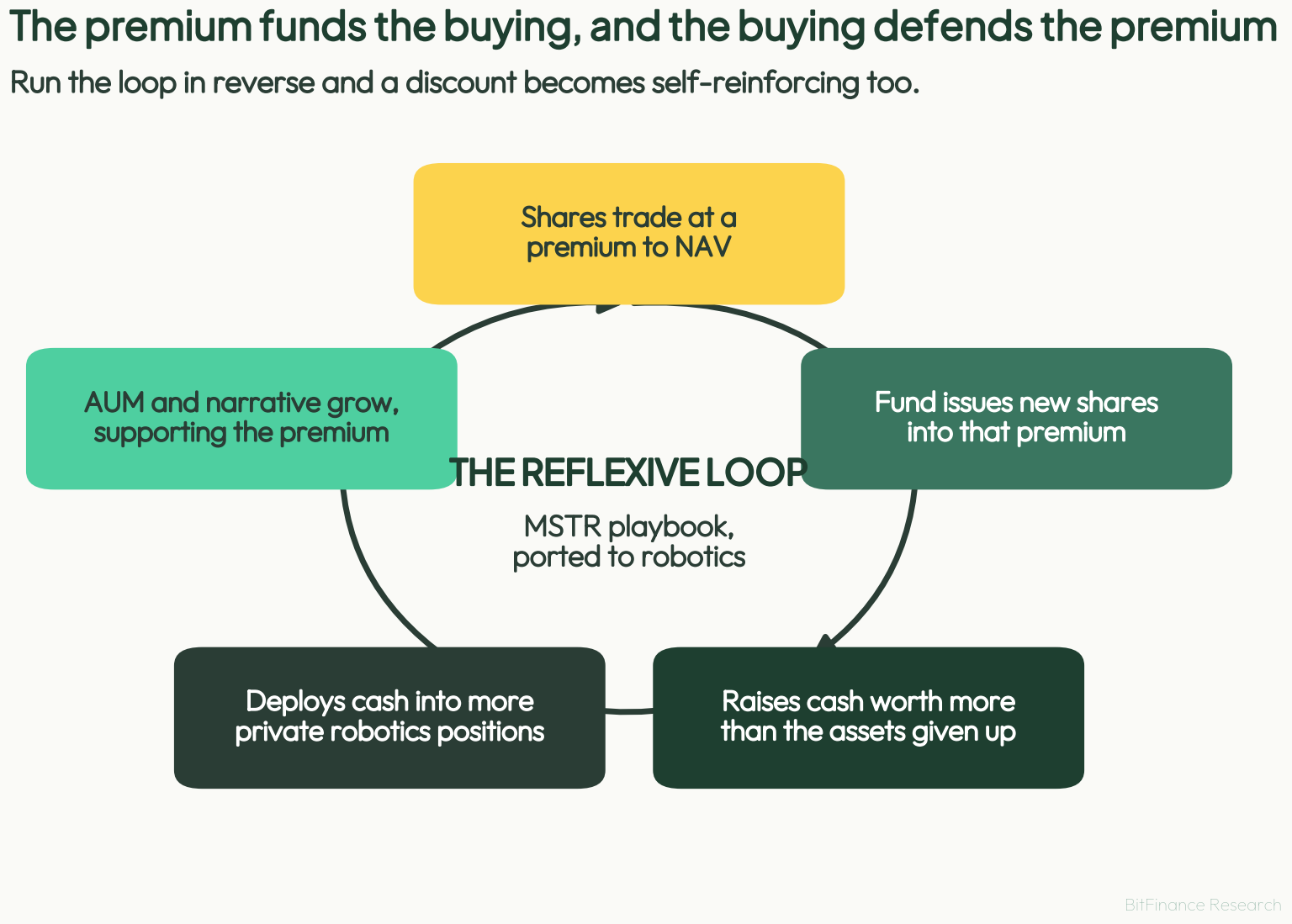
When it works, the loop is powerful.
A premium funds the buying, and the buying defends the premium. A holder gets concentrated, single-ticker exposure to a basket of private robotics companies, plus optionality on the cycle compounding in their favor. If Figure or Apptronik eventually goes public at a higher mark, the fund’s stake gets revalued upward, and the holder captured that move without ever needing access to a private round.
There is also a quieter source of return that has nothing to do with the robots. The premium or discount itself moves, sometimes sharply, so a patient buyer who acquires shares at a discount to a conservative estimate of value carries a very different risk profile than someone buying into a rich premium. The structure creates its own tradeable variable on top of the underlying.
How to Think About Risks
Here is where the same structure that creates the opportunity creates the danger, and where I would slow down. Start with what a price actually tells you in this fund.
A closed-end fund has two numbers that rarely match:
the market price, which trades live every second, and
the net asset value, which is the fund’s own estimate of what holdings are worth.
For a fund holding liquid assets, NAV is easy to calculate and the two numbers stay close. For a fund holding mostly private, pre-IPO companies, NAV is a quarterly model estimate based on the last round each company raised. The price moves daily. The value it is supposedly tracking updates on a lag, and even when it updates, it is an estimate rather than a market-clearing price.
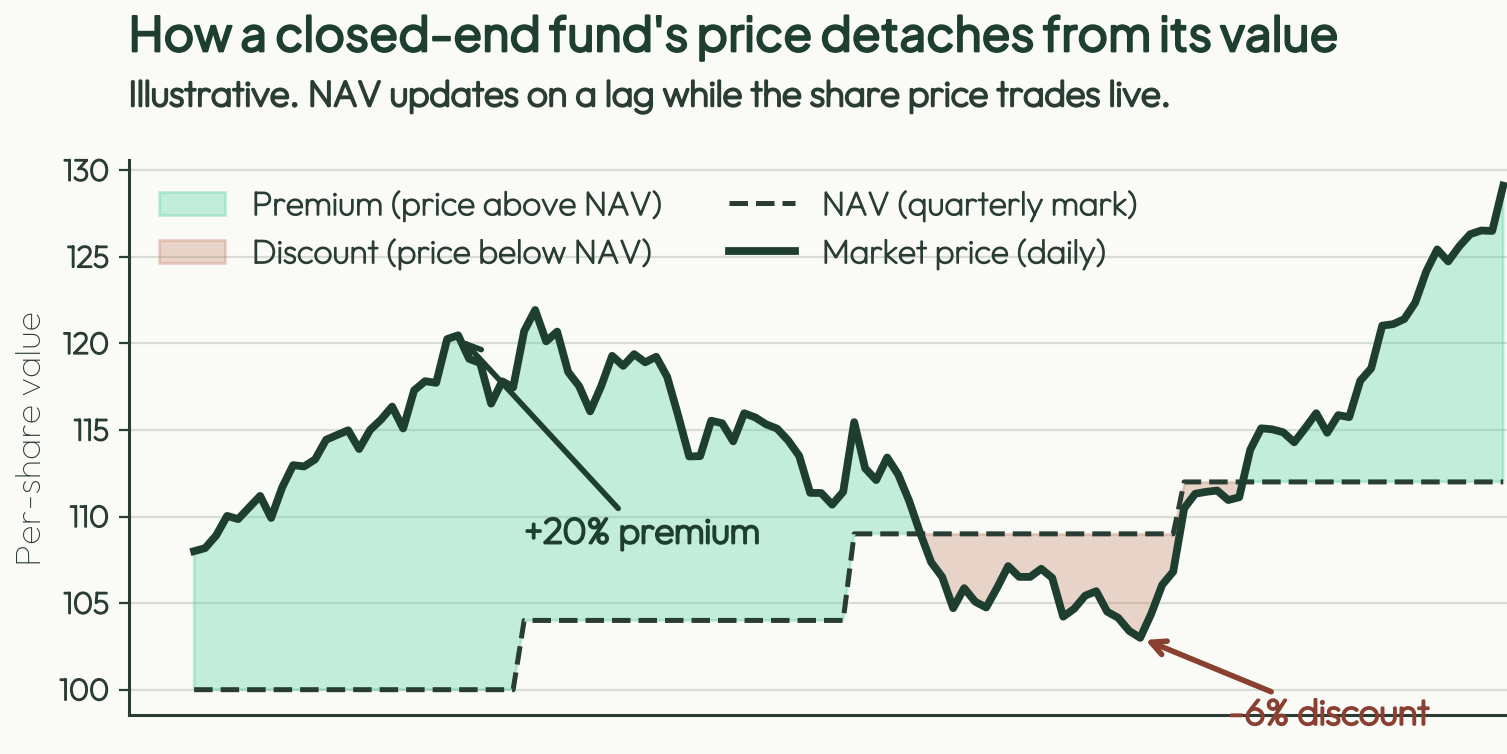
So the straight answer to what is really going on with the price is that the fundamental value is opaque by construction. You are not buying a number you can verify. You are buying a model output wrapped in market sentiment, and the sentiment can dominate the model for long stretches.
Buffett Framework
“Price is what you pay. Value is what you get.”
With a closed-end fund holding private companies, the price trades live and the value is a quarterly estimate, so the two can drift further apart than usual. The discipline is to watch the gap, not just the price.
Layer the risks and the picture gets clearer.
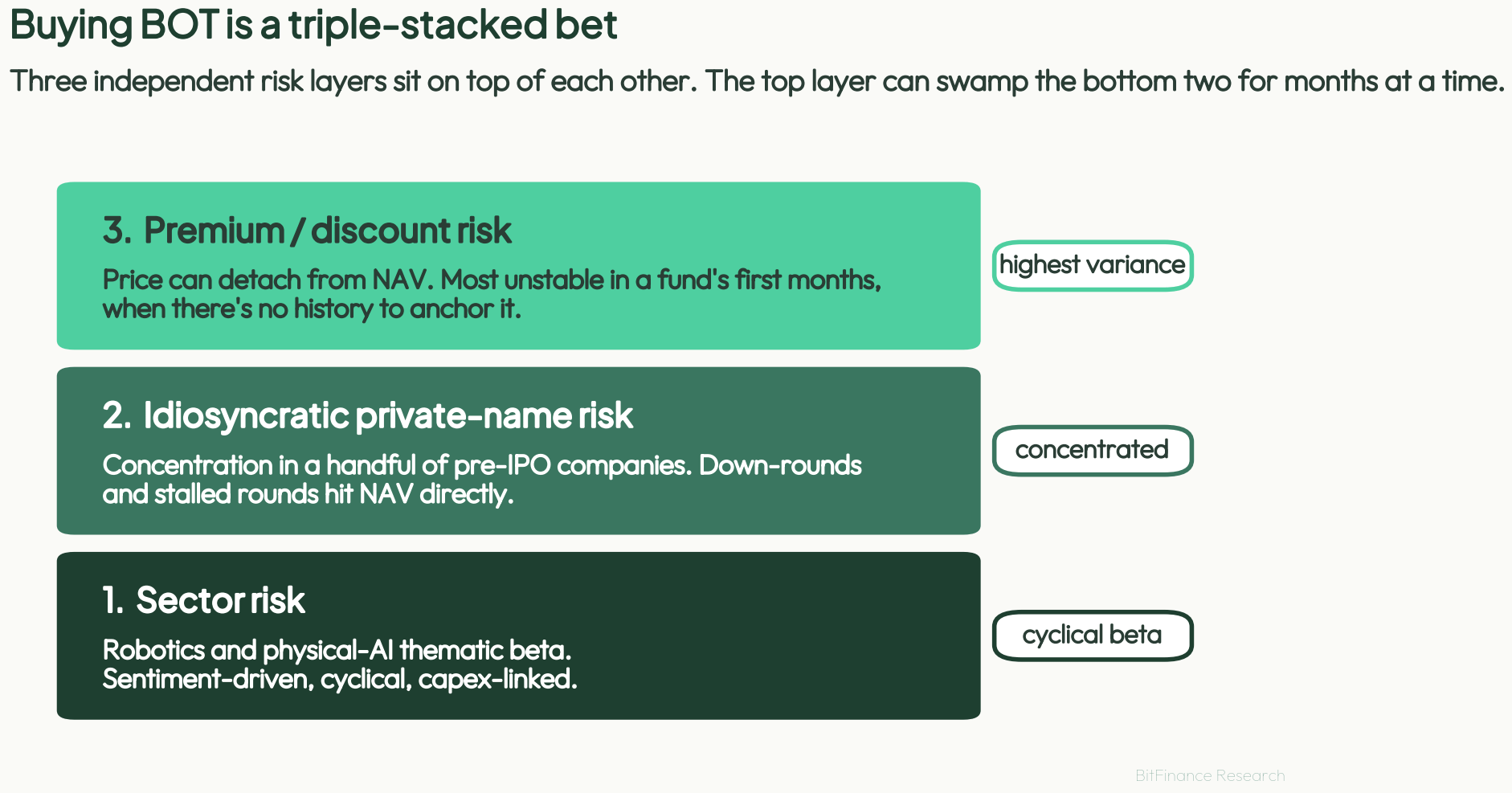
Sector risk sits at the bottom. Robotics and physical AI are cyclical, capex-linked, and sentiment-driven, and a buyer carries all of that thematic beta.
Idiosyncratic private-name risk sits in the middle. The portfolio is concentrated in a handful of pre-IPO companies, so a single down-round or a stalled financing flows straight into NAV. Figure shows the fragility well. Its $39 billion dollar mark sits on revenue estimated in the low tens of millions, and when BMW announced a humanoid pilot at its Leipzig plant this February, it chose a competitor’s robot rather than Figure’s. None of that shows up in a quarterly NAV until the next mark, if it shows up at all.
Premium or discount risk sits on top, and it is the one most likely to surprise people. The reflexive loop runs in reverse just as easily as it runs forward. A discount can become self-reinforcing, where a falling price makes new issuance dilutive instead of accretive, which removes the engine that was defending the price. A fund only weeks into public trading has almost no history to tell you how its premium behaves under stress, and the early life of these vehicles is exactly when the premium is least anchored.
So the framework I would use is simple to state and harder to practice. Treat NAV as a model output rather than a price. Watch the premium or discount as the primary variable, not the share price in isolation. Pay attention to share issuance, because the pace of issuance tells you whether the loop is running forward or backward. Size any position to the understanding that the top risk layer can swamp the bottom two for months at a time. I am not telling you to buy it or to avoid it. I am telling you that if you do buy it, the premium to NAV is the thing to watch above the robots.
How BOT, MSTR, and a Robotics ETF Compare
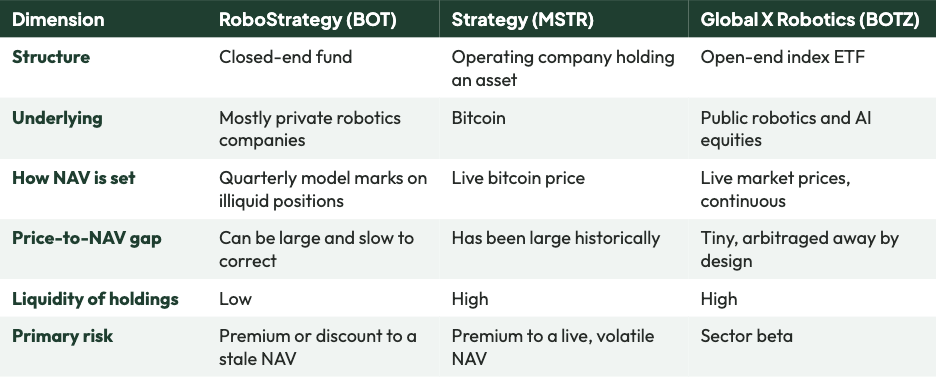
The table makes the point cleanly. BOTZ tracks its holdings tightly because they are liquid and priced all day. MSTR can detach from its NAV, but at least that NAV is a live bitcoin price. RoboStrategy can detach from a NAV that is itself an estimate, which stacks one layer of uncertainty on top of another.
What I’m Watching 👀
Should you buy $BOT, probably not right now. It’s extremely volatile as a very new and illiquid security. I’m certainly not a buyer right now…but I am an active watcher.
I built a small monitor for this one with Claude Code, because it’s a good test case and the data is useful whether or not anyone trades it. The monitor watches the premium or discount to the last reported NAV, the fund’s share issuance activity, the funding news for the underlying private names, and the divergence between BOT and a liquid public robotics basket. The divergence between the two is close to a pure read on sentiment, since the public basket strips out most of the shared sector beta. I will report what it surfaces in future issues.
The broader lesson travels well beyond one ticker. A number that looks precise can still be measuring something soft underneath, and the discipline is in asking what the number actually represents before you act on it. That is true of a NAV on a closed-end fund, and it is true of a Sharpe ratio on a backtest.
Until next time - trade safely fam!
Matthew Snider is the founder of Block3 Strategy Group, author of “Warren Buffett in a Web3 World,” and publisher of the BitFinance newsletter. He holds a Series 65 and MBA, and has been an active participant in digital asset markets since 2015. This article is for educational purposes only and should not be considered financial advice. Always consult with a qualified professional before making investment decisions.
Sources
RoboStrategy, Inc. Nasdaq listing announcement, GlobeNewswire / Nasdaq, May 11, 2026
RoboStrategy SEC Form 497AD, FY2026
Reporting on the $200M / $2B commitment and Andrew Kang background (Mechanism Capital)
Figure AI Series C announcement, The Robot Report, September 2025 ($39B post-money)
Figure AI funding and BMW Leipzig pilot context, TechMarketBriefs, April 2026
Apptronik Series A extension coverage, CNBC and Bloomberg, February 2026 (~$5.5B)
Robotics sector funding totals, Crunchbase News, February 2026