My 18-Month Education Plan to Stay Ahead of AI

Last night I registered for the Securities Industry Essentials exam.
$80 bucks and about thirty hours of prep ahead of me.
It’s the first step in an 18-month plan that doubles as my answer to a question more knowledge workers should be asking themselves: what’s my AI hedge?
I want to walk through what I’m doing and why, because some version of it is relevant to more people than the headline suggests.
The AI Moat Almost Nobody Talks About
AI is going to compress a lot of what people get paid for in financial services. Full stop.
Analyst tasks, modeling, research write-ups, first drafts of nearly everything. I use AI extensively in my own work, so this isn’t speculation, it’s observation. The 80% of a typical knowledge-worker job involving drafting, summarizing, and structured analysis is getting commoditized in real time.
What AI doesn’t change is licensing.
Treat professional licenses like a career “moat”.
You can’t sell securities without a license.
You can’t give investment advice for compensation without an IAR registration.
You can’t solicit futures customers without an AP registration.
The regulatory perimeter around financial services is one of the few moats genuinely insulated from AI commoditization, because the moat is statutory rather than technical.
Software can’t pass a Series 7 on your behalf and it can’t file your U4.
The administrative 80% of the work gets automated. The 20% that requires the credential becomes a higher proportion of where my time goes, and the value of that 20% goes up rather than down. In a heavily AI-disrupted services market, being unlicensed means being replaceable, while being licensed makes you one of the people the AI runs through rather than around.
This is, by some distance, the most durable career hedge I see in front of me. If you’re in professional services and not thinking about your work in these terms, you should be.
The Lucky Part
Here’s the fortunate alignment. I’m a sucker for an educational challenge.
The MBA was a stretch I genuinely enjoyed. Studying for the Series 65 was the same kind of fun. All I kept hearing on crypto twitter was influencers and talking heads saying “this isn’t financial advice” - and I thought I could differentiate myself by passing a rigorous exam that allowed me to do just that.
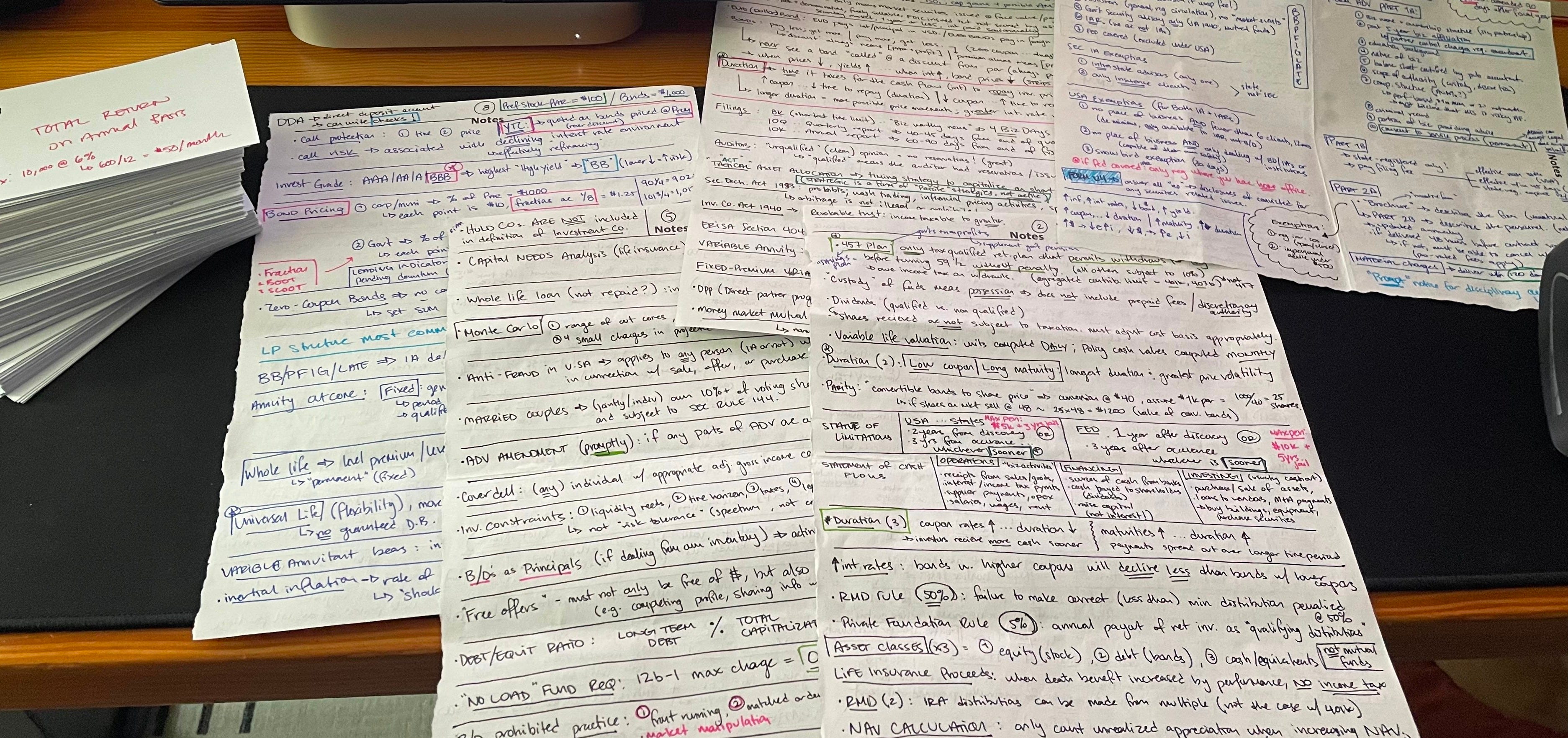
There’s a particular satisfaction in sitting down with hard material, working it until it clicks, and walking out genuinely more capable. People train for marathons. I sign up for exams. The wiring is the same.
So this isn’t me white-knuckling through a defensive credentialing program because I’m worried about AI. I’m doing something I’d want to do anyway, and the fact that it happens to be one of the most durable AI hedges available is a bonus.
The 18-Month Plan
By end of 2026:
SIE (registered last night)
Series 7 (general securities representative)
Series 63 (state law for BD agents)
Series 3 (commodities and futures)
By end of 2027:
CAIA Level I and Level II (Chartered Alternative Investment Analyst)
FRM Part I and Part II (Financial Risk Manager)
Credential Count: 6
Time to Goal: 18 months
Total Cost (incl. study materials): ~$11,000
What Each One Does and Why I Want It
The SIE is foundation. Anyone over 18 can take it without sponsorship. I’m taking it because it unlocks the others.
The Series 7 closes the brokerage-side gap. When a client wants help structuring a Reg D offering and placing the resulting interests, currently I can handle one half cleanly. The 7 makes the other half mine.
The Series 63 is the state law exam that activates the Series 7 in your home state. It’s the most accessible exam in the FINRA stack. You can self-enroll without sponsorship, and heavy overlap with the Series 65 makes it the fastest of the group for me.
The Series 3 is commodities and futures. Half the crypto strategies I look at touch this. BTC basis trades, ETH funding rate arbitrage, anything with a futures leg; e.g. Perpetual Futures. (read more here)
The CAIA is the alternative investments designation. Most of what I do at Block3 is alts-adjacent or alts-native. The CAIA puts an institutional stamp on a body of work I’ve been doing for years managing hedge funds and building investment vehicles. It makes a powerful career complement when paired with the Series 7.
The FRM is the risk management designation. For someone publishing investment research and helping family offices and PMs evaluate digital asset exposure, FRM is the credential that says I think about downside the way they do. Oh, and last time I checked…crypto and blockchain tech is still risky. Having a framework to help orgs manage risk is going to be huge.
Each one maps onto a conversation I already have. The credentials put institutional language behind work I’m already doing, and each adds a layer AI can’t strip away.
The Accredited Investor Unlock Most People Miss
Here’s something underdiscussed and relevant if you’re reading this and thinking “interesting, but not for me.”
In 2020 the SEC expanded the accredited investor definition. Net worth and income are still the common qualifying paths, but holders of the Series 7, Series 65, or Series 82 in good standing now qualify on credential alone.
No $200K income or $1M net worth requirement.
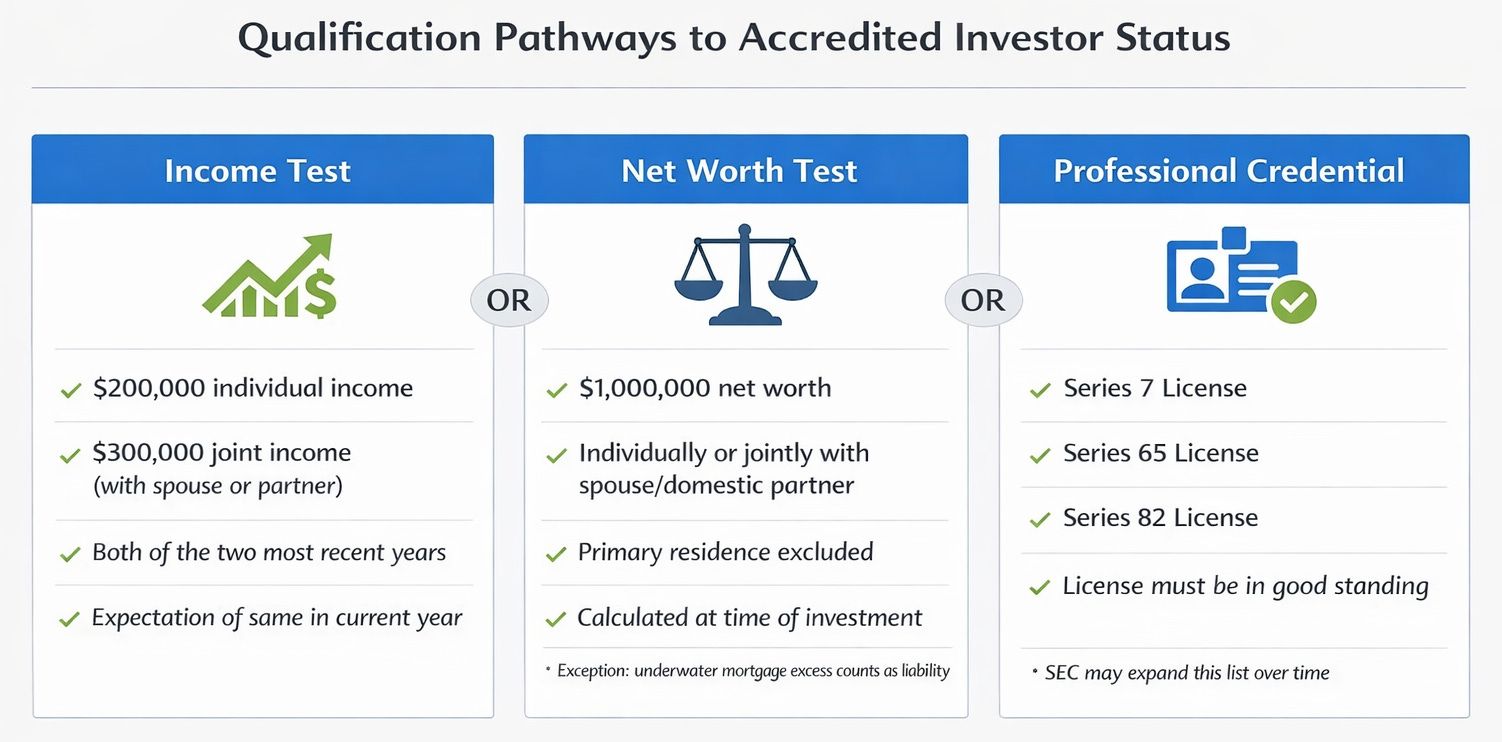
Being an accredited investor matters because accredited status unlocks Regulation D private placements, pre-IPO secondaries, hedge fund participation, venture deals.
The Anthropic and SpaceX secondaries everyone has been trying to get into are accredited-only. Most people qualify through income or net worth. Licensed professionals can qualify through holding the license itself.
If you’re an early-career professional, or a serious investor without the income to clear the bar, the Series 65 is a roughly $400 path to accredited status.
One of the most underrated arbitrages in personal finance. Bar none.
Cost Reality + Honest Gaps
A two-year credential stack at $10K to $12K is real money. It’s also less than 12% of what a decent MBA program costs today, and the opportunity cost on a two-year residential MBA adds another six figures in foregone income.
I have an MBA. I’d recommend it for the networking, not the credentials. If you like education, MBAs are great. If you like people, MBAs are great.
Candidly, there are faster, more direct ways to become a financial professional, though, and business school isn’t the right tool if the specific goal is operational fluency in financial services.
The Gaps: What this credential stack doesn’t make me…
A CFA charterholder (buy-side equity research).
A CFP (personal financial planning).
A JD or CPA (better partnered with than competed against).
Specialization rocks.
For Anyone Considering This Path
Some of these exams require firm sponsorship. The Series 7 and Series 3 in particular need an affiliated firm willing to register you. That’s a real barrier.
What isn’t a barrier: starting to study. The SIE, Series 65, and Series 63 you can all take on your own - you don’t even need a college degree!

By the time you’re ready to ask a firm to bring you on, you can demonstrate not just interest but real preparation. In financial services, people who actually do what they say they will do are rarer than you’d expect.
If you’re reading this with even mild anxiety about AI displacing your work, don’t wait. Start with the exams you can take on your own. The Series 65 in particular is a thirty-hour commitment that pays off in both AI insulation and accredited investor status.
I’ll be writing about this periodically over the next 18 months.
If you’re on a similar path, I’d love to hear about it.
🛑 Quick Reminder 🛑
Quick reminder of what we’re building. Live indicators. The research behind them. The methodology taught alongside the signal. A small room where you leave knowing how the work actually gets done
I’m building the early cohort for when the Discord opens and the first indicators ship. If you want a seat, this is where to claim one.
Interested? Fill out the 30-second interest form here. 👈
This Week In 2 Mins

I Found a Token That Acts Like a 30-Year Mortgage on AI Compute (May 12)
Erik Voorhees's privacy-first AI platform Venice has built two of the more coherent token mechanics in the AI-crypto category.
VVV gives stakers proportional access to the platform's inference capacity at 14-18% yield, while DIEM represents $1/day in API credit in perpetuity. Think of this like a power purchase agreement but applied to AI compute.
Buy-and-burn engine, 42% of supply already burned, $700-800M market cap, real revenue. Article also flags three other AI plays I'm watching: Bittensor (TAO), NEAR Protocol, and Virtuals (VIRTUAL).
What are your pics in the AI/crypto sphere?🤔

Ten Years Ago, Crypto Built the Most Important Derivative of the Decade
(May 14)
On May 13, 2016, BitMEX shipped the first perpetual futures contract with no expiration, no settlement, no precedent in 200 years of derivatives history.
A decade later it's a $7.24T market.
This article walks through the funding rate mechanic (the "dog on a leash" metaphor), why the design works, how sophisticated traders use perps for yield rather than leverage, and what's coming next as the contract spreads to oil, gold, S&P 500, and tokenized real-world assets.
Hyperliquid runs 44% of perp DEX volume with a $640M annualized fee run rate and 97% buy-and-burn. JPM, Grayscale, Bitwise, and VanEck have all moved into the space.
Are you using perps to trade? I want to know!
Winners 🏆
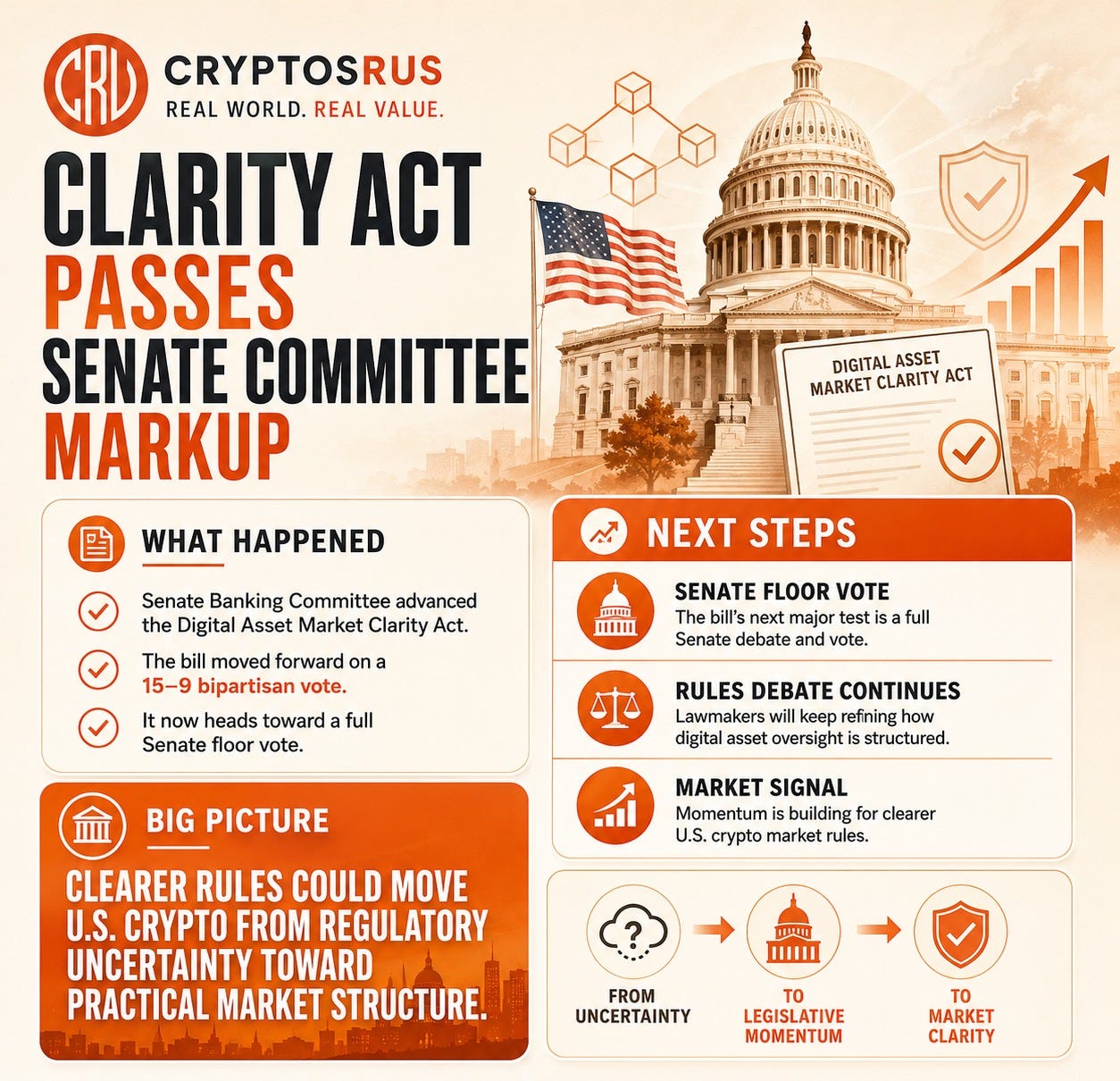
CLARITY Act. Senate Banking Committee 15-9 bipartisan vote on May 14, headed to the Senate floor. Two Democrats (Gallego, Alsobrooks) joined all Republicans. First real bipartisan progress on U.S. crypto market structure after four months of negotiation gridlock. Legislative path still requires merging with the Agriculture Committee version and resolving the ethics provision, but the political momentum changed direction this week.
Q1 earnings season. S&P 500 blended earnings growth came in at 27.1%, the highest growth rate since Q4 2021 (32.0%) and the 6th consecutive quarter of double-digit year-over-year earnings growth. 84% of companies that have reported beat EPS estimates, above the 5-year average of 78%. Communications Services, IT, Consumer Discretionary, and Materials led growth. Whatever you think of valuations, the underlying corporate earnings story is doing its job.
Energy sector. Energy was the sole sector with gains on Friday, rising 1.6% as the post-Iran War oil spike continues to ripple through markets. With one airline CEO noting the jet fuel crisis is about to hit airlines worse than Covid and the Strait of Hormuz logistics still unwinding, energy looks like the obvious risk-off hedge for a market increasingly nervous about an inflation re-acceleration.
Losers 📉
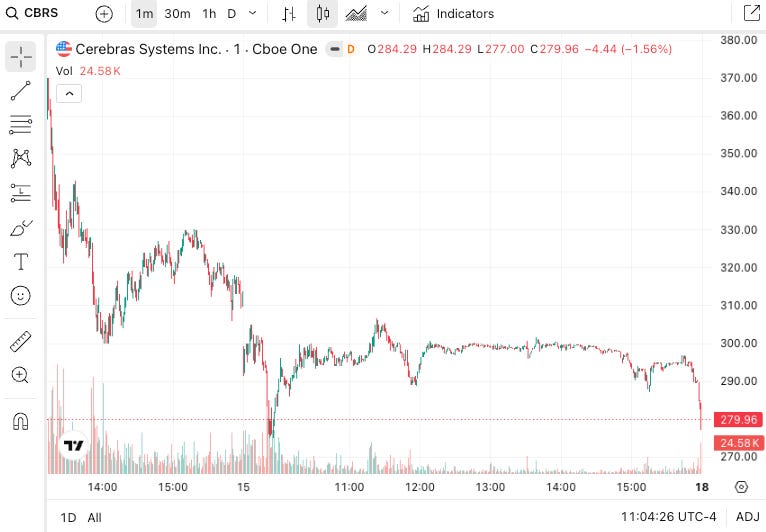
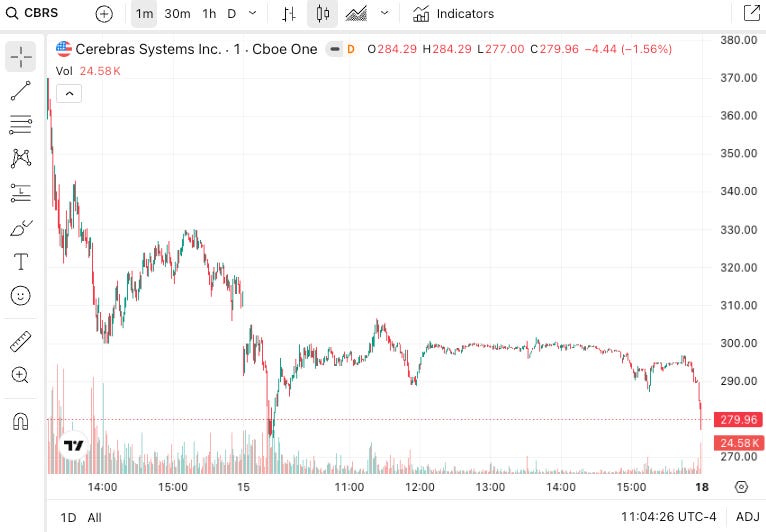
Semiconductors and AI hardware. Friday’s profit-taking was brutal across the AI rally’s biggest names. Intel retreated more than 6%, while Advanced Micro Devices and Micron Technology lost 5.7% and 6.6%, respectively. Nvidia dropped 4.4%, while Cerebras Systems — which surged 68% Thursday after it began trading on the Nasdaq — shed 10%. The trigger was the Trump-Xi summit ending without major breakthroughs, but the deeper read is that the group is being called out for an unsustainable recent move. Worth watching whether this is a healthy reset or the start of something bigger.
Small caps. The Russell 2000 lost more than 2% in midday Friday trading. If that holds through session close, it would mark the index’s worst day since November... The Russell 2000 is now down more than 2% on the week, putting it on track to snap a seven-week winning streak. Small caps had been the breadth story underneath the mega-cap-led rally. Breaking the streak matters because it suggests the rally’s been narrower than it looked.
Rate cut expectations. The Fed funds futures market repriced hard this week. Traders now see the Fed raising rates for its next move, a complete reversal from where positioning sat a month ago. “Ten of the last 12 recessions were preceded by a spike in oil”, Dan Niles noted on CNBC Friday. The Fed’s hands look increasingly tied between oil-driven inflation and growth concerns, and the cost of waiting is no longer obvious.
Watch this coming week (May 18-22)
Retail earnings week. Walmart, Home Depot, Target, Lowe’s, and TJX are expected to report. The K-shaped consumer thesis (high-end resilient, low-end pressured by gas prices) gets its biggest test of the cycle. Watch the guidance more than the prints. Retailers cutting full-year outlooks would be the cleanest signal that the consumer is finally cracking.
NVIDIA earnings (likely late May). The most important single print in equities, full stop. After Friday’s semis selloff, the bar is higher than it’s been in two years. Beat-and-raise gets the AI rally back on track. Anything less reframes the entire group as overextended.
Oil price direction. Brent and WTI behavior is now the dominant macro variable. It will be months before the oil disruption rights itself, as it takes weeks for ships sailing out of the Strait of Hormuz to reach destinations in North America, Europe or East Asia, and investors don’t expect oil prices to return to pre-war levels. Sustained levels above current marks keep pressure on the Fed and the consumer. A break lower opens room for the cut narrative to come back.
🛑 REMINDER 🛑
Quick reminder of what we’re building. Live indicators. The research behind them. The methodology taught alongside the signal. A small room where you leave knowing how the work actually gets done
I’m building the early cohort for when the Discord opens and the first indicators ship. If you want a seat, this is where to claim one.
Interested? Fill out the 30-second interest form here. 👈
Matthew Snider is the founder of Block3 Strategy Group, author of “Warren Buffett in a Web3 World,” and publisher of the BitFinance newsletter. He holds a Series 65 and MBA, and has been an active participant in digital asset markets since 2015. This article is for educational purposes only and should not be considered financial advice. Always consult with a qualified professional before making investment decisions.