Venice (VVV): The 30-Year Mortgage of AI Compute
Most retail investors who want AI exposure own NVIDIA, AMD, or an AI-focused ETF. That’s fine. Those are real businesses doing real work.
The question I keep coming back to is whether the layer above the chips has any investable representation outside equity markets.
Remember, this layer does the actual compute and accesses the infrastructure that AI applications need to consumeIt does. Most of it is still speculative.
One project in particular has built something I find genuinely worth understanding: Venice (VVV) and its companion token Diem (DIEM).
This article is mostly about that ecosystem. The bullish case, the risk-managed view, and why the founder behind it matters. At the end, I’ll give you a quick snapshot of 3 other AI projects I’m watching in the crypto space, but the depth is on Venice.
Buffett Framework Question
“What does this business actually do, and does it have to keep doing it for the token to be worth holding?” For AI infrastructure projects, the answer has to involve real compute being produced or consumed, not just narrative momentum.
Usual disclaimers apply:
✅ Educational only. ✅ Not investment advice. ✅ Do your own research.
Start With the Founder
Before getting into the mechanics, it’s worth understanding who built Venice. Erik Voorhees has been operating in crypto since 2011, which makes him one of the longest-tenured builders in the entire space. He was involved with BitInstant in the early Bitcoin days. He founded SatoshiDice in 2012 and later settled with the SEC over what became one of the first widely-discussed token offering cases. In 2014, he founded ShapeShift, the non-custodial exchange that he ran through multiple cycles and eventually decentralized.

Two things matter about his track record for the Venice thesis.
The first is ideological consistency. Voorhees has been a vocal advocate for financial sovereignty, privacy, and censorship resistance for the better part of 15 years. Venice is the logical extension of that worldview applied to AI. A privacy-first platform that runs uncensored open-source models is exactly what you’d expect him to build if he believed AI was about to become as important to society as money. He believes that, and he’s building accordingly.
The second is operational durability. Most crypto founders haven’t survived more than one cycle. Voorhees has shipped through at least four. He has experience navigating regulators, running production infrastructure, and managing a token economy in real conditions. That’s a rare profile in this space, where most projects are run by anonymous developers or first-time founders with academic backgrounds. None of that guarantees Venice succeeds, but it raises the floor of seriousness considerably.
Venice (VVV): The Access Layer
By the numbers
VVV market cap ~$700-800M (May 2026)
~46M circulating of 80M total supply
~42% of original supply already burned
Annual emissions cut 25% in Feb 2026 (8M to 6M VVV)
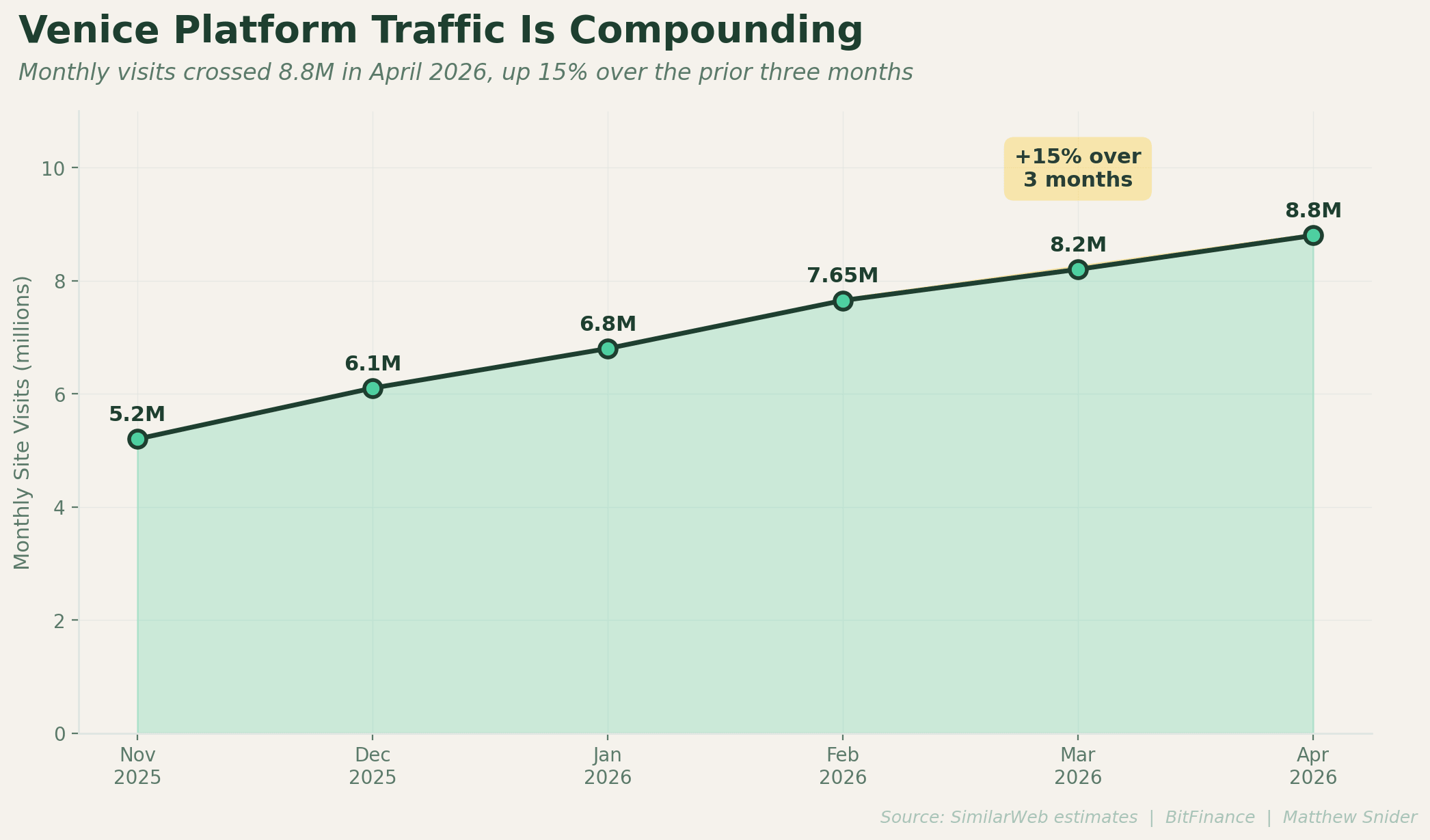
1.3M+ users, 8.8M monthly visits, 15,000+ inference requests/hour
Founded by Erik Voorhees (ShapeShift), built on Base
Venice is a privacy-first AI platform. It gives you access to leading open-source models like Llama and DeepSeek without storing your data, logging your prompts, or filtering your outputs. The platform itself is the consumer product and the investable layer sits underneath.
Most AI APIs charge per request. Predictable for casual users, painful for serious builders, because costs swing with usage and budgeting gets hard.
Venice does it differently. You stake VVV tokens and receive a proportional share of the network’s total inference capacity. Stake 1% of all staked VVV, get 1% of Venice’s daily compute. Forever. You don’t spend the tokens. You lock them, use the compute, and earn staking yield on top, currently running 14 to 18% depending on utilization. The tokens stay yours and the compute keeps flowing.
Oh, and yeah, the token has done almost a 10x
While this alone is interesting, what makes the ecosystem worth a longer look is DIEM.
DIEM: The Financial Primitive
DIEM is the companion token Venice introduced in 2025. Each DIEM represents $1 per day in API credit, in perpetuity. You mint DIEM by locking staked VVV. Once minted, that DIEM produces compute access forever, regardless of what VVV does in the open market.
Think of it like a power purchase agreement. A factory locks in 10 years of electricity at a fixed rate so a price spike can’t kill the business. DIEM applies the same logic to AI inference. You’re not flipping a token. You’re buying production capacity at a known cost, indefinitely.
For an autonomous agent that needs predictable unit economics to operate as a business, that kind of certainty is the difference between a working product and a science experiment.
The bigger picture is what this could mean for the AI buildout. Compute prices have come down dramatically over the past two years, but demand keeps rising faster than supply. Any serious AI builder has to budget for inference costs that could swing 50% in either direction over a 12-month window.
DIEM is one of the first credible attempts to turn that operational expense into a fixed asset on a balance sheet. Whether that primitive scales is the open question. Whether it’s the right idea for this moment seems much less debatable.
How Venice Makes Money (and Why It Matters for Token Holders)
Two flywheels drive the economics, both tied to actual platform revenue.
The first is the buy-and-burn. A portion of subscription revenue automatically buys VVV on the open market and burns it. Each Pro signup burns $2 worth of VVV. Pro+ burns $5. Max burns $10. These aren’t governance promises. They’re automated mechanisms tied directly to user growth. The more the platform grows, the more tokens get removed from circulation, permanently.
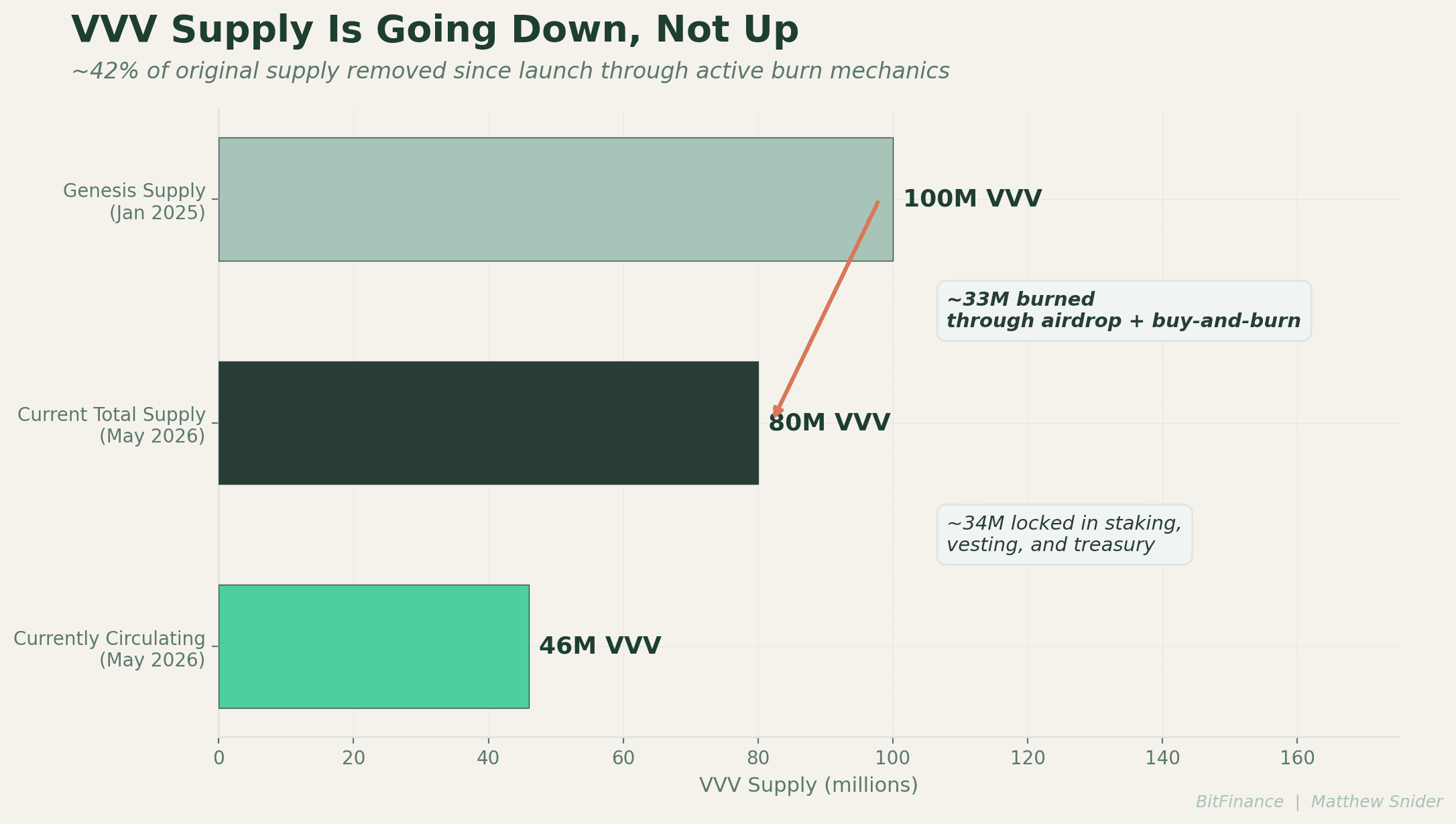
The second is supply discipline. Annual emissions were cut from 8M to 6M VVV in February. Roughly 42% of the original 100M supply has already been burned, including a one-time burn of unclaimed airdrop tokens. The supply curve is moving aggressively in the right direction, which is unusual in crypto where teams typically prioritize their own emissions over holder dilution.
Demand comes from a different direction. AI agents, developers, and individual users stake VVV to access inference at zero marginal cost. As the platform expands its GPU fleet, the same staked VVV represents a larger share of a bigger pie. Token holders benefit from deflationary mechanics on one side and growing capacity on the other. That’s a coherent value-accrual story, which is more than I can say for most tokens in this category.
Buffett Framework Question
“Would I rent or own this resource?” The DIEM thesis is that AI compute is becoming infrastructure important enough that locking it in at a fixed cost makes sense. That’s the same logic that drove fuel hedging, power purchase agreements, and 30-year mortgages. The bet is whether AI inference rises to that level of strategic importance for enough buyers.
The Bullish Case
Put together, the bull case for VVV and DIEM is one of the cleaner ones in crypto right now.
Venice is a working business with revenue. 1.3 million users, 8.8 million monthly site visits (up 15% over a three-month window), and 15,000+ inference requests per hour. The buy-and-burn engine is tied directly to that revenue. As the platform grows, the token gets scarcer in a way that’s visible and verifiable on chain.
DIEM creates a financial primitive that didn’t exist before. Locking in AI compute at a fixed cost matters more as AI becomes critical infrastructure, not less. If autonomous agents become a meaningful share of internet activity over the next five years (which is what almost every major AI lab is now publicly betting on), the demand for predictable inference capacity grows alongside them.
The founder has shipped through four cycles. Voorhees doesn’t pivot, doesn’t disappear, and doesn’t run sketchy promotions. His worldview maps cleanly to where AI is heading, which means his execution priorities are likely to stay aligned with the project’s stated mission rather than drifting toward easier revenue.
The tokenomics favor long-term holders. Aggressive burns, transparent emission cuts, no governance theater. The team has made decisions that hurt their own emissions allocation to benefit stakers. That’s rare.
The Risk-Managed View
Now the other side of the ledger. Anyone who only reads the bull case isn’t doing real work.
Governance is centralized (and that’s OK!). The emission cuts, the burn parameters, and the DIEM launch were all decisions made by the Venice team without token-holder voting. Efficient for moving fast, fragile if the team ever pivots. A protocol built on decentralization principles that runs on centralized governance has a contradiction baked in. That contradiction is fine right now but - as we’ve seen in crypto - it might not be later.
The product is concentrated. Venice is one platform offering one core service. If a major competitor (OpenAI, Anthropic, Google) offers similar privacy guarantees at lower cost, the case erodes quickly. The platform has to keep winning users against deep-pocketed incumbents that are themselves rolling out privacy features. The moat depends on staying meaningfully ahead on privacy and uncensored access, which is a moving target.
Valuation is rich. VVV is up over 1,500% from its December 2025 low and trades at roughly $700 to $800 million market cap. Some of the move is fundamental. Much of it is reflexive momentum tied to the broader AI rally. A 50% correction from here would still leave the token well above its December trough, but it would be painful for anyone buying at recent highs.
Regulatory exposure is real. Privacy-first AI that processes uncensored outputs sits in genuinely uncharted territory. If U.S. or European regulators decide decentralized AI platforms need to implement content moderation or KYC requirements for high-volume users, the entire value proposition shifts. Voorhees has navigated regulators before, but the AI regulatory environment is going to look very different from anything he’s dealt with in financial services.
Position sizing matters. I hold a small VVV position, representing roughly 7-8% of my overall digital asset portfolio, with a cost basis under $9. That weighting reflects high conviction in the thesis combined with healthy caution about a token that has run hard in a short window. I’d be careful about anyone treating a token up 1,500% in five months as a high-conviction buy at current levels. The thesis is intact. The entry matters.
3 Other AI Plays I’m Watching
Venice and DIEM are the deep dive. Here are three others I’m tracking at a higher level, with the headline numbers and the single reason each is worth your attention.

Bittensor (TAO): The production layer for decentralized AI
Market cap: ~$3-3.5B (top 30)
Supply: ~10.9M circulating, 21M hard cap
Active subnets: 128 (expanding to 256)
Q1 2026 compute revenue: ~$43M across subnets
Institutional inflows: NVIDIA ~$420M, Polychain ~$200M
Why I’m watching: Bitcoin-style scarcity (21M cap, halving cut daily emissions in half) combined with the first credible proof that decentralized training can compete with centralized AI.
Key risk: Governance friction. Covenant AI publicly left in April 2026 and dumped 37K TAO on the way out.

NEAR Protocol (NEAR): The AI-native Layer 1 bet
Type: Base-layer blockchain positioned as “the chain for AI”
Co-founder: Illia Polosukhin
Polosukhin’s pedigree: One of eight authors of the 2017 transformer paper
Thesis: AI agents will be the primary users of blockchain
Key product: NEAR Intents (cross-chain agent settlement)
Why I’m watching: Polosukhin’s transformer research underpins GPT, Claude, and the entire current AI boom. NEAR is the only L1 with that kind of pedigree at the founder level.
Key risk: Competing with Ethereum, Solana, and Base for the same agentic positioning. Layer 1 narratives are crowded.
Quick Note: Legend wrote an awesome article comparing Near and TAO that I would highly recommend you read.

Virtuals Protocol (VIRTUAL): The agent payment and tokenization layer
Market cap: ~$485M
From ATH: Down 86% from $5.05
Supply: ~656M of 1B (no future inflation)
Chain: Base
Key standard: ERC-8183 (co-authored with Ethereum Foundation)
Why I’m watching: Coinbase’s x402 Foundation launch at Consensus 2026 (with Visa, Mastercard, Stripe, AWS, Google) validates the agentic commerce thesis. Virtuals has been building this infrastructure for two years.
Key risk: Agent narrative has cooled hard. Most agent tokens on the platform haven’t found durable use cases.
Putting It Together
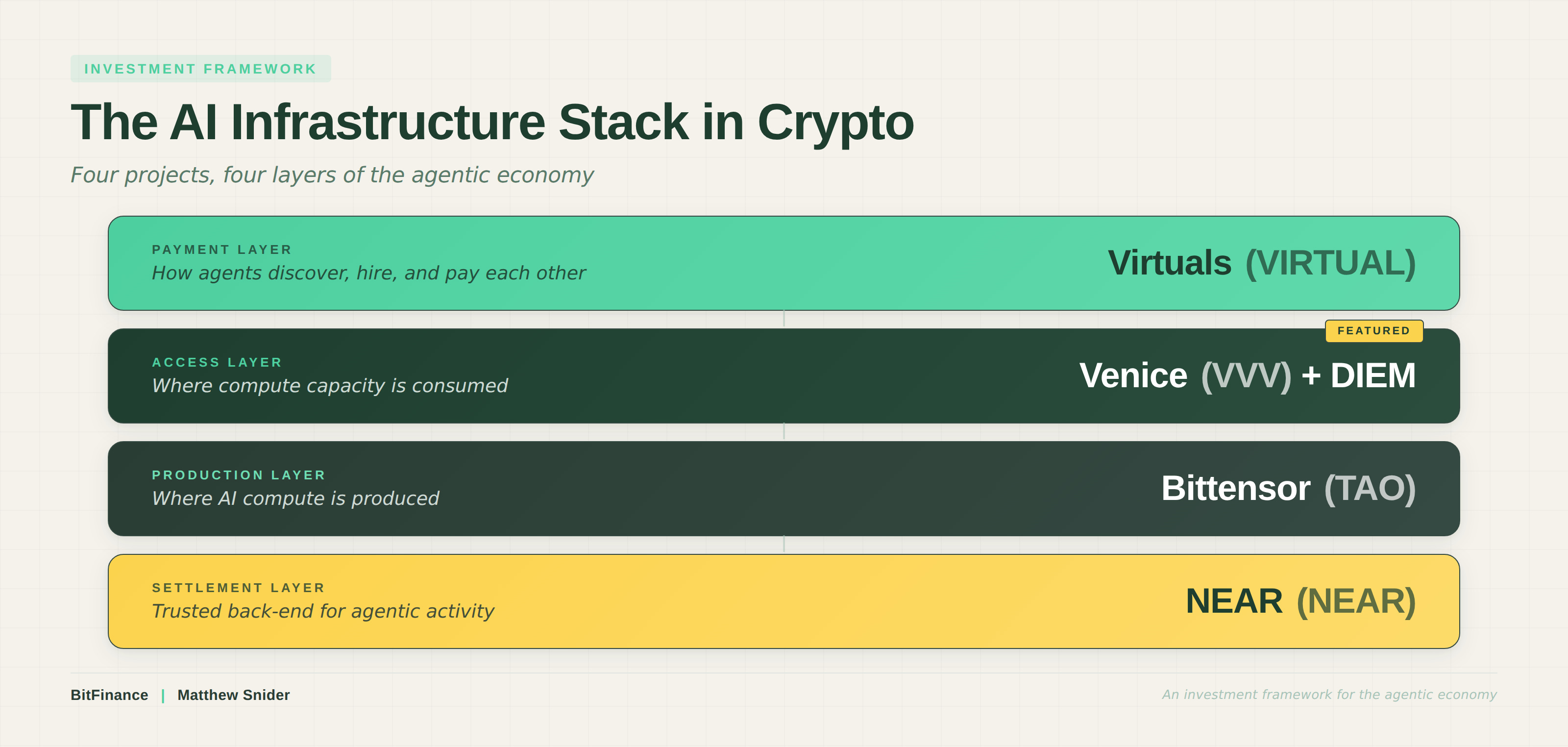
The AI buildout needs production, access, and payment rails. Bittensor sits at production. Venice and DIEM sit at access. Virtuals sits at agent payments. NEAR is making a bet on being the settlement layer underneath all of it. None of these are mutually exclusive, and a serious AI agent five years from now might use all four.
Of the four, Venice is the one I find most worth understanding right now. DIEM converts a recurring expense into a fixed asset in a way that’s actually useful. The supply mechanics are aggressive, the platform is shipping, and the founder has shipped before. That combination is hard to find in crypto.
For most retail investors, NVIDIA, AMD, or an AI ETF probably remains the cleaner way to express the AI thesis. These crypto tokens are higher beta and require more work to understand.
I push back on the assumption that the only way to invest in AI is to buy the obvious names. The plumbing layer is being built, and some of it lives on chain. Whether you participate is a separate question from whether you should understand it.
Matthew Snider is the founder of Block3 Strategy Group, author of “Warren Buffett in a Web3 World,” and publisher of the BitFinance newsletter. He holds a Series 65 and MBA, and has been an active participant in digital asset markets since 2015. This article is for educational purposes only and should not be considered financial advice. Always consult with a qualified professional before making investment decisions.