How (and Why) I Own Quantum Tech Without Having to Pick the Winner
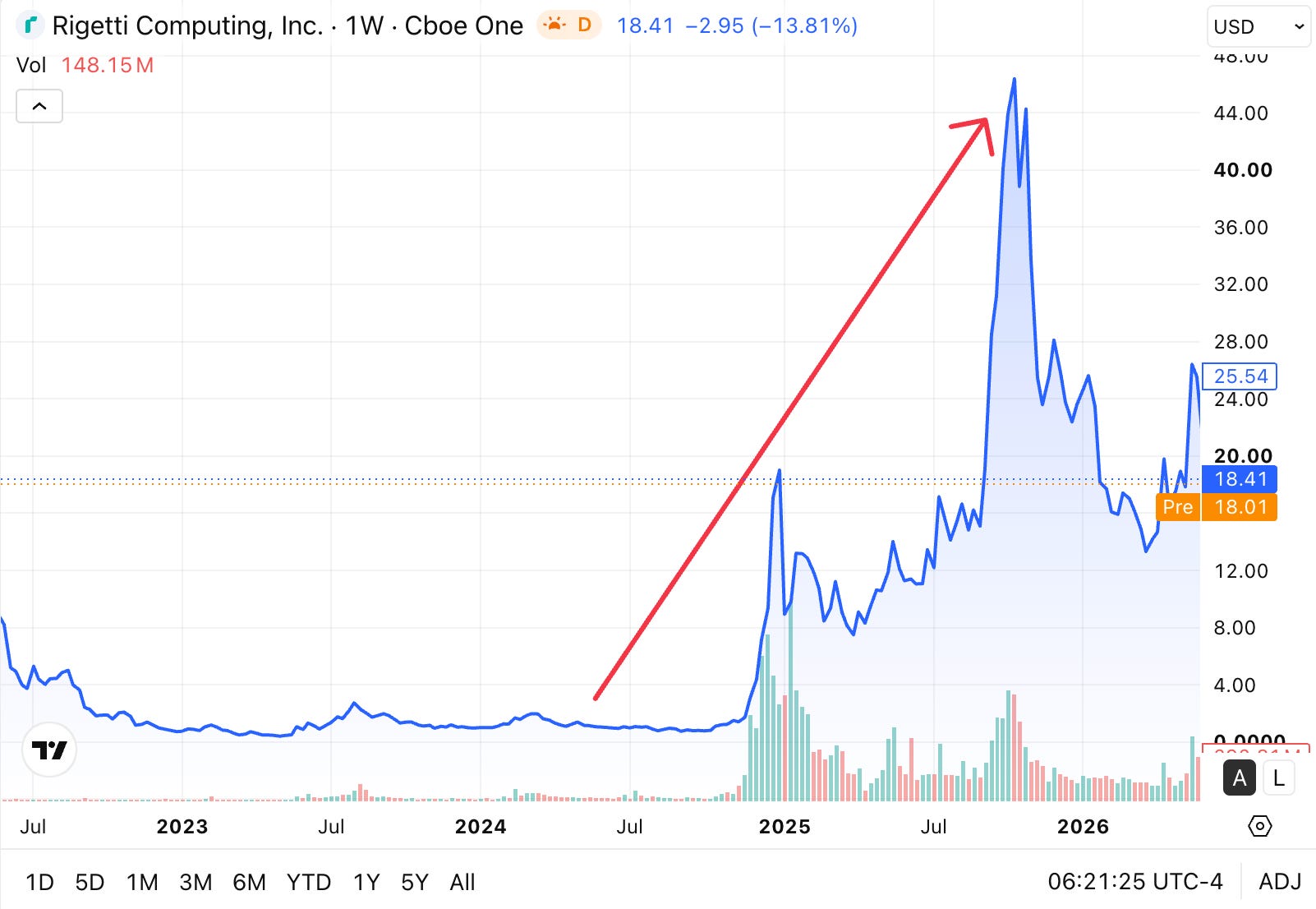
Not long ago, Rigetti, a quantum computing stock, ran up nearly 4,800% in a single year, taking its market value from around $200 million to roughly $15 billion.
Here’s the strange part. These companies barely sell anything. Rigetti booked about $7 million in revenue last year.
IonQ, the largest of the pure-plays, did about $130 million and still trades near $20 billion. The entire sector, every quantum company on the planet, booked a little over a billion dollars in sales in 2025. McKinsey thinks the technology creates up to $2.7 trillion in value by 2035.
Read those last two numbers again.
A trillion-dollar prize.
A billion in sales.
That 2,700x difference is the whole trade.
For a while it was easy to wave off as a bubble with a physics degree. Then two things happened:
In May, the government became a shareholder in nine quantum companies.
In June, the President signed two executive orders pointed straight at the technology.
The timeline stopped being a guess so that it’s no longer a matter of “IF” but “WHEN”.
Quantum isn’t one trade. It’s a stack.
Here’s the mistake I see many investors and clients make. They treat “investing in quantum” as one decision: buy IonQ or Rigetti, hold on, and hope the science works.
That’s the lottery ticket.
It’s also the smallest, riskiest layer of a much bigger structure.
Underneath the pure-plays sits a stack. One layer already has revenue and a federal deadline forcing customers to buy. One layer gets paid no matter which machine wins. One layer is the giants, who can fund a decade of losses out of petty cash. The government just took equity across it.
The money isn’t in picking the winning machine.
It’s in knowing which layer you’re buying.
That’s the reframe. Sixty seconds on what the machine does first, because the technology is what tells you which layer is real.
What the machine actually does
Picture a computer solving a maze. A normal one traces a single path, hits a dead end, backs up, and tries the next. One route at a time. A quantum computer runs every path at once, then reads off the way out.
This epic visualization brought to you by the team at 60 Minutes shows this example as roughly the real physics; not a metaphor.
The engine is interference: the machine lines up all those paths so the wrong ones cancel and the right one rings clear. A normal bit is a switch, on or off. A qubit is both at once, so a few hundred of them hold more combinations than there are atoms in the visible universe.
That’s the power; but it’s also the catch.
Those in-between states are so fragile they collapse if you look at them wrong, and keeping them stable long enough to compute is the whole engineering problem.
Quantum won’t load your email faster. It’s built for one job: finding a single right answer buried in an impossible pile of wrong ones.
A new drug molecule.
A better battery.
The cheapest route through a global supply chain.
That’s where the $2.7 trillion comes from.
Why now, and not five years ago
For years the real knock on quantum was simple. The machines made too many errors to be useful. That is beginning to change in a meaningful (and investable) way.
Google’s Willow chip crossed below-threshold error correction, the point where adding more hardware fixes more errors than it creates. IBM put a date on a fault-tolerant machine, 2029. The roadmaps started reading like project plans.
Then the checks cleared.
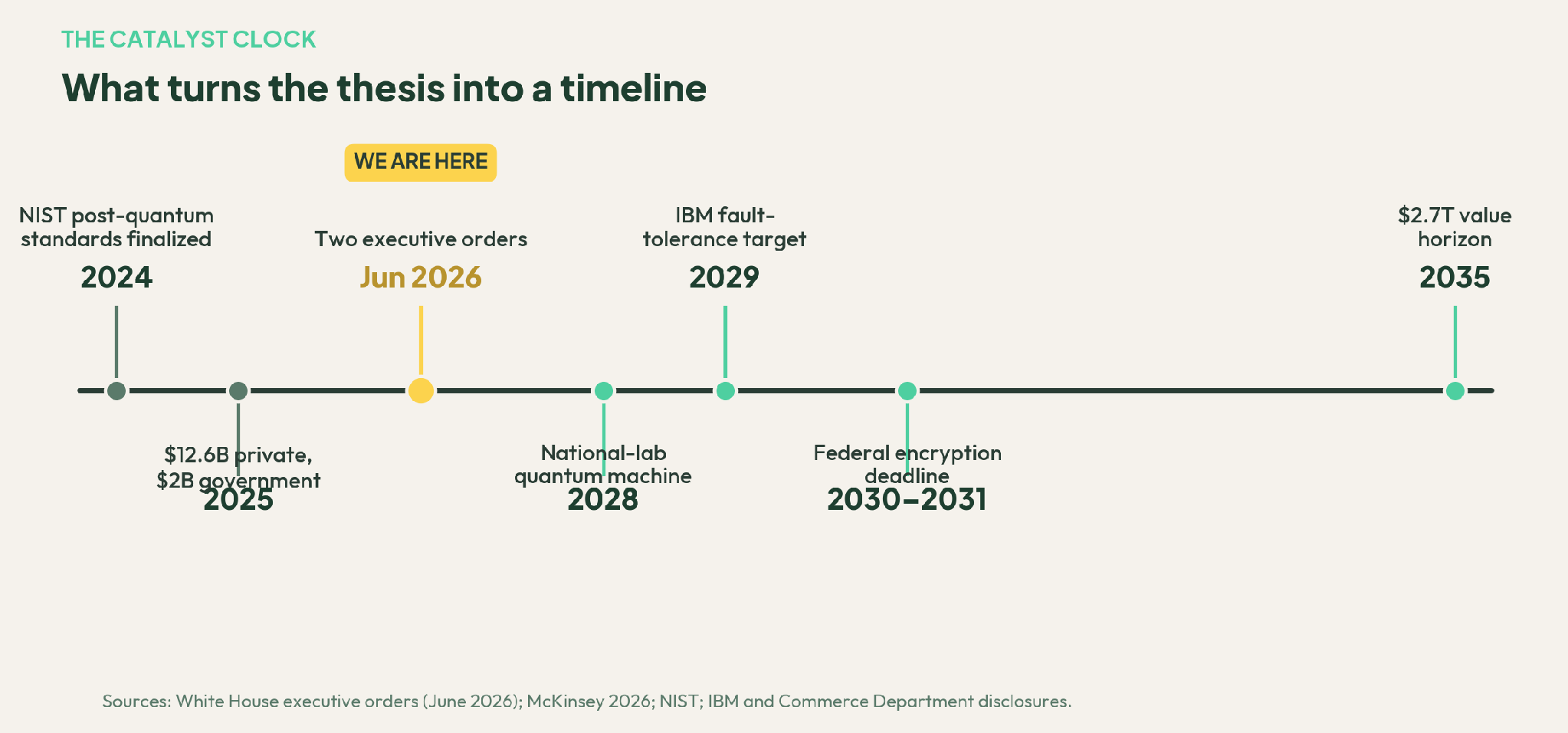
In May, the Commerce Department signed letters of intent to put roughly $2 billion into nine quantum companies, and took a minority equity stake in every one.
IBM got $1 billion to build Anderon, a domestic quantum-chip foundry, and matched it with a billion of its own.
D-Wave, Rigetti, Quantinuum, Infleqtion, PsiQuantum, and Atom Computing got $100 million each.
In June, two executive orders set a 2028 deadline for a national-lab machine and pulled the federal encryption-migration deadline forward to 2030 and 2031.
The 5-layer stack
Most people buy the top of this stack and ignore the rest. Here’s all five, from the speculative tip down to the foundation.
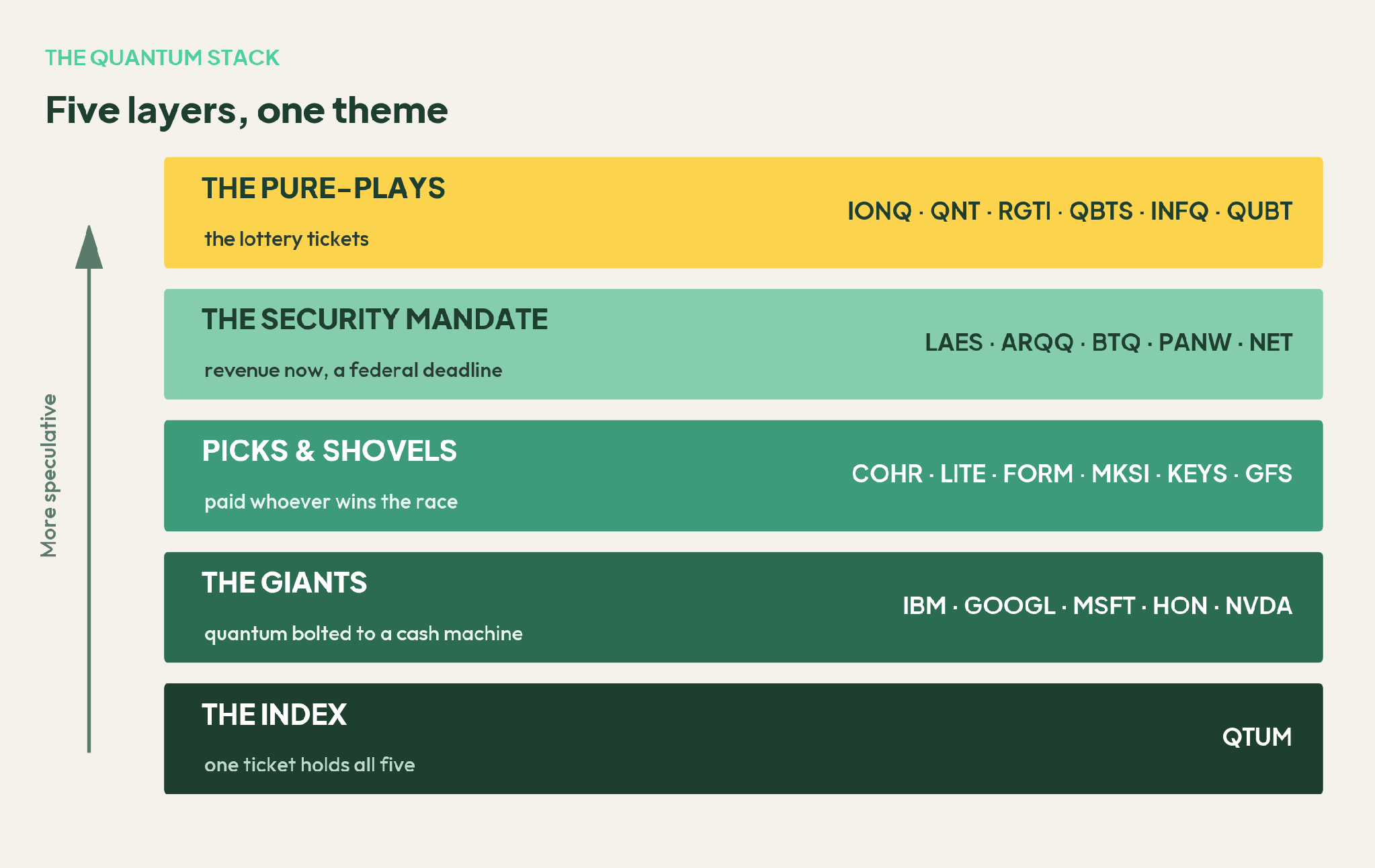
The pure-plays. The lottery tickets, and where the valuations get silly. Nobody knows which architecture wins, which is the whole point.
IonQ (IONQ), Quantinuum (QNT), trapped-ion
Rigetti (RGTI), superconducting
D-Wave (QBTS), annealing + gate-model program, both superconducting qubits
Infleqtion (INFQ), neutral-atom
Quantum Computing Inc (QUBT), photonic
IonQ trades near $20 billion on ~$130 million in sales, and these names swing 30% in a week. Smallest slice.
The security mandate. The layer most people miss, and the only one with revenue today and a law forcing the buying. The federal order makes every agency rip out today’s encryption by 2031, a procurement wave with a calendar.
SEALSQ (LAES), quantum-resistant security chips
Arqit (ARQQ), post-quantum encryption software, already landing early defense and telecom contracts
BTQ Technologies (BTQ), the same theme
Palo Alto (PANW), Cloudflare (NET), large caps shipping the new standards
SandboxAQ, the private leader, an Alphabet spinout on more than a billion raised
For the crypto crowd, the same vulnerable math secures Bitcoin, which can migrate to quantum-resistant signatures through a soft fork when it needs to.
Picks-and-shovels. Whoever wins the architecture race, they all buy the same lasers, cryogenics, control electronics, and wafers. Quantum is one market among many for these names, so you get exposure with a floor under it.
Coherent (COHR), Lumentum (LITE), lasers and photonics
FormFactor (FORM), cryogenic test
MKS Instruments (MKSI), Keysight (KEYS), control and measurement
GlobalFoundries (GFS), took $375 million to build a quantum foundry
The giants. Quantum programs funded by real businesses. You give up the lottery upside and get a quantum option bolted to a cash machine.
IBM, building the Anderon foundry, fault tolerance targeted for 2029
Alphabet (GOOGL), built the Willow chip
Honeywell (HON), owns most of Quantinuum
Nvidia (NVDA), sells CUDA-Q and NVQLink, invested in three quantum makers in 2025
Microsoft (MSFT), Azure Quantum
The index. The simplest way to own all of the above.
Defiance Quantum ETF (QTUM), 70-plus names across every layer, 0.40% fee
One ticket holds the whole stack. For most people, this is the position, and everything above is to understand what’s inside it.
The number everyone quotes is the wrong one
Here’s the discipline that matters most: The headline metric in quantum is the qubit count, and on its own it’s close to meaningless.
A machine can boast a thousand physical qubits and be further from useful work than one with fifty error-corrected, “logical” qubits. Physical qubits are raw and noisy. Logical qubits survive error correction and actually compute.
A company can announce a big number and move its stock 20% on a metric that doesn’t measure the thing you’re buying.
A qubit count is the Sharpe ratio of quantum: a precise-looking number measuring something soft underneath.
The same discipline I bring to a backtest applies here. Before you act on the number, ask what it represents. Watch logical qubits and error rates, not the press-release headline.
Managing the risks
As always, we would be prudent to discuss some of the risks and concerns here.
Sector and timeline risk sits at the bottom. The whole thesis assumes the machines scale on roughly the advertised schedule. Fault tolerance has been “a few years out” for a decade.
Idiosyncratic name risk sits in the middle. These are small, thinly covered companies. In February, short-seller Wolfpack Research accused IonQ of misleading investors, alleging a $54.6 million revenue “black hole” from lost government contracts. True or not, that’s the kind of single-name shock that doesn’t show up until it does.
Valuation and sentiment risk sits on top, and it’s the one most likely to hurt. A sector trading on roadmaps reprices violently on a single demo or delay. Priced for perfection means every miss is expensive.
Buffett Framework Question: “Am I buying a business or a roadmap?” In picks-and-shovels and the giants you’re mostly buying businesses that happen to carry a quantum option. In the pure-plays you’re buying a roadmap. That difference decides how much you commit, not whether you show up.
So how do I size around all of this? Three rules:
Size for a 50% drop. You’ll get one.
Treat it as a multi-year option, not a trade. The payoff needs machines that don’t exist yet.
Move on milestones, not press releases. Logical qubits and signed contracts, not headlines.
What I’m Watching
The qubit counts are the noise. The signal is which companies report logical, error-corrected qubits instead of raw ones, which of the nine Commerce letters convert into actual milestone payments, whether SEALSQ and Arqit start landing the federal procurement the 2031 deadline guarantees, and whether IonQ answers the Wolfpack allegations with numbers rather than press releases.
The architecture that reaches fault tolerance first resets the whole table.
I’m bullish on the technology and cautious on the price, and those sit together fine. The build-out is real, the security spending is already moving, and the odds that any single ticker is the decade’s winner are lower than the hype suggests.
Own the theme through the stack, not through one bet.
Keep the lottery tickets small. Be right about the build-out without having to be right about the company, the architecture, or the year.
You can’t see which path leads out of the maze yet.
So hold the whole thing until you can.
Until next time fam!
Matthew Snider is the founder of Block3 Strategy Group, author of “Warren Buffett in a Web3 World,” and publisher of the BitFinance newsletter. He holds a Series 65 and MBA, and has been an active participant in digital asset markets since 2015. This article is for educational purposes only and should not be considered financial advice. Always consult with a qualified professional before making investment decisions.
Sources
$2 billion in Commerce equity stakes across nine companies (IBM $1B for the Anderon foundry, GlobalFoundries $375M, $100M each to D-Wave, Rigetti, Quantinuum, Infleqtion, PsiQuantum, Atom Computing, $38M to Diraq): CNBC, DataCenterDynamics, Manufacturing Dive.
The two executive orders (June 22, 2026), the 2028 national-lab machine, and the 2030/2031 encryption deadlines: NBC News, Cybersecurity Dive.
Quantinuum IPO (~$15.7B, more than 400x revenue): CNBC. IBM fault-tolerance target of 2029: Yahoo Finance.
$2.7 trillion of value by 2035, ~$1B sector revenue in 2025, and $12.6B of 2025 startup funding: McKinsey.
Rigetti’s ~4,800% twelve-month run, ~$15B valuation and ~$7M revenue: The Motley Fool, stockanalysis.com. IonQ revenue (~$130M) and valuation, plus the Wolfpack short report alleging a $54.6M revenue gap: stockanalysis.com, DataCenterDynamics.
Security and supplier names (SEALSQ, Arqit, Coherent, FormFactor, MKS, Keysight, GlobalFoundries) and Nvidia’s quantum investments: StockTitan, The Quantum Insider.
NIST post-quantum standards (FIPS 203/204/205, 2024): NIST. Willow below-threshold error correction: Google Quantum AI, Nature, December 2024.