How I'm Building a Monetization Machine Out of a Mac Studio, 1,200 Pages of Quant Books, and 1TB of Compressed Data.
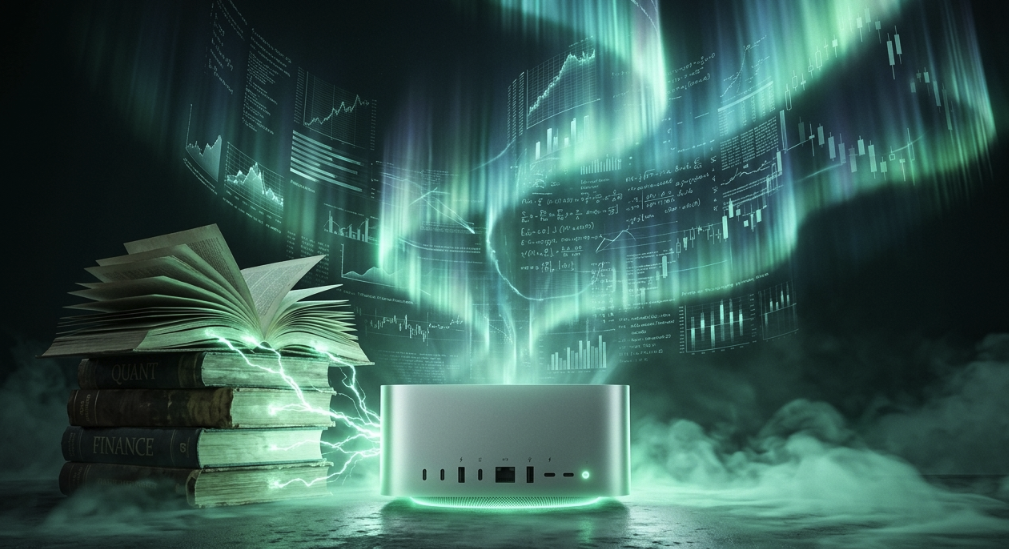
Two months ago I saw the mad dash of people trying to buy Mac Minis so that they could run an autonomous AI bot called OpenClaw.
Sure that was cool…but in a true “Tim-the-Tool-Man-Taylor” fashion I asked Claude a simple question: what could i do with MORE POWER?
More specifically, would it take to run autonomous research loops that could test hundreds or thousands of trading strategy experiments without any human involvement?
The answer came back quite specific:
You need enough unified memory to load large AI models and massive datasets into a single addressable space, without the bottleneck of shuttling data between a CPU and a separate GPU.
You need enough parallel processing cores to run dozens of experiments simultaneously, each one testing a different hypothesis.
The configuration that checks both of those boxes is a Mac Studio M4 Max with 128 gigabytes of unified memory and a 40-core GPU.
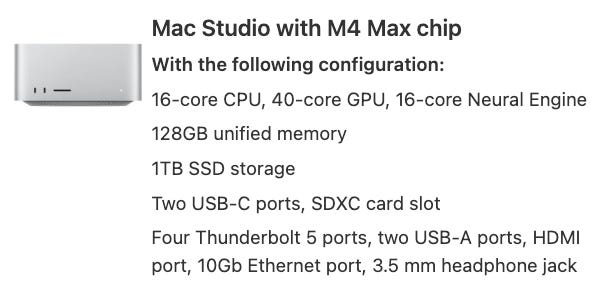
Together with this machine, troves of curated and high quality data and research from over 1,200+ pages of quantitative trading books we get a durable competitive advantage.
Most retail traders test ideas one at a time, by hand, and keep the best-looking result. This machine lets us test a thousand ideas per day, automatically, and apply real statistical rigor to figure out which ones are actually worth something. It’s the difference between picking stocks by gut feeling and building a research lab.
The Wait Was the Strategy
So then I went to buy one…and Apple told me to wait 8 weeks.
My reaction: “Eight F******* WEEKS?? What am I going to do until then??”
Turns out, the demand for this specific configuration was so high it was backordered well into spring.
My first reaction was frustration. I was ready to build dammit!
My second reaction was: okay, what do I do with two months?
That question turned out to be the most important one I’ve asked in this entire project.
Here’s what I’ve learned building with AI over the past couple months:
The tools are incredible (if you’re not using them yet, get started!).
The speed is real. I can wire up a backtesting pipeline in an afternoon that would’ve taken a team of developers weeks to build five years ago.
Garbage In = Garbage Out
Speed without direction is just expensive noise.
When I told the AI I had two months before the hardware arrived, it didn’t say “great, let’s start coding.” It said something closer to: go read 4 books. Understand the field before you start building in it. Learn what breaks most trading strategies before you build yours.
(and I did! you can read about it here)
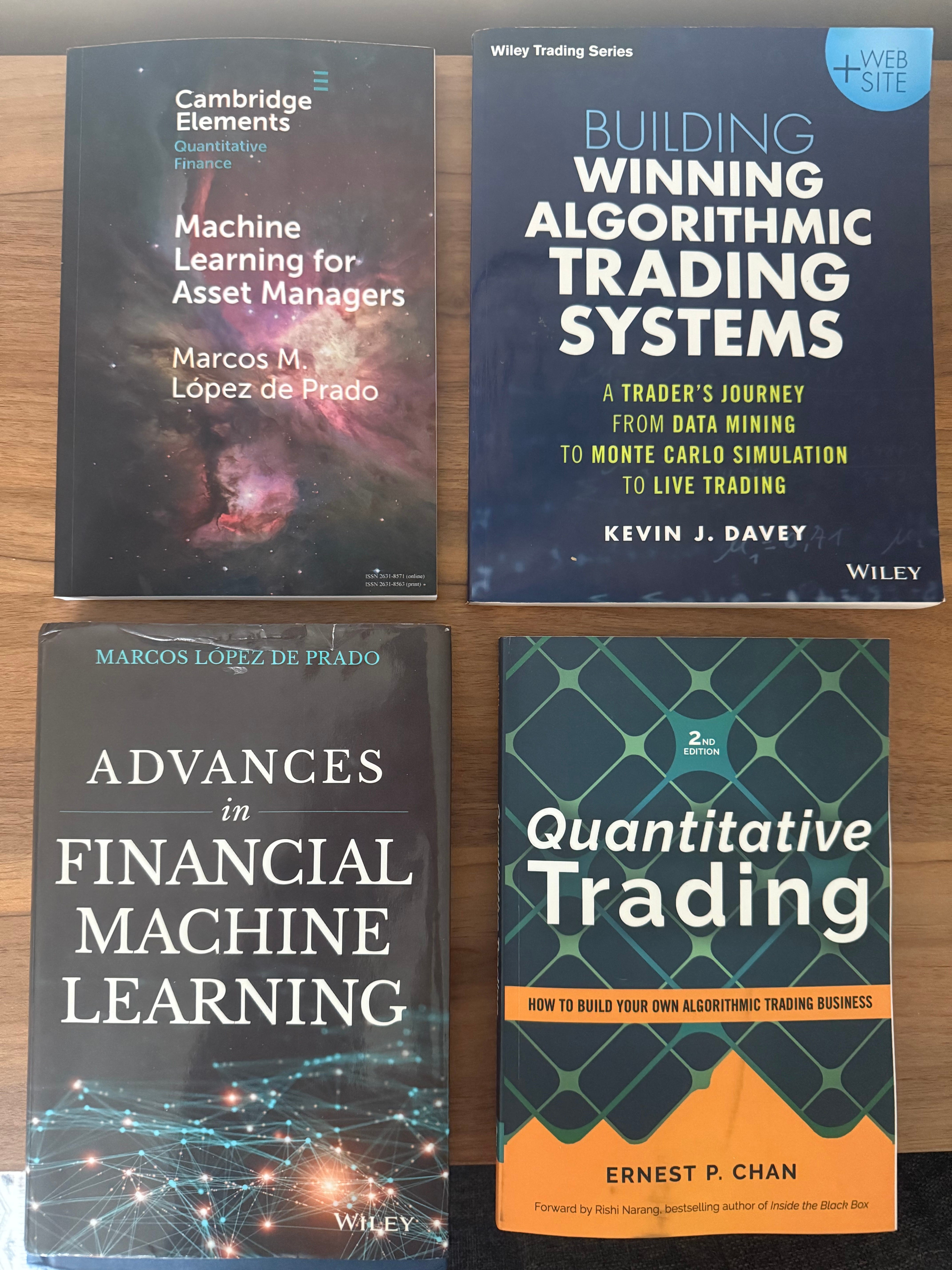
That advice was worth more than the machine.
I spent the next several weeks reading these quantitative finance books cover to cover. Not because I’m some lifelong quant nerd but because the AI essentially told me that if I wanted to build something that actually worked, I needed to understand why most of this stuff fails first.
In my research, I gained detailed knowledge of how I could make this vision come to life.
How backtesting can lie to you if you don’t test your strategy on data it’s never seen.
How testing hundreds of settings and keeping the best one creates an illusion of performance that evaporates in live markets.
The difference between a strategy that looks good and one that is good comes down to how rigorously you’re willing to stress-test it.
Then I synthesized everything into a single reference document we call the Quant Bible. A working playbook for how to validate any trading idea honestly. Rules for what has to be true before we’d ever trust an indicator with real capital.
If I’d had the machine on day one, I would’ve skipped all of that. I would’ve started running experiments immediately, gotten excited about the first result that looked promising, and probably built something fragile on top of it.
The forced wait made me plan first and build second.
Three Pieces, One Machine
What we’ve been building is a system with three layers. I want to introduce the names, because I’ll be referencing them going forward and I think they make the whole operation easier to understand.
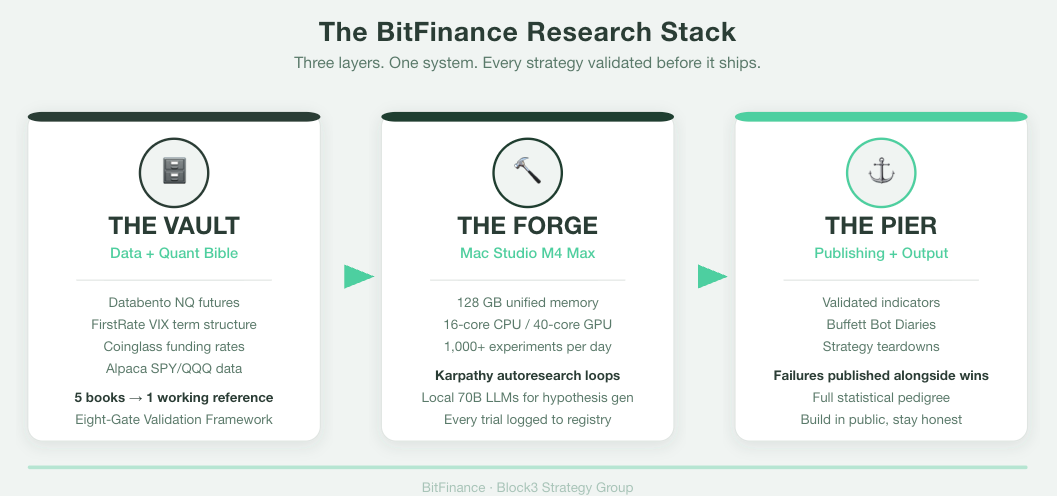
The Vault is the foundation. It holds two things: the institutional-quality data we invested in (futures data, volatility data, crypto funding rates, equity pricing from Alpaca) and the Quant Bible that defines how we test ideas without fooling ourselves. I wrote about the data investment a few weeks ago. It wasn’t cheap, and I made a public bet that the return on that investment would be substantial. The Vault is what keeps the whole system honest. Garbage data produces garbage results, and undisciplined testing produces results that look great until they touch real money.
The Forge is the Mac Studio I described above. You already know the specs. What matters here is what it enables: the autoresearch loops I wrote about last week, where an AI agent proposes a change, runs the experiment, measures the result, and keeps or discards it automatically. Right now on the Mac Mini, that loop is grinding through weather prediction markets on Kalshi as a proof of concept. When the Forge arrives, it points at real trading strategies. Same loop, higher stakes, massively more compute.
The Pier is the output layer, where everything we learn reaches you. Validated indicators. Strategy breakdowns showing what works and why. Teardowns showing what failed and why. If you’ve been reading BitFinance, you’ve already seen Pier content: the March Madness prediction experiment that showed strong results early and decayed as the field narrowed. The teardown of a viral trading bot that looked impressive on the surface but was essentially memorizing the past instead of learning from it. The SMART Gates framework that forces us to define our success criteria before we look at results, not after.
The Pier carries the wins and the losses equally. That’s the part most people in this space skip. Nobody publishes the strategies that didn’t work. We do, because understanding why something fails is usually more instructive than knowing that something else succeeded.
The Lesson Underneath All of This
I think the biggest takeaway from the past two months isn’t about trading at all. It’s about how to use AI well.
The temptation with these tools is to go fast.
You can build so quickly now that the bottleneck has shifted from “can I build this” to “should I build this, and have I thought it through?” Just because you can spin up a backtesting engine in an afternoon doesn’t mean the results it produces will be worth anything. The thinking has to come first. The reading has to come first. The planning has to come first.
If I’m being honest with myself, I got lucky that the hardware was backordered.
It forced a planning phase that I probably would’ve skipped if I could’ve started building immediately.
The AI pushed me toward books.
The books gave me a framework.
The framework shaped the data requirements.
The data shaped the pipeline.
By the time the Studio arrives Monday, everything is pre-built. The scripts, the data connections, the validation rules, the logging infrastructure. I’ll take it out of the box, connect it, and the system is essentially ready to run.
That’s not how most AI projects go. Most of them start with the shiny tool and figure out the plan later. I’ve done that myself, more than once. This one happened in the right order, and the two-month wait is the reason.
What Happens Next
By this time next week, the Forge will be running its first autoresearch loops. Over 60 strategy ideas are seeded in the registry. Fifteen indicators are prioritized for testing in Q2. The whole pipeline, from hypothesis to validation to publication, activates for the first time.
Most of those ideas will fail. That’s expected, and I’ll be writing about both sides.
The goal of this system is simple: find trading indicators and strategies that actually hold up under rigorous testing, publish the ones that pass, explain the ones that don’t, and build a research operation that compounds knowledge over time. Better insights for traders. Honest assessments of what the market is actually doing. Real transparency about what works and what doesn’t.
The Mac Studio arrives Tuesday. Everything else is already built.
Two months of patience. Let’s see what it’s worth….
This Week In 2 Minutes
The Greatest Roster in Sports History Can’t Save This Stock. (April 13)
Rory McIlroy won back-to-back Masters titles wearing Nike. Scottie Scheffler finished second in Nike. LeBron is still in Nike. The ad they dropped after the Masters was genuinely brilliant.
The stock is down 76% from its high and trading at 2014 levels.
This piece walks through why the greatest athlete roster in sports marketing history can’t fix a margin problem, a tariff problem, and a competitor problem all at the same time, and what it tells investors about the difference between brand power and business fundamentals.
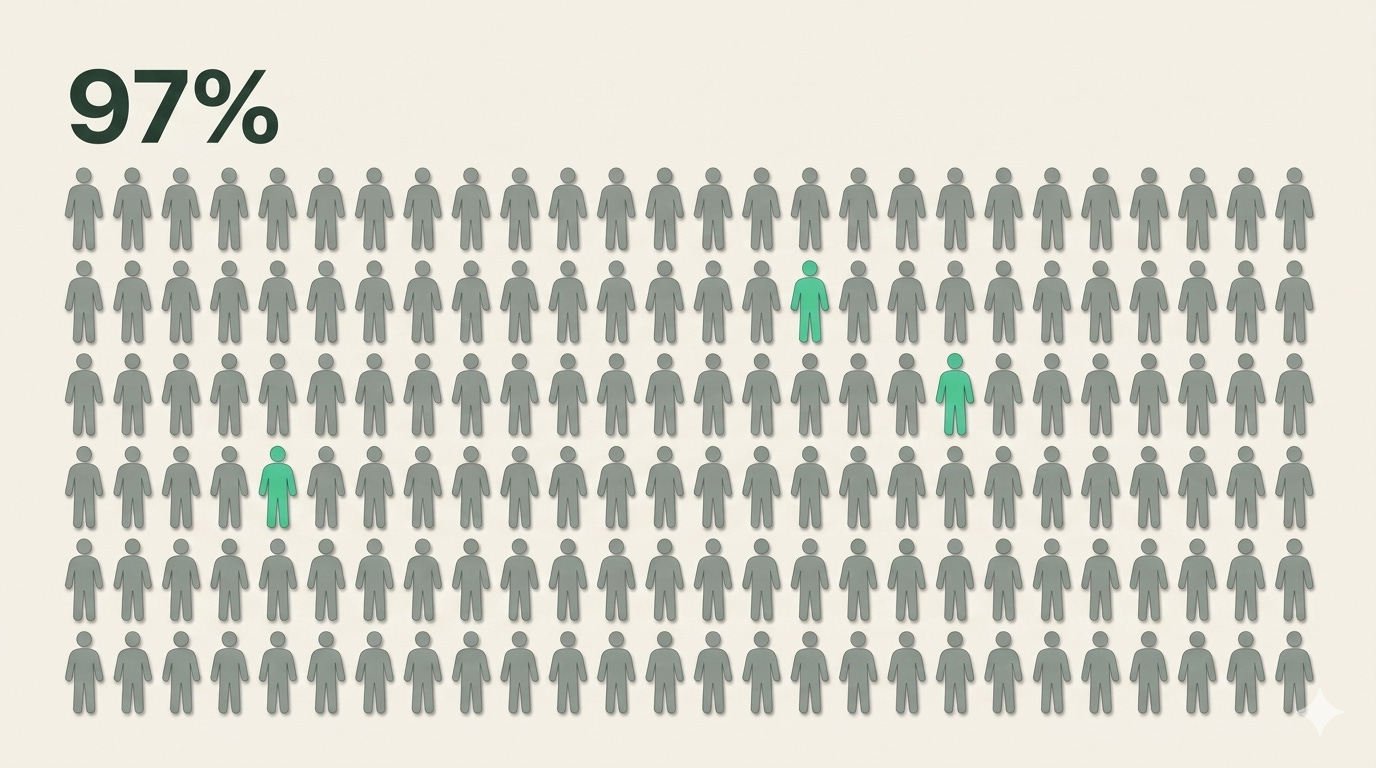
97% of Day Traders Lose Money and The SEC Just Invited More of Them In. (April 15)
The $25,000 Pattern Day Trader rule is officially dead after 24 years.
Social media is celebrating but the academic research is less optimistic. Studies across the US, Brazil, and Taiwan show that 97% of persistent day traders lose money, and the failure rate hasn’t budged despite better technology, cheaper access, or more education.
We walk through who actually profits when millions of new accounts start trading actively (hint: it’s the brokerages), and why removing a guardrail without adding education tends to end the same way every time.
From Value Investing to Systematic Trading: Building a Multi-Strategy Backtesting Dashboard with AI (April 9)
I got published! 🔥
A deep dive published this week on how I went from zero programming experience to six trading strategies running in a paper trading environment across equities and crypto, all built with AI assistance. Covers the interactive backtesting dashboard, the multi-strategy portfolio approach, why strategy diversification works exactly like asset diversification, and the honest lessons I’ve learned about what AI can and can’t do as a coding partner.
Weekly Winners 🏆
S&P 500 and Nasdaq: Both hit fresh all-time highs this week. The S&P closed above 7,000 for the first time, and the Nasdaq posted an 11-day winning streak, the fastest oversold-to-overbought swing since the early 1980s. The Iran ceasefire optimism and strong bank earnings drove the rally.
Citigroup: Posted its highest quarterly revenue in a decade. $24.6 billion in revenue, beating estimates by nearly a billion. Net income up 42% year over year. Jane Fraser called it an “exceptionally strong start to 2026.” The clearest winner of the big bank earnings cycle.
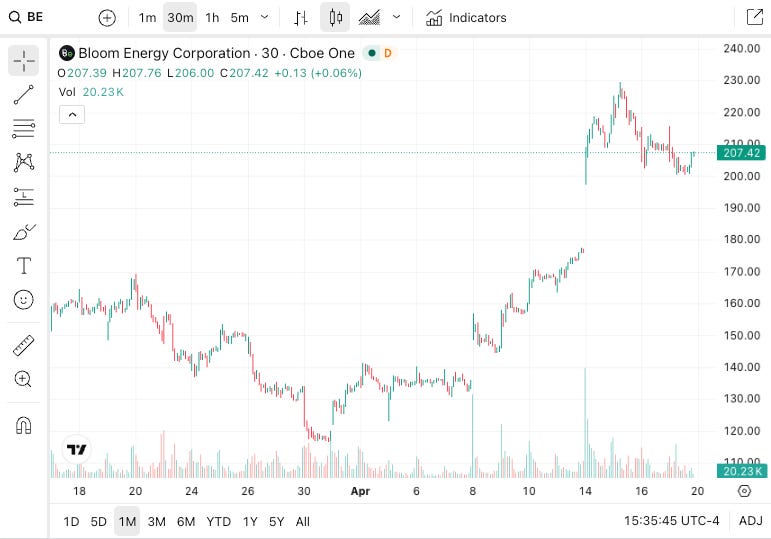
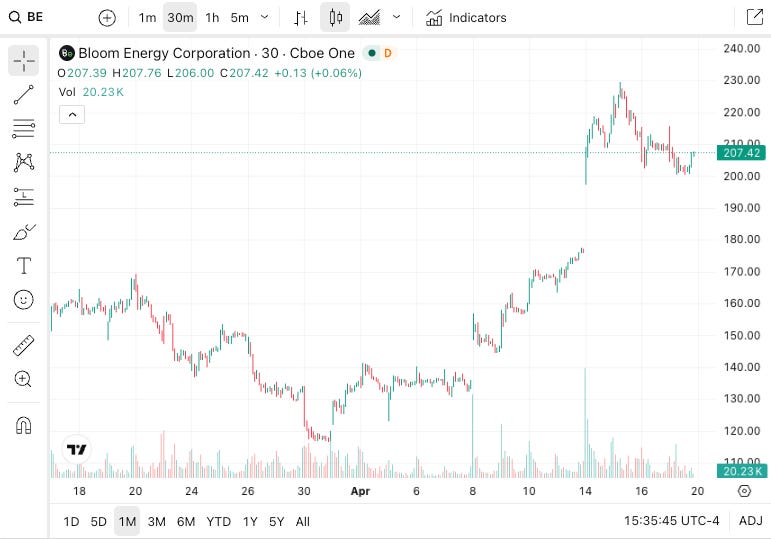
Oracle: Surged roughly 8% on Tuesday after announcing a deal to purchase up to 2.8 gigawatts of fuel cell power from Bloom Energy for its expanding data center footprint. AI infrastructure spending continues to be the gift that keeps giving.
Oil bears: WTI crude dropped 7% on Tuesday alone, falling to roughly $92 per barrel, after Iran announced the Strait of Hormuz is “completely open” for the remaining ceasefire period. The Israel-Lebanon ceasefire announcement today added another leg down.
Weekly Losers 📉
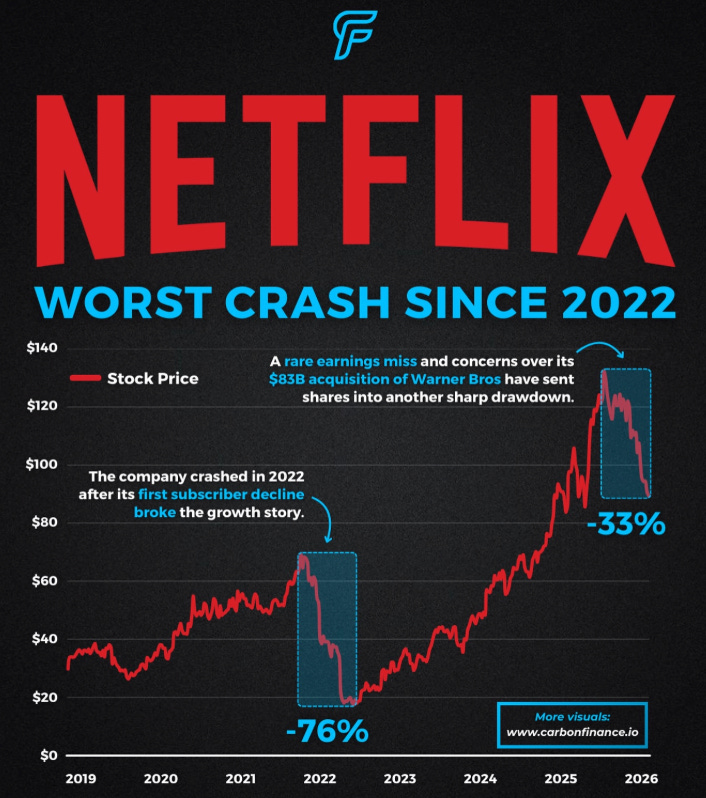
Netflix: Beat on revenue ($12.25B, +16% YoY) and crushed EPS expectations ($1.23 vs $0.76 estimate), but the stock dropped nearly 10% after hours. Reed Hastings announced he’s leaving the board. Q2 margin guidance came in slightly below the Street. The WBD termination fee padded the quarter, and investors didn’t love the organic picture underneath it.
Live Nation: Shares fell after a New York federal jury found the company holds an illegal monopoly over the ticketing market. The antitrust case brought by 34 states just delivered its verdict after a six-week trial. The Ticketmaster era may be entering its final chapter.
Refiners (PBF Energy, Delek, Par Pacific): All down 12-15% as oil prices collapsed on ceasefire momentum. When your margins depend on elevated crude prices and supply disruptions, peace is bad for business.
On Deck for the Week of April 20
Iran ceasefire expiration (April 21): The two-week ceasefire expires Monday. Iran just declared the Strait of Hormuz fully open, and a Lebanon ceasefire was announced today. A second round of talks in Islamabad is under discussion. If this holds, oil continues to fall. If it collapses, brace for a volatility spike that ripples through every asset class.
Tesla earnings (April 22): Deliveries already missed expectations. Street consensus is $0.37 EPS on $22.7B revenue, but the smart money estimate is closer to $0.30. The real question isn’t the car numbers. It’s whether Musk delivers credible timelines on Robotaxi, Optimus, and the Terafab capex ramp. The stock broke out of a descending channel this week on AI chip news. Earnings will determine whether that breakout sticks.
Alphabet and Amazon earnings (late next week): Both report after the bell. AI infrastructure spending is the story. Analysts expect Alphabet’s capex to exceed $115 billion this year. The market wants to see that spend translating into cloud revenue growth, not just announcements.
Bitcoin at $75K resistance: BTC has been consolidating above $73K all week with the broader risk rally. Dealers are sitting on negative gamma at the $75K strike, which means a breakout in either direction could accelerate fast. The ceasefire news cycle and equity market momentum are the near-term catalysts.
Matthew Snider is the founder of Block3 Strategy Group, author of “Warren Buffett in a Web3 World,” and publisher of the BitFinance newsletter. He holds a Series 65 and MBA, and has been an active participant in digital asset markets since 2015. This article is for educational purposes only and should not be considered financial advice. Always consult with a qualified professional before making investment decisions.