Capital That Thinks for Itself: My Bet on AI-Native Asset Management
I write BitFinance because I think the real edge in markets sits in the validation work most people skip.
Show the real numbers.
Show the strategies that died.
Let the track record stand somewhere anyone can check it.
That’s the whole thesis, and it’s why I’m careful about what I put my name on.
So when I tell you I’ve joined Duon Labs as a formal advisor, I want to be straight about the why. The deck didn’t win me over, but the work did. Their team is building in the open and - more importantly - shipping.
Let me give you the plain version of what that is.
A foundation model, pointed at markets
You already know what a foundation model is, even if you’ve never used the term. It’s the engine underneath tools like ChatGPT or Claude, one big system trained to understand language that then powers a hundred different apps on top.
Duon Labs is building one of those for financial markets instead of language.
Picture a machine that runs millions of simulated futures every day, thousands of versions of what markets might do next, then writes down where all those futures tend to agree. That shared read becomes a forecast.
The forecast becomes a strategy.
The strategy deploys real capital.
The whole chain, from raw data to live trades, runs under one roof.
Here’s the part that I think is easy to miss:
Most trading bots follow rules a person wrote by hand. Duon Labs’s system writes and tests its own. New versions of the models turn over constantly, each one measured against the last, the better ones kept and the weaker ones retired.
The research loop improves on its own and creates a valuable flywheel effect.
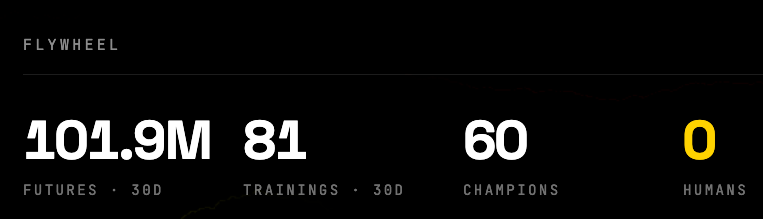
That changes the shape of the business. A traditional asset manager grows by hiring more people. Duon Labs grows by adding compute and letting the loop compound. Think of a wind tunnel for strategies: thousands of designs tested against simulated conditions before a single dollar goes near the real thing.
There’s a quieter advantage in here too.
The engine doesn’t care what it’s pointed at. The same stack that models crypto can model commodities, equities, rates, or anything else with a price history, because it learns from the structure of markets rather than the quirks of one of them. Build the wind tunnel once and you can test aircraft, race cars, and rockets in it. That’s why a commodities sleeve is on the way and why the long-term story isn’t a crypto fund but a research engine that travels across asset classes.
Why the on-chain part matters
Now the piece I care about most.
Every trade Duon Labs makes settles on a public blockchain. That sounds technical, but the consequence is simple. The track record stops being a quarterly letter you take on faith and becomes a ledger anyone can open and check in real time.
Sit with that for a second, because it inverts something critically important.
In most of finance, transparency is an actual cost. You disclose details because you have to by a regulated mandate - not because it helps the business.
With Duon Labs, transparency is the product.
The same property that lets an outside investor audit the strategy also lets a custodian’s risk team underwrite it, lets an advisor report it to clients, and lets a board see exactly what it owns. One feature, doing work across the whole stack.
For a newsletter built on the idea that numbers you can check beat marketing, that’s the entire appeal.
The train has left the station (choo! choo!)
None of this is theoretical, so it’s worth grounding in what the team is shipping.
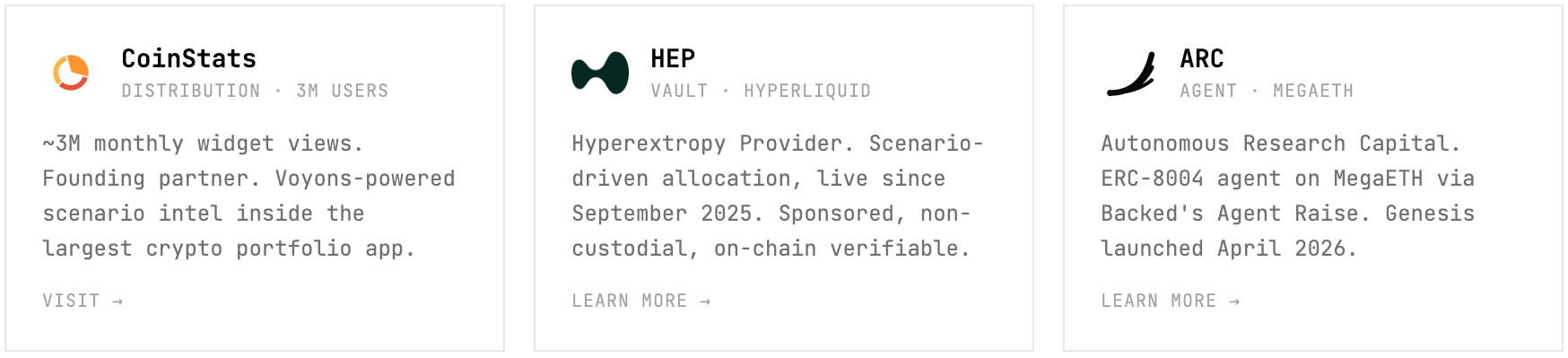
Consumer reach most research shops never get near. Duon Labs’s signals sit inside a widget on CoinStats, a portfolio app with a large retail following, and that placement has pulled in more than 3 million monthly widget views. The same intelligence behind the institutional strategies is already living on people’s phones.
Running on serious on-chain infrastructure. The vaults trade live on Hyperliquid, one of the busiest venues in on-chain markets, and a newer vault launched on MegaETH this spring. Two different network designs, one underlying brain.
Developers lining up to build on it. Next to the vaults, Duon Labs is opening an API so coders and quant teams can build on the same engine. Almost 200 of them are on the waitlist before it’s even fully open.
Ultimately there are really two stories here:
One is capital the system runs on its own.
The other is an engine other people get to build on top of.
Both are already moving.
The art of the possible
The interesting question isn’t whether the engine works but who it works for. A few of the places this could land:
Custodians and custodial platforms. A custodian can hold a client’s assets safely but can’t do much to grow them beyond basic staking. Duon Labs plugs in as an actively managed yield option where the capital never leaves custody and every trade is verifiable. That clears the compliance bar that usually kills these products before launch, because the risk team can audit the strategy instead of taking a counterparty’s word for it.
Tokenization issuers and platforms. The hard part of tokenizing a fund isn’t the wrapper but the thing inside it: a strategy institutions will actually buy. An auditable, on-chain track record is exactly that, a transferable vehicle any allocator can verify before committing a dollar. The issuer distributes through rails it already runs, and the underlying does the convincing.
RIAs and wealth managers. Most advisors still can’t offer real digital asset exposure they can stand behind, so they default to a spot ETF or to nothing. This is actively managed exposure, held at a qualified custodian, and reportable down to the individual trade. An advisor can pull up the actual position on-chain in front of a client, which turns a hard conversation into a simple one. This one feels like the long-term destination.
Asset managers and allocators. An allocator’s job is to trust a manager’s numbers between quarterly letters, which is mostly an act of faith. Here the sleeve is verifiable continuously rather than reconciled once a quarter. You stop auditing the past and start watching the present.
Trading desks and quant shops. A desk doesn’t want someone else’s black box but better inputs for its own. Duon Labs’s read arrives through an API as one more signal that stacks on top of existing models, not a replacement for them. It’s edge a desk can test against its own book before ever leaning on it.
Different customers, one engine underneath. Every dollar of research compounds across all of them, which is what makes the economics hard to copy.
My role, and where it stands
I’m advising on methodology and validation, on how research gets pressure-tested before it touches live money, and on how to frame the work for the institutional investors who might one day allocate to it. I bring a Series 65, prior experience running a digital asset strategy, and a low tolerance for flattering numbers. Coincidentally, we’re complementary because I’m building an engine to auto-curate indicators that could be used by Duon Labs’ to hone their agent accuracy.
None of this is finished, and I won’t pretend otherwise. The out-of-sample research is strong, and it’s auditable. Turning research-grade results into consistent live performance is the hard part, and that translation work is a big reason I said yes. I’d rather you hear that from me than find it on the audit page later.
So go take a look for yourself and see what we’re cooking!
The vaults trade on-chain, the model releases are public, and you can watch the whole thing run live here: live.duonlabs.com
I’ve said for a while that crypto + AI is the most interesting place to be building right now. Duon Labs is the clearest example I’ve found of someone doing it out in the open, with the receipts attached. I’m glad to be along for it, and I’ll keep showing you what I learn, the wins and the misses both.
Excited to keep you posted on the opportunity. If you’re interested in learning more about what their building or their fundraising efforts - please reach out!
🛑 SIGN UP HERE BELOW TO BE PART OF WHAT WE’RE BUILDING! 🛑
I’m building the early cohort for when the Discord opens and the first indicators ship. If you want a seat, this is where to claim one.
Interested? Fill out the 30-second interest form here. 👈
This Week in Two Minutes

Your Software Is About to Start Paying Its Own Bills (May 26)
Keyrock, Coinbase, Tempo, and Virtuals published twelve months of real machine-to-machine payment data.
AI agents settled $73 million across 176 million transactions between May 2025 and May 2026, with 98.6% of that flow moving through USDC. The sustained Q1 2026 run rate was $11 to $15 million weekly.
Why it matters: a USDC transfer on Base costs about 1/100th of a cent, while a Stripe card rail costs about 31 cents. For a $0.31 transaction, one rail leaves the merchant with $0.3099, the other with $0.001. The old rails can’t carry that traffic at that price point. Post office vs. email, fifty years later.
The part worth holding: roughly 74% of agent volume currently flows through Coinbase’s chain, Coinbase’s stablecoin, and Coinbase’s facilitator. That’s the most vertically integrated payment stack since Stripe.

Tokenization’s Missing Buyers (May 28)
A few days ago, Adam Blumberg published a piece in the Tokenized Asset Coalition’s Industry Veteran Series that did something the tokenization industry has spent five years avoiding.
He runs an SEC-registered RIA built for the crypto-native UHNW investor, and he still can’t allocate to tokenized RWAs at scale. The buyers aren’t missing, they’re blocked. Five operational barriers (custody fragmentation, opaque token-to-asset data, KYC rebuilt at every issuer, no reporting integration, four different income mechanics) sit between conviction and allocation.
Tokenization works for stablecoins and tokenized Treasuries because the underlying is liquid and the data is clean. It stalls in private credit, real estate, and specialty finance because the operational rails to hold those assets don’t exist yet.
The article ties to the RIA work I’m doing in Puerto Rico, and the gap that work is built around.
Winners This Week🏆
Public-chain tokenization rails. 2 big wins in one week!
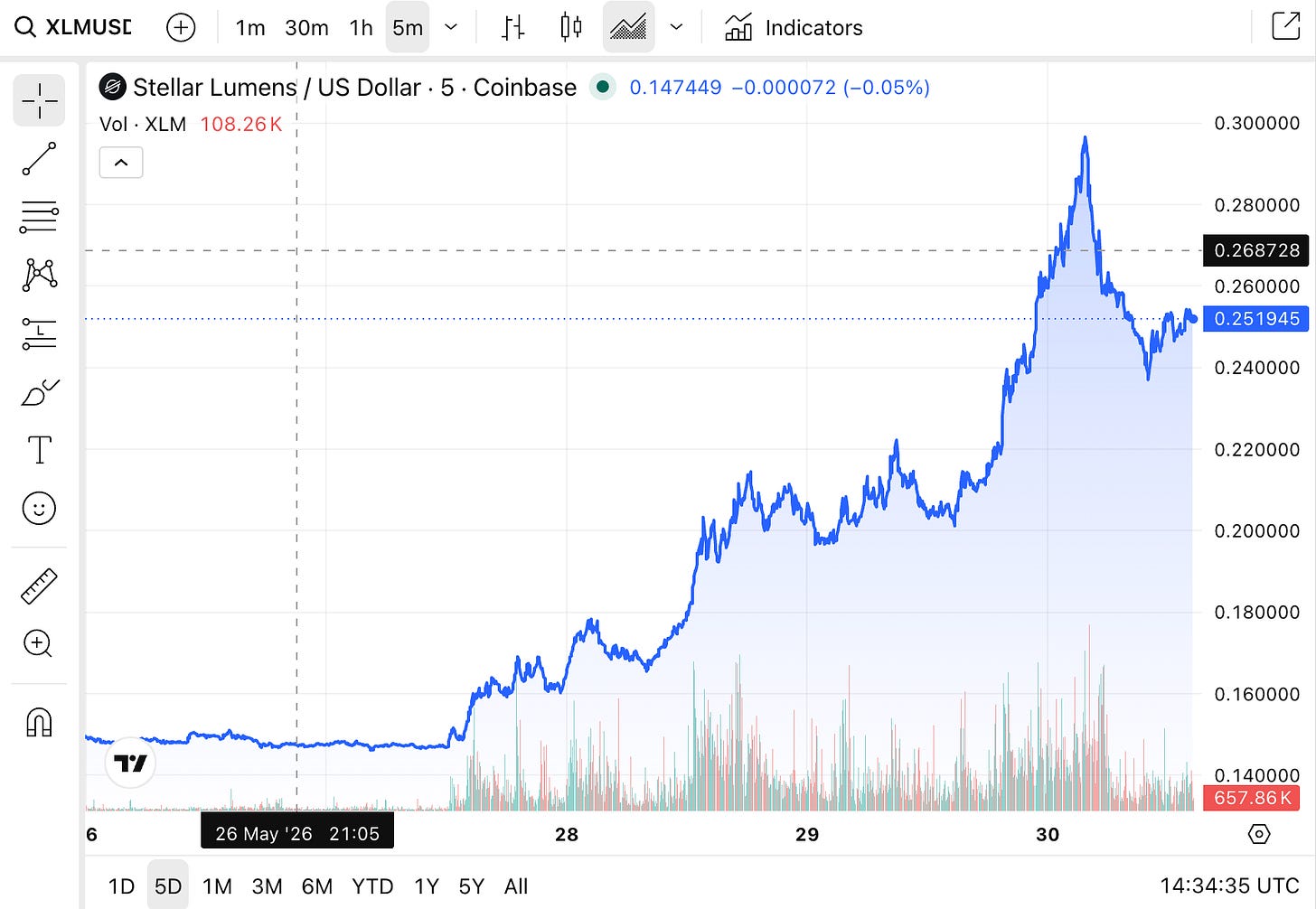
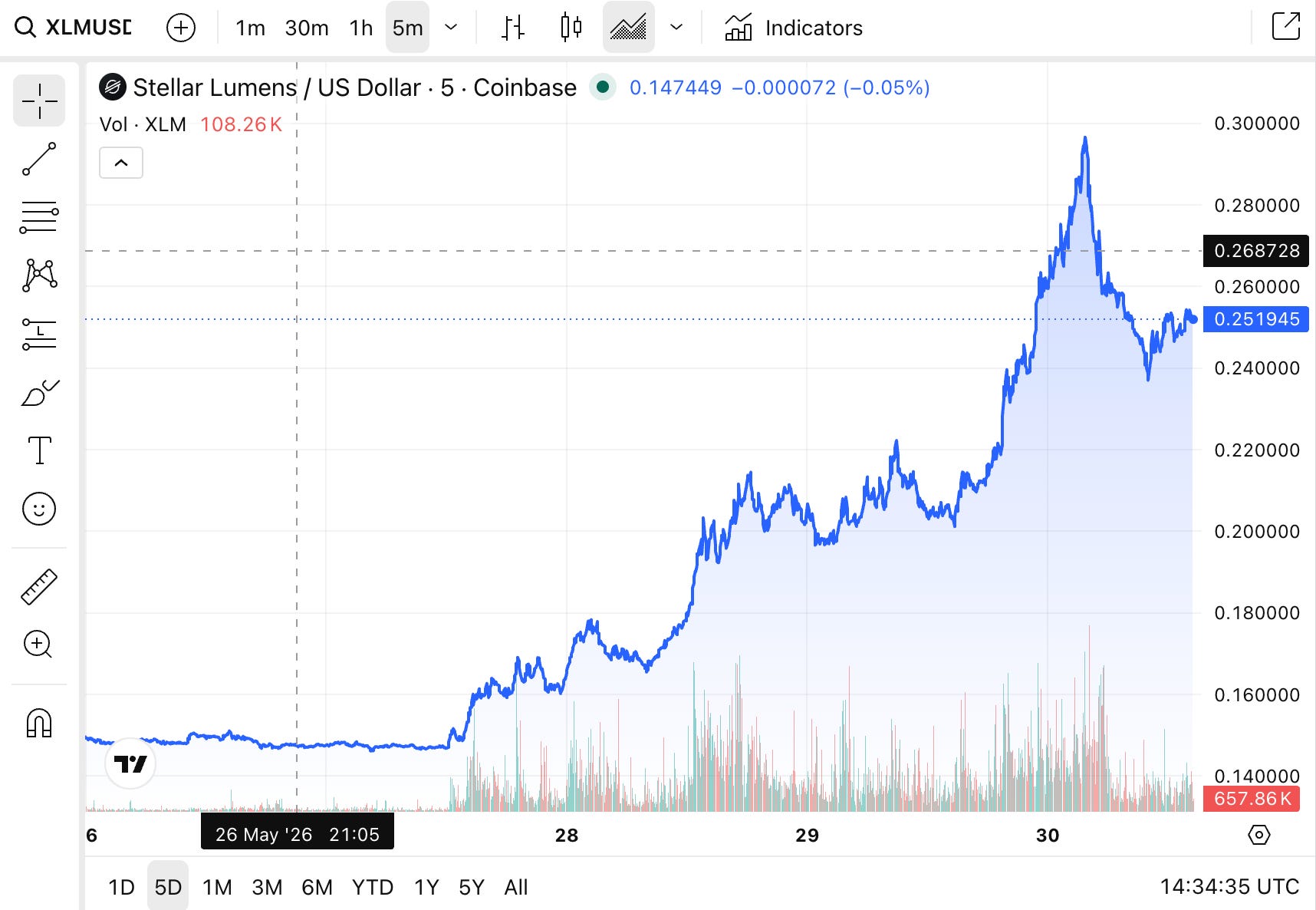
DTCC announced a partnership to tokenize Russell 1000 equities and US Treasuries on Stellar ($XLM) by 1H 2027. Paxos became the first blockchain-native firm registered with the SEC as a clearing agency and central securities depository, after seven years of regulatory back-and-forth. The legacy infrastructure that has run US securities for decades is migrating to public blockchain rails. If you’ve been waiting for a structural signal that tokenized real-world assets are a real category and not a slide deck, this week was it.
I guess the $XLM market liked the news…
US regulated crypto derivatives. Kalshi got the first CFTC approval for a Bitcoin perpetual futures product, with stated plans to expand to more than a dozen currencies. Coinbase received a separate no-action letter allowing perpetual futures through its Bermuda affiliate, with BTC, ETH, and stablecoins as eligible collateral. US-based traders no longer have to use offshore venues to get perp exposure. Better tax treatment, lower counterparty risk, and a competitive landscape that suddenly looks domestic.
Bank-issued stablecoins. SoFi launched SoFiUSD, a bank-issued dollar stablecoin available inside its app with Ethereum and Solana support. Banks have moved from regulating stablecoins to issuing them. The competitive set against USDT and USDC just changed shape, and the door is now open for other US banks to follow the same playbook.
Hyperliquid and the DEX thesis. The 11-person team’s HYPE token sits within 4.5% of its all-time high after ICE CEO Jeffrey Sprecher called the protocol “bigger than Nasdaq” at the Bernstein conference and disclosed multiple meetings between ICE and the team. Legacy exchanges have stopped pretending decentralized rivals don’t exist. That’s a meaningful change in posture from the firms that run the regulated markets.
And The Losers…📉
Long-duration bond holders. The 30-year Treasury yield hit 5.19% earlier this week, the highest since July 2007. The 10-year touched 4.67% before easing to 4.44% Friday on tentative US-Iran ceasefire news. Anyone holding duration through this repricing took a beating, and the bid-to-cover ratios on recent 10- and 30-year auctions show real demand strain at the long end. Yields eased late in the week, but the structural backup is the story.
Anyone positioned for rate cuts. Fed funds futures now show markets assigning a 46% probability to a rate hike in December, not a cut. Six months ago the consensus was for multiple cuts in 2026. Core PCE came in at 3.3% year-over-year this week, still well above the Fed’s 2% target. The trade that the Fed would ride to the rescue this summer has been mostly squeezed out.
Small caps. The Russell 2000 trailed every major index again this week, finishing in the red while the S&P, Dow, and Nasdaq all closed green or near it. Smaller balance sheets carry more funding-cost sensitivity, and the rate-hike repricing makes that exposure expensive. The gap between large-cap AI beneficiaries and the rest of the economy keeps widening.
Bitcoin spot and the “uncorrelated asset” pitch. BTC trading around $73K and underperforming AI and semiconductor stocks while the broader market notches highs. Spot Bitcoin ETFs hit a record nine-day outflow streak with $2.8 billion pulled, the longest run of withdrawals since they listed in January 2024. The narrative that Bitcoin trades independently of risk assets is being tested in real time, and right now it’s struggling to hold.
What’s on Deck This Week: June 1
June FOMC meeting and the jobs report. Non-farm payrolls land Friday, June 5. With rate-hike expectations creeping back into futures and core PCE at 3.3%, the labor data is the cleanest read on whether the Fed has room to move in either direction this year. The June FOMC follows mid-month, and any pivot language from Chair Warsh moves both equities and fixed income.
Iran ceasefire verification. The reported 60-day memorandum of understanding between the US and Iran extends the current truce and gradually restores tanker flow through the Strait of Hormuz. The deal is contingent on Trump approval. Oil markets, Treasury yields, and inflation-linked positioning all move with the headline risk on this one.
ETF flows as a forward indicator. Watch whether the nine-day Bitcoin ETF outflow streak breaks or extends. Flows have led price by a few sessions this cycle. The same read applies to equity ETF flows heading into the FOMC.
Stablecoin regulatory deadlines. The GENIUS Act implementation deadline is July 18. MiCA’s transitional period ends July 1. Neither contains provisions for autonomous machine-to-machine transactions, which is the gap the agentic commerce piece spent time on. Worth watching how issuers and regulators handle the mismatch.
Until next time! Trade safe out there fam 😎
Matthew Snider is the founder of Block3 Strategy Group, author of “Warren Buffett in a Web3 World,” and publisher of the BitFinance newsletter. He holds a Series 65 and MBA, and has been an active participant in digital asset markets since 2015. This article is for educational purposes only and should not be considered financial advice. Always consult with a qualified professional before making investment decisions.