Most Trading Ideas Deserve to Die ☠️
A few weeks ago this whole thing still felt like a sketch on a whiteboard.
We had the broad idea. Build a research engine that could take rough trading ideas, test them against real market data, keep track of what worked, kill what didn’t, and eventually help us turn the best ideas into things people can actually use: research notes, dashboards, and maybe, one day, live trading systems.
That sounds clean when you write it in a single sentence.
In practice it’s messy. Very messy.
Trading research is full of traps.
A strategy can look great because it accidentally peeked into the future.
A backtest can look amazing because it worked during one stretch of history.
A set of settings can look “optimized” when really it was fit too tightly to noise.
A chart can look convincing while the data underneath is doing something dumb.
The goal was never simply to have an AI go find trades. That’s too easy to say and far too dangerous to trust.
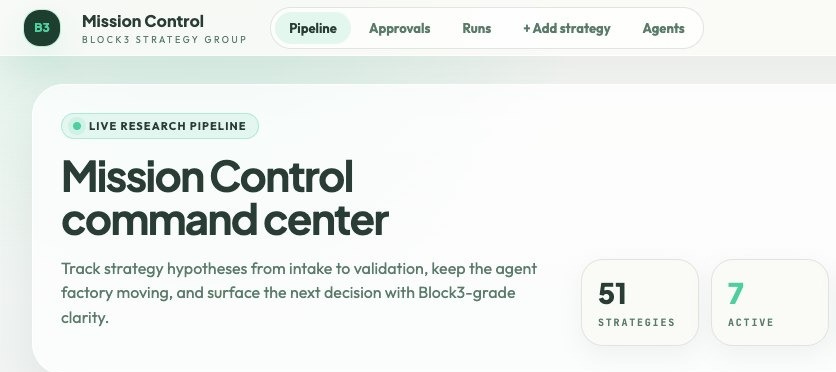
The goal is to build something closer to a research factory, disciplined enough to take an idea, ask the right questions, test it in layers, keep the evidence, and make it easier for a human to decide whether it deserves any more attention.
This week, that factory started to feel real.
Three parts that have to click
The engine only works when three things move together:
human intuition,
AI-assisted research, and
A dashboard that keeps score.
Take any one of them away and you’re back to guessing.
The human part still matters most. We can talk through an idea in plain English. It might start as something simple, like “what if a certain market pattern works better after a strong move?” Or “what if this setup behaves differently in futures than it does in stocks?” Or even “this looks interesting, but I don’t know how to define it yet.”
That’s where the conversation with Skyla (our Hermes-based AI agent leveraging Codex) has become useful. Instead of needing to turn every passing thought into a fully specified research plan, we can message Skyla back and forth and she helps translate a vague hunch into something more structured: what market, what signal, what rules, what should count as success, what would prove the idea wrong, and what follow-up tests would make sense if the first pass looks promising.
What’s more fun, we can leverage Skyla to help prove, debunk or improve upon ideas that are out there in the wild and on twitter. Take this conversation as an example where I dropped an interesting idea that I found and asked her to evaluate it…
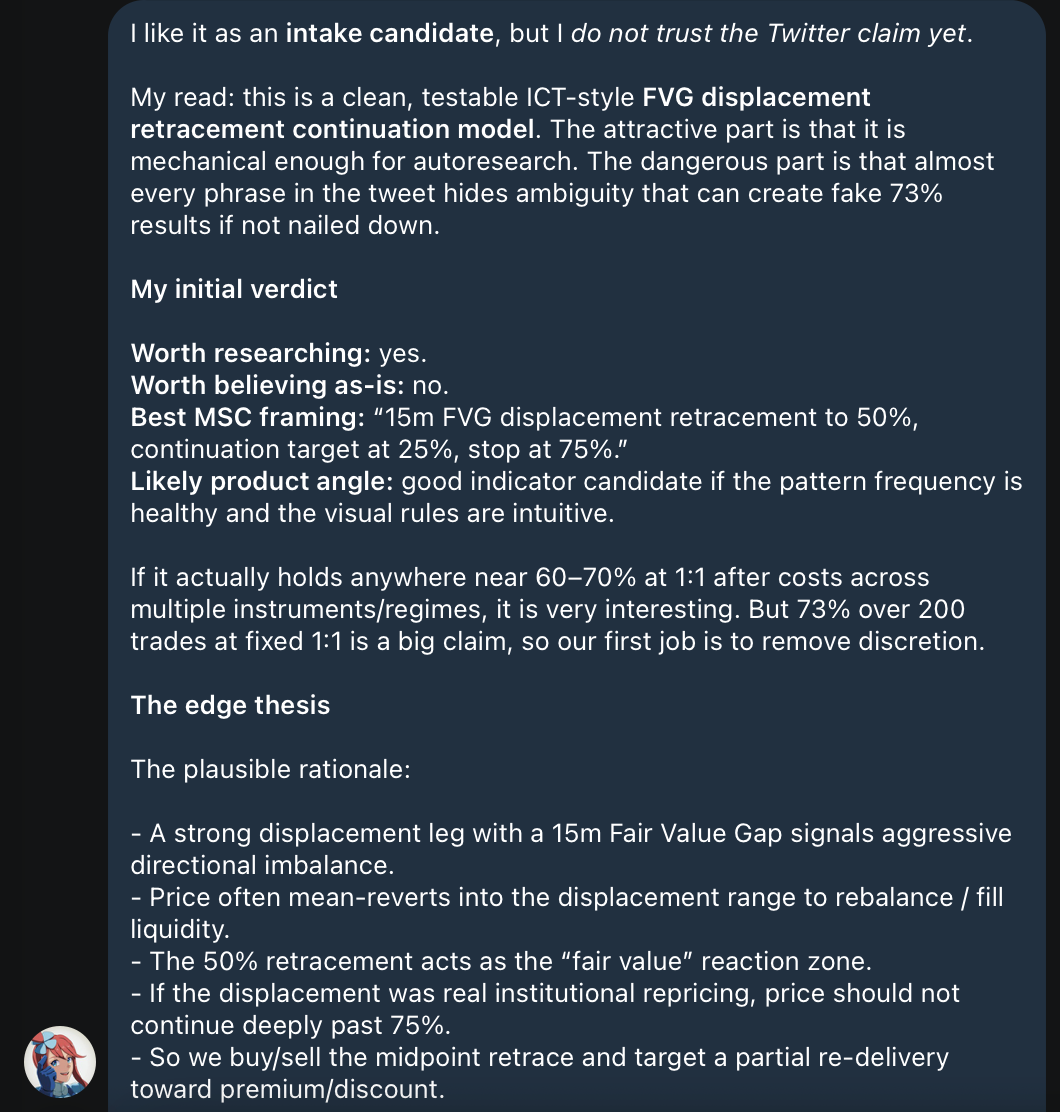
The fact is, most trading ideas should die quickly, and that isn’t a failure of the process but the entire point of it.
A good research process protects you from falling in love with a chart. It makes testing cheap, and it makes it easy to say “nope, this probably isn’t real.” When something does survive the first round, though, the system finally has a place to put it.
Mission Control
That place is Mission Control, our internal dashboard, and it’s one of the bigger pieces we improved this week.
Mission Control is becoming the cockpit for the research engine. It’s where ideas, test runs, results, and the evidence behind them start to show up in a form a human can actually inspect, rather than being buried in logs, scattered across random files, or dependent on somebody remembering what happened two days ago.
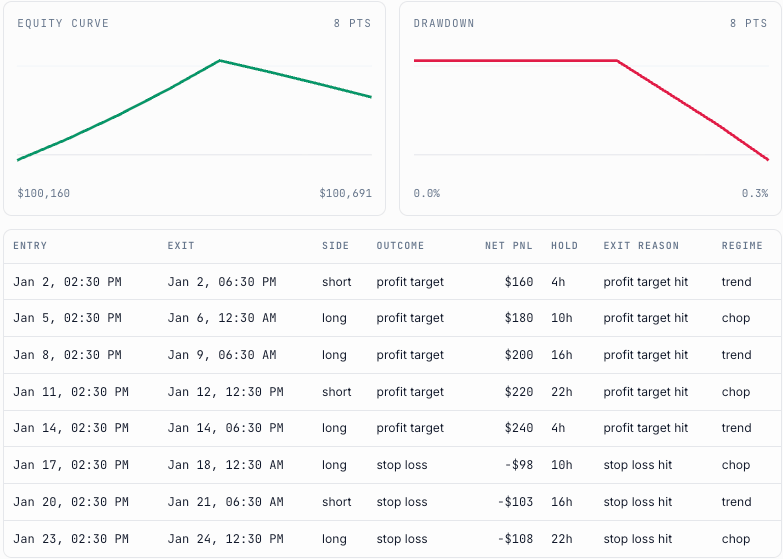
The screenshot above is a small example, but a meaningful one. It shows one trial we kept from an early research path. You can see which market it traded, how many long and short positions it took, and the numbers that actually matter: how much it made, how deep the worst losing stretch ran, how many trades it took, and whether the returns justified the risk. There’s also room for the charts that show the account climbing and the ones that show it bleeding.
This isn’t us saying we found the magic trade, so please don’t read it that way. What it shows is more important than any single result. The machine can now run a trial, keep the result, and present the evidence in a format a human can review. That’s the difference between playing with ideas and building a real research process.
Building the questions into the machine
One of the biggest challenges with AI-assisted trading work is trust. If an AI tells you “this strategy looks good,” that’s basically useless on its own.
Good according to what?
Tested where?
Over what period?
How many trades?
What happened when it was losing money?
Did it cheat?
Did it try so many variations that one was bound to look good by accident?
We’re trying to build the system so those questions aren’t optional, but baked into the workflow. The engine breaks research into stages. A rough idea first becomes a clear, testable setup, then passes basic sanity checks, then produces trial evidence, then faces tougher evaluation that helps separate real signal from lucky noise. If it fails, it gets killed cleanly.
If it survives, it carries its evidence forward.
That’s the part I’m most excited about. Not because any single test result is exciting on its own, but because the process is starting to compound.
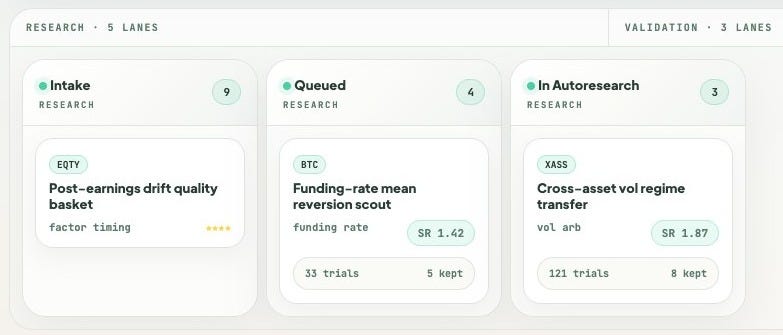
We also made progress on the autoresearch side, which lets the system move from one research step to the next without us babysitting every action. It can take a structured idea, run a bounded test, record what happened, and tee up the next decision. Bounded is the important word. We’re not building a runaway black box that fires off endless experiments and declares victory, so the system carries guardrails: limits on how many loops it can run, rules for when to stop, thresholds for what gets promoted or killed, and human approval wherever the work could have real consequences.
Here’s a sample of some trial runs our autoresearch agents were able to curate and display within Mission Control for review.
Finance doesn’t reward people for moving fast and breaking things.
It rewards people for being a little less wrong, over and over again.
Buffett Framework: “Risk comes from not knowing what you’re doing.”
The question that drives this whole build isn’t whether the engine can surface something that looks good, but whether we can tell a real edge from a lucky one before a single dollar is ever at stake.
Answers people can actually read
A research engine is only useful if people can understand what it found. If every result means digging through raw data or reading dense technical output, it’ll never become part of a real decision.
So we’ve been building toward a cleaner path.
A human has an idea.
Skyla helps shape it into a real research question.
The system runs the first pass.
Mission Control shows what happened.
The idea then dies, gets revised, or earns another round.
Eventually, if the evidence is strong enough, that work can become something more polished: a post, a chart pack, an indicator concept, or a strategy note a reader can actually follow.
The Art of the Possible
That’s the long game, and we’re not there yet. We’re still building the engine. The dashboard is improving but isn’t finished. The autoresearch loop works in an early form, though it still needs more wiring, more testing, more operator controls, and more real-world reps. We’re still learning what the system should automate and where a human should stay firmly in the loop.
The progress this week was real, though.
The system is no longer just a clever chat window bolted to a workstation. It’s starting to become an operating layer for research, one that can turn loose ideas into testable ones, run early trials, keep the evidence, and show results in a dashboard instead of leaving them in memory, vibes, or a folder full of screenshots. That might sound unglamorous, but it’s exactly the kind of plumbing serious research needs.
The fun part is imagining where this goes and thinking through the art of the possible.
As we keep building, we should be able to ask better questions faster, compare new ideas against old ones, and watch which families of strategies survive while others die, building a library of tested patterns instead of a graveyard of half-remembered experiments.
For readers, that means the research we share over time should get better too. More evidence behind the claims, cleaner explanations, and more transparency about what failed. More confidence that when we say something looks interesting, it’s been through more than a pretty chart and a good story.
That’s the part I keep coming back to. The engine isn’t meant to replace judgment, but to make it sharper. This week, we got a little closer.
Onward and upward fam! 📈
🛑 SIGN UP HERE BELOW TO BE PART OF WHAT WE’RE BUILDING! 🛑
I’m building the early cohort for when the Discord opens and the first indicators ship. If you want a seat, this is where to claim one.
Interested? Fill out the 30-second interest form here. 👈
This Week In 2 Mins

I Found a Way to Invest in the Robot Boom on the Nasdaq (June 2)
A reader flagged a new Nasdaq ticker, $BOT, and it turned out to be the first closed-end fund built to give regular investors a single-ticker stake in private humanoid robotics names like Figure AI and Apptronik.
It runs the same premium-to-NAV engine MicroStrategy used for Bitcoin, which is both what makes it interesting and where the risk hides. The catch is that its NAV is a quarterly estimate of private companies, so the price can drift far from any value you can actually verify, and the loop that funds the buying can run in reverse just as easily as forward.
I’m not a buyer here yet, but I built a monitor to track the premium or discount, because that gap, not the robots, is the real story.

Saylor Finally Sold. Here’s the Part Nobody’s Pricing In. (June 4)
Bitcoin for the first time in four years this week, though it was only 32 coins, about $2.5 million, to cover a payment it had promised investors.
The number itself is noise, but what it hinted at isn't: the product the company uses to raise money slipped below the $100 level it needs to keep issuing, its cash cushion is down to roughly six months against about $1.7 billion a year in promised payments, and Bitcoin now trades below the company's average cost. None of that forces anything today, yet for the first time we watched the machine run in reverse instead of forward.
The point I keep shouting is that Saylor isn't Bitcoin and Bitcoin doesn't need Saylor, so the real risk worth watching is that its biggest holder turns out to be its most fragile one.
This Week’s Winners…🏆
Marvell (MRVL). Nvidia's Jensen Huang called it the next trillion-dollar company on Tuesday, and the stock soared more than 25% in a session to a fresh all-time high, helped by a $2 billion Nvidia investment and a spot in the S&P 500 starting June 22. It gave some back in Friday's chip rout, but it was still the week's headline name, now up more than 130% on the year.
The US labor market. May payrolls came in at 172,000 against expectations of around 88,000, with unemployment holding at 4.3%. A genuinely strong report, even though Wall Street treated it like bad news (more on that below).
And Losers 📉
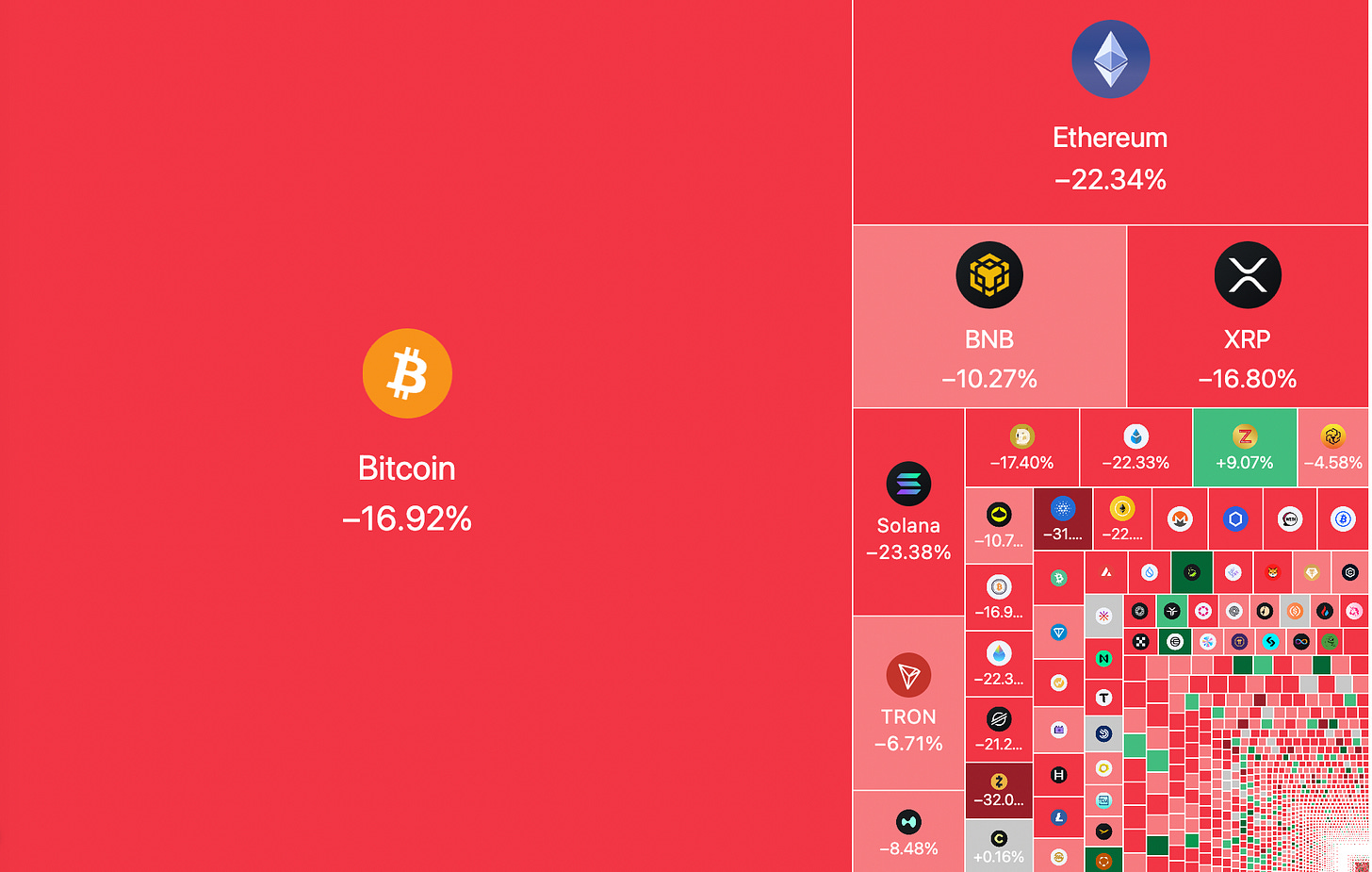
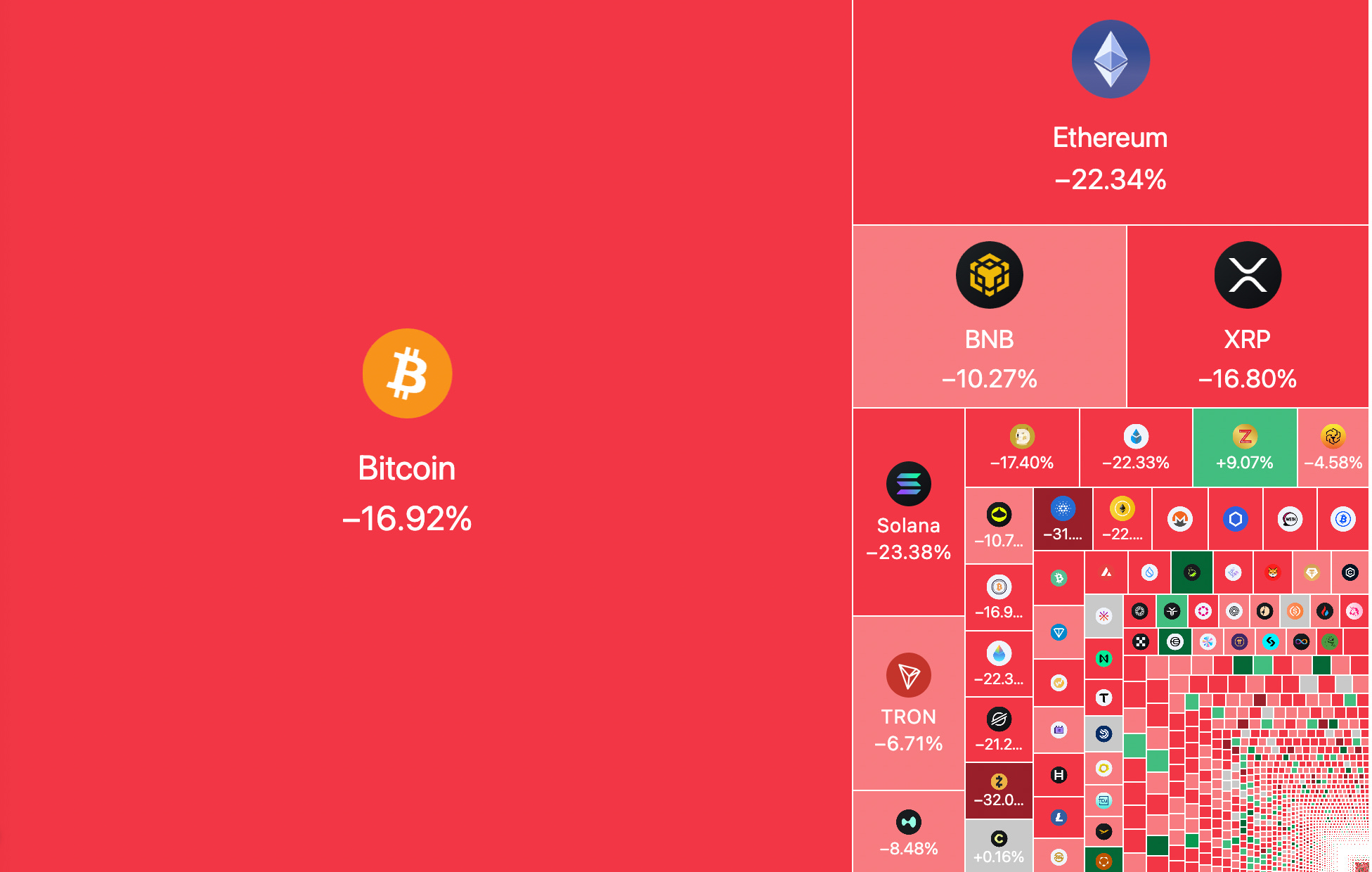
Bitcoin and the broader crypto market. Bitcoin slipped under $62,000, roughly 51% below its October high near $126,200, with about $1.5 billion in leveraged longs wiped out and a record streak of spot Bitcoin ETF outflows. Saylor's 32-coin sale didn't start the slide, but it didn't help the mood either. Here’s the one week look…
Chip stocks and the AI trade. The group that led the rally led the retreat. Friday's selloff knocked the Nasdaq down 4.18% to 25,709.43, its biggest drop since April 2025, with Nvidia off 6% and the chipmaker gauge down 10%. Broadcom fell about 14% after earnings despite revenue topping $22 billion. The S&P dropped 2.64% and the Dow lost 695 points, and the S&P's run of weekly gains snapped at nine, so close to everyone had a rough Friday.
Anyone hoping for a rate cut. That strong jobs report pushed traders to start pricing in a Fed rate hike this year rather than a cut, and Treasury yields jumped with them.
What’s On Deck the Week of June 8th
May CPI, Wednesday June 10 at 8:30am ET. The inflation print everyone’s waiting on, made louder by Friday’s hot jobs number. PPI follows Thursday the 11th, and both land with the June 17 Fed meeting one week out, which makes them matter more than usual.
SpaceX IPO, reportedly around June 12. Reports saying the company is targeting $75 billion raised at $135 per share. Investor demand reportedly is already about 2x oversubscribed, with roughly $150 billion of demand against the planned raise, though allocations can still change. It will be the largest IPO in history.
I’ll be at Wealth Management EDGE in Boca Raton, June 9 to 11. If you’ll be there, or anywhere in South Florida that week, reply and let me know. Would love to connect in person.
Matthew Snider is the founder of Block3 Strategy Group, author of “Warren Buffett in a Web3 World,” and publisher of the BitFinance newsletter. He holds a Series 65 and MBA, and has been an active participant in digital asset markets since 2015. This article is for educational purposes only and should not be considered financial advice. Always consult with a qualified professional before making investment decisions.