I Ran Buffett's Math on What XRP Is Worth
In his 2011 letter to Berkshire shareholders, Warren Buffett sorted every investment on earth into 3 buckets.
Things denominated in currency (think treasury bonds)
Things that produce something, like farms and businesses.
Things that produce nothing but that you hope someone pays more for later.
In his mind, the bucket matters more than the asset.
Before you argue about any price, you have to decide which bucket you’re standing in, because each one is valued with different math. Most crypto arguments go nowhere for exactly this reason. One person is doing bucket-two math on a bucket-three asset, and the other person is doing no math at all.
So today I want to hand you the method, walk it once, and then run it on XRP, which I know plenty of you hold. The point isn’t to dunk on anyone’s bag. The point is that once you see how the method works, you can run it on anything, and you’ll know what kind of claim you’re holding.
The Method in 4 Steps
Step one: pick the bucket. Does holding the asset entitle you to cash flows? A share of Coca-Cola does. A bar of gold doesn’t. Holding XRP entitles you to nothing; the small fees paid on the XRP Ledger are burned, destroyed, rather than paid out to holders. XRP lives in bucket two, next to gold, and that’s a classification rather than an insult.
Step two: capitalize the toll booth. Even a non-productive asset can have a business humming next to it. The XRPL burns a small amount of XRP with every transaction, which works like a tiny buyback for all holders. Add up a year of burn, put a generous multiple on it, and you get $40 to $60 million of value. Against a $71 billion market cap, that’s a rounding error, well under a penny per token.
Step three: size the utility float. Here’s the working-capital question. If XRP is a bridge currency for payments, how much XRP does the world need to hold at any moment to run the pipes? Ripple’s payment product settles in seconds, but let’s be generous and assume every token in flight sits for a full day. Against roughly $35 billion in annual payment volume, the network needs $1 to $2 billion of XRP as float. Spread across 62 billion circulating tokens, that’s 2 to 4 cents each.
Step four: name the remainder. Price, minus toll booth, minus float. For XRP at $1.14, the remainder is about $1.11. Call it what it is: monetary premium. The market’s bet that XRP will be treated as money.
The Results?
Three cents of machinery. (~$0.03)
A dollar and eleven cents of belief. (~$1.11)
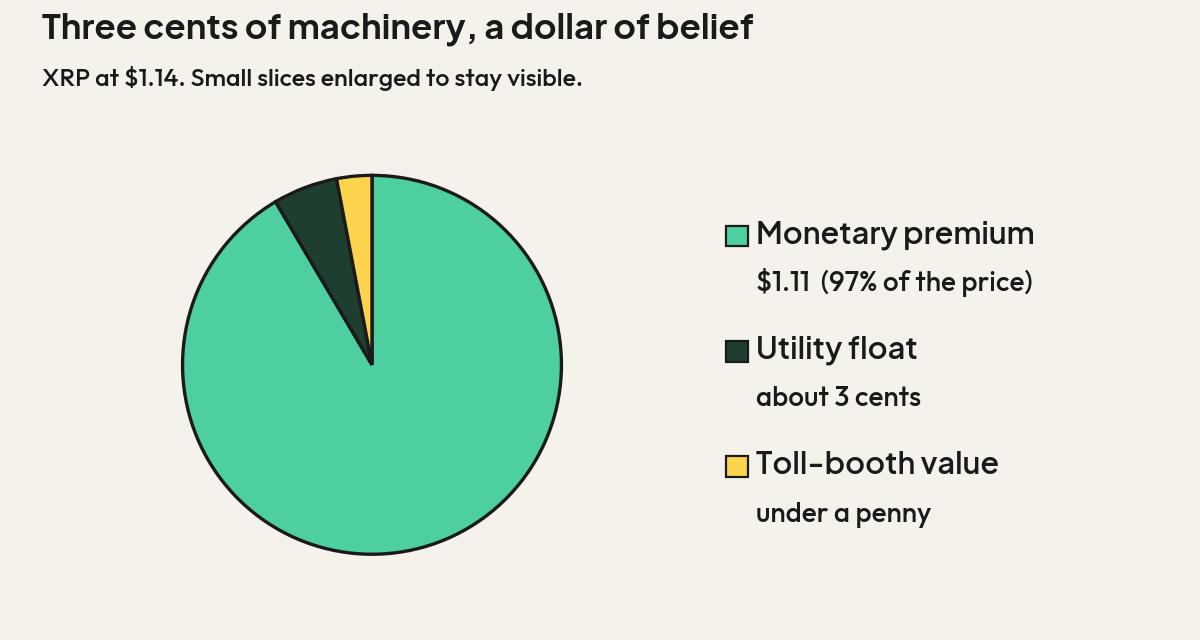
XRP’s $1.14 price decomposed. The utility and toll-booth slices are enlarged to stay visible; their true shares are 2.6% and under half a percent.
Sources: CoinMarketCap, XRPL data, author’s calculations.
Before you close the tab in anger, look at the stock market…
A 97% premium sounds damning until you price a few things your neighbors own.
Palantir trades near 150x its trailing earnings. If you’d only pay a normal market multiple of 15x for the profits it earns today, current earnings support about 10% of the price. The other 90% is premium, a bet on profits that don’t exist yet.
Tesla is more extreme. At more than 300x trailing earnings, the same anchor says current profits support about 5% of the price. A position that is 95% premium sits inside millions of retirement accounts, and nobody blinks.
Gold trades at $4,100 an ounce while industry and dentistry account for roughly 10% of annual demand. The rest of the price is 5,000 years of agreement that gold is money. Nobody calls gold a scam. They call it a store of value, which is what a monetary premium looks like after it survives long enough.
Strategy, the company I’ve covered all summer, traded at 3.4x the value of the Bitcoin it held in late 2024. This year that premium collapsed below 1.0. We watched a premium get repriced in real time.
At the far end sit Bitcoin and Dogecoin, effectively 100% premium.
Bitcoin wears it openly, the way gold does. Nobody buys Bitcoin for a toll booth, because the premium is the product. Dogecoin shows that a monetary premium doesn’t even need a story, just coordination that hasn’t broken yet.
So technically for the sake of argument here, XRP has more technical utility than Bitcoin. Sure, Bitcoin has it’s technical features, but the moat lies in the network effect, not necessarily the engine under the hood. That engine can be replicated (see Dogecoin), but Bitcoin’s value is derived SOLELY from the perspective that the majority of people think it’s a store of value; exactly the same with gold.
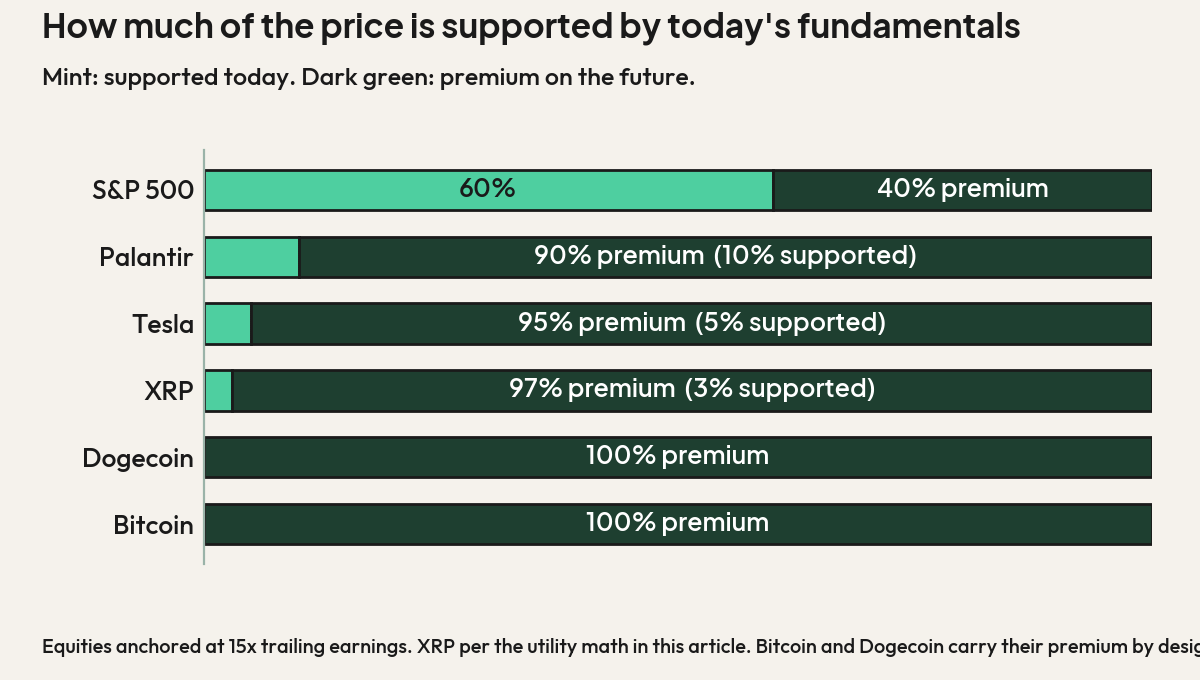
Share of price supported by current fundamentals, with the remainder as premium. Sources: StockAnalysis, GuruFocus, author’s calculations.
Premiums aren’t scams. A premium is a claim.
The entire question, for anything you own, is what kind of claim you’re holding, because the kinds fail differently.
A growth premium, the Palantir kind, is a claim on future cash flows. It’s aggressive, but it can be retired. If earnings triple, the multiple shrinks under you and the premium converts into value. It dies on earnings misses.
A monetary premium, the XRP kind, is a claim on future agreement. No cash flow ever arrives to retire it. It has to be re-earned every single day, by everyone continuing to agree. It dies on coordination breaks, and it can also outlive every company on this page, as gold has.
What the Claim Requires
Here’s the scale of the agreement embedded in $1.14.
For utility alone to justify the price, XRP’s float math has to grow into the full $71 billion. Even with our generous full-day holding assumption, that implies roughly $26 trillion in annual settled volume, about a fifth of every cross-border payment made on earth, flowing through one bridge asset.
That’s the bet.
Not a crazy bet, and one that some patient, informed people are making with open eyes. It’s a monetary bet, though, not a business bet, and it deserves to be sized in your portfolio the way you’d size a currency position rather than a stock.
Buffett Framework Question
Would you rather own pile A or pile B?
Pile A is every XRP token in circulation, $71 billion worth, producing nothing while you wait for the agreement to strengthen.
Pile B is $71 billion of businesses earning three to four billion dollars a year, every year, in cash, regardless of what anyone agrees about anything.
Buffett ran this exact exercise on gold in his 2011 letter and chose pile B without blinking. Gold has done fine since, which is the part worth sitting with: the framework tells you what you’re holding, and the market decides what it’s worth.
Full disclosure, I hold BOTH Bitcoin and XRP.
This Week In 2 Minutes

An 89-Year-Old Asset Manager Just Launched the First Actively Managed Crypto ETF (July 21)
T. Rowe Price launched TKNZ, the first actively managed multi-token crypto ETF, and it opened with roughly $15 million in assets and a portfolio that reads like a live thesis.
Human managers set the weights by conviction rather than market cap: Bitcoin sits underweight at 40.75% against a 60%-plus share of the market, XRP runs about 9.37%, near three times its share, and Hyperliquid carries close to ten times its weight in the index. The fee is 0.75% waived through May 2027, then 0.90%, against passive baskets charging 0.19% to 0.59%.
With only a few trading days of history at publication, any verdict on the strategy is premature, which is the point of watching it in the open.

Saylor Stopped Buying Bitcoin (July 23)
After four years of buying Bitcoin with nearly every capital dollar it raised, Michael Saylor’s Strategy halted purchases in late June when market stress forced a choice between its public commitments and its own survival. The company holds 843,775 Bitcoin, close to 4% of every coin that will ever exist, bought at a $63.7 billion cost and an average of $75,476 each, now worth about $54.7 billion near $64,000 a coin for a paper loss around $9 billion. In early July it sold 3,588 coins at an average of $60,773, locking in roughly 20% losses, tripled its dollar reserve to $3.225 billion, and watched MSTR fall 38.6% year to date. The framing is a reverse float, a mirror of Berkshire’s model, where Strategy must pay dividends monthly while its Bitcoin produces no cash as it sits.
The warning is blunt: the largest corporate holder on the planet showed that its coins are collateral now, and collateral gets sold when the lender needs the money. Corporate Bitcoin holdings are contingent assets rather than permanent reserves, and that recognition reprices every leveraged Bitcoin-treasury company against the same precedent.
Market Winners 🏆
Defense: Lockheed Martin (LMT) and RTX (RTX). Both climbed on Q2 beats and raised full-year forecasts, with Lockheed up around 10% and RTX up more than 7% on the week. Lockheed posted $20.1 billion in sales, up 11%, and lifted 2026 revenue guidance toward $79.75 billion to $81.75 billion; RTX reported $24.7 billion in revenue, up 14%, raised adjusted sales guidance to $95 billion to $96 billion, and disclosed a record $289 billion backlog as the Pentagon and its allies restock missiles depleted by Ukraine and the Middle East. Defense is one of the few groups where the order book is expanding for reasons that have nothing to do with the AI-capex debate now whipsawing tech, which is exactly why it held up in a down week.
Crude Oil. Oil rallied more than 15% for the week as renewed US-Iran hostilities disrupted tanker traffic through the Persian Gulf and the Red Sea, before the global benchmark fell about 4% on Friday alone to settle near $97 on reports of stalled peace talks. Energy shares benefited, but the larger consequence is what a fresh oil shock does to inflation just days before the Fed meets. When crude jumps 15% in a week, the disinflation story that markets were counting on gets a lot harder to tell.
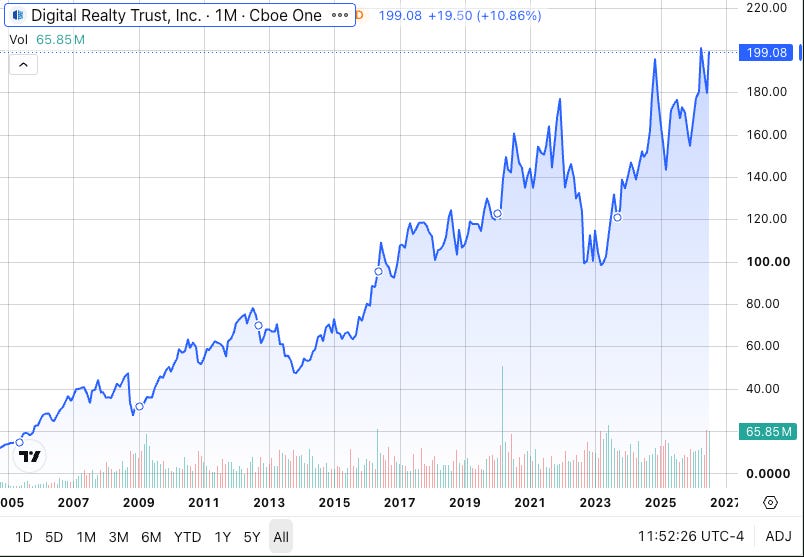
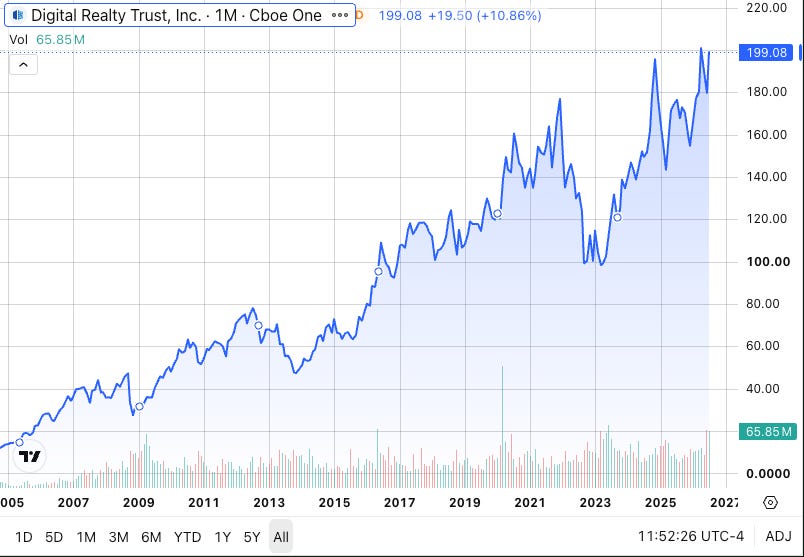
Digital Realty (DLR). The data-center REIT jumped to a record close near $204 from a $190 open, roughly a 7% single-session gain, after a Q2 beat and a raised full-year outlook. Core FFO hit a record $2.13, revenue came in at $1.92 billion against a $1.67 billion estimate, renewal leases repriced more than 25% higher, and the backlog reached $1.9 billion in annualized base rent. It rose the same week memory chips cratered, which tells you investors still want AI-infrastructure exposure but are rotating toward the parts with contracted, recurring cash flows rather than commodity silicon.
Market Losers 📉
Memory and Semiconductor Stocks. The Philadelphia Semiconductor Index dropped more than 4% on Friday, led by memory names: SanDisk fell nearly 11%, SK Hynix more than 8%, and Micron and Western Digital over 6% each. The trigger was Alphabet lifting its 2026 capital-expenditure guidance to $195 billion to $205 billion from $180 billion to $190 billion, which flipped sentiment from fear of missing the AI build-out to fear of overspending on it. Memory has been the market’s best-performing corner this year, with SanDisk up several hundred percent, so a sentiment break there tests the foundation of the entire AI trade.
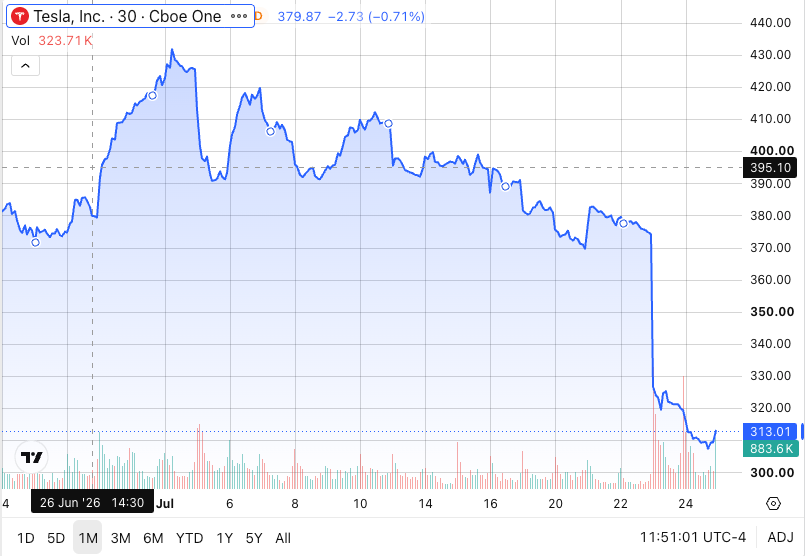
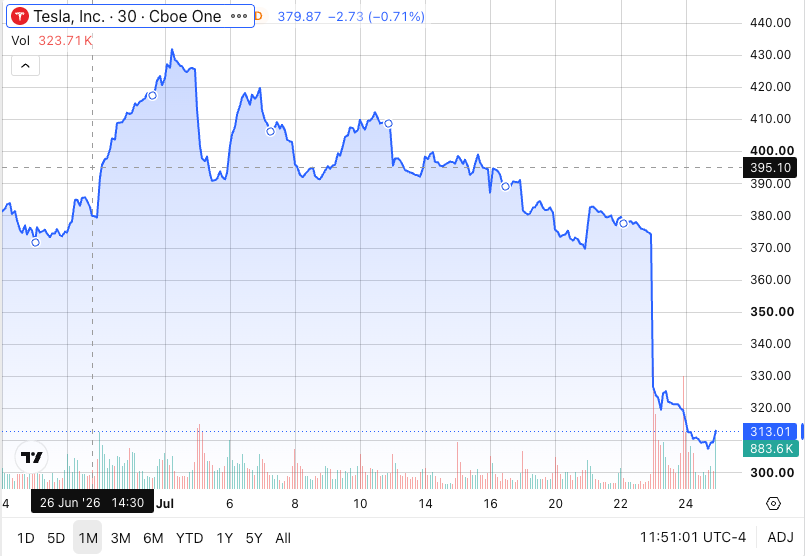
Tesla (TSLA). Shares fell about 14% after earnings, the steepest drop among the week’s big reporters, as investors balked at heavy spending on the company’s asset-heavy AI ambitions. Strong quarterly numbers weren’t enough to offset the capex line. It is the clearest example of the market’s new rule this quarter, where good results no longer buy a pass on rising spending.
Alphabet (GOOGL). The stock dropped roughly 7% after earnings despite solid Q2 results, punished for the same capex guidance that set off the memory-chip selloff. When the company underwriting a large share of the AI build-out gets marked down for underwriting it, the read-through lands on every hyperscaler reporting next week, which is why this move mattered well beyond one ticker.
Gold. Gold posted its second straight weekly decline, pulling back below $4,100 an ounce even as the Middle East conflict widened, because rising oil, renewed inflation worries, and Fed uncertainty pushed rate expectations higher. The safe haven that usually rallies on war headlines stalled instead, a reminder that real-rate expectations, rather than fear alone, set the price of gold.
What to Watch Next Week 👀
The Fed Decision (Wednesday, July 29, 2 p.m. ET). The July 28-29 meeting delivers a policy statement and a Chair Warsh press conference at 2:30 p.m., but no fresh multi-year projections. Economists expect a fifth straight hold at 3.5% to 3.75%, yet markets now price roughly a one-in-three chance of a hike after Warsh’s “prices are too high” message and this week’s 15% jump in oil. With nine committee members penciling in at least one hike before year-end and none projecting a cut, the risk skews hawkish, and how Warsh weighs the oil shock against cooling headline inflation is the pivot for both rates and risk appetite.
Big Tech Earnings: Microsoft, Meta, Amazon, and Apple (Wednesday-Thursday, July 29-30). Three hyperscalers report back-to-back, with Apple after Thursday’s close expected to post EPS up 20.4% to $1.89 on $108.89 billion in revenue, a 15.8% annual gain. After Alphabet and Tesla were punished for their spending, the question is whether Microsoft, Meta, and Amazon draw the same reaction or manage to show their AI capex is already paying its way. These four reports will settle whether the tech selloff was a wobble or a turn.
PayPal Q2 Earnings (Tuesday, July 28). PayPal reports with a roughly $53 billion takeover bid from Stripe and Advent International hanging over it, an offer of $60.50 a share, about 28% above the prior close, that the board reportedly considers too low. The print is management’s chance to argue the company and its stablecoin ambitions are worth more than the bid on the table, which makes it the most consequential fintech report of the week for anyone tracking where payments and crypto rails converge.
Matthew Snider is the founder of Block3 Strategy Group, author of “Warren Buffett in a Web3 World,” and publisher of the BitFinance newsletter. He holds a Series 65 and MBA, and has been an active participant in digital asset markets since 2015. This article is for educational purposes only and should not be considered financial advice. Always consult with a qualified professional before making investment decisions.
Sources
Warren Buffett, Berkshire Hathaway Shareholder Letter, 2011.
Palantir Technologies statistics and valuation. StockAnalysis.com.
Yahoo Finance: Stock market today: Nasdaq slips, Dow and S&P 500 recover to close a volatile week on Wall Street
The Motley Fool: Stock Market Today, July 24: Dow Recovers and Sandisk Tumbles 11% as Tech Stocks Fall Further
24/7 Wall St.: SK Hynix and Micron Sink 6%, SanDisk Drops 9% as Korea Chip Selloff Hits U.S. Memory Stocks
The Motley Fool: Stock Market Today, July 22: Nasdaq Slides Prior to Tesla and Alphabet’s Earnings After Market Close
Reuters via Investing.com: Lockheed Martin, RTX lift 2026 forecasts as Pentagon looks to restock weapons
BigGo Finance: Digital Realty Posts Record $2.13 Core FFO, Raises 2026 Outlook on 25%+ Renewal Spreads
Investing.com: Earnings call transcript: SLB tops Q2 2026 estimates as shares jump 9.6%
HDFC Sky: Gold, Crude Diverge as Iran Tensions Rise; Oil Jumps 15% Weekly
Yahoo Finance: Gold prices today, Friday, July 24, 2026
CBS News: Will the Federal Reserve raise interest rates? Here is what experts predict for July’s meeting