A Church With a Casino: Buffett's Market Warning

I watched the Berkshire Hathaway annual meeting wind down this weekend with that strange feeling you get when something big is ending without quite admitting it. Greg Abel was on stage. Buffett was in the front row. The arena was about two-thirds full.
Seriously.
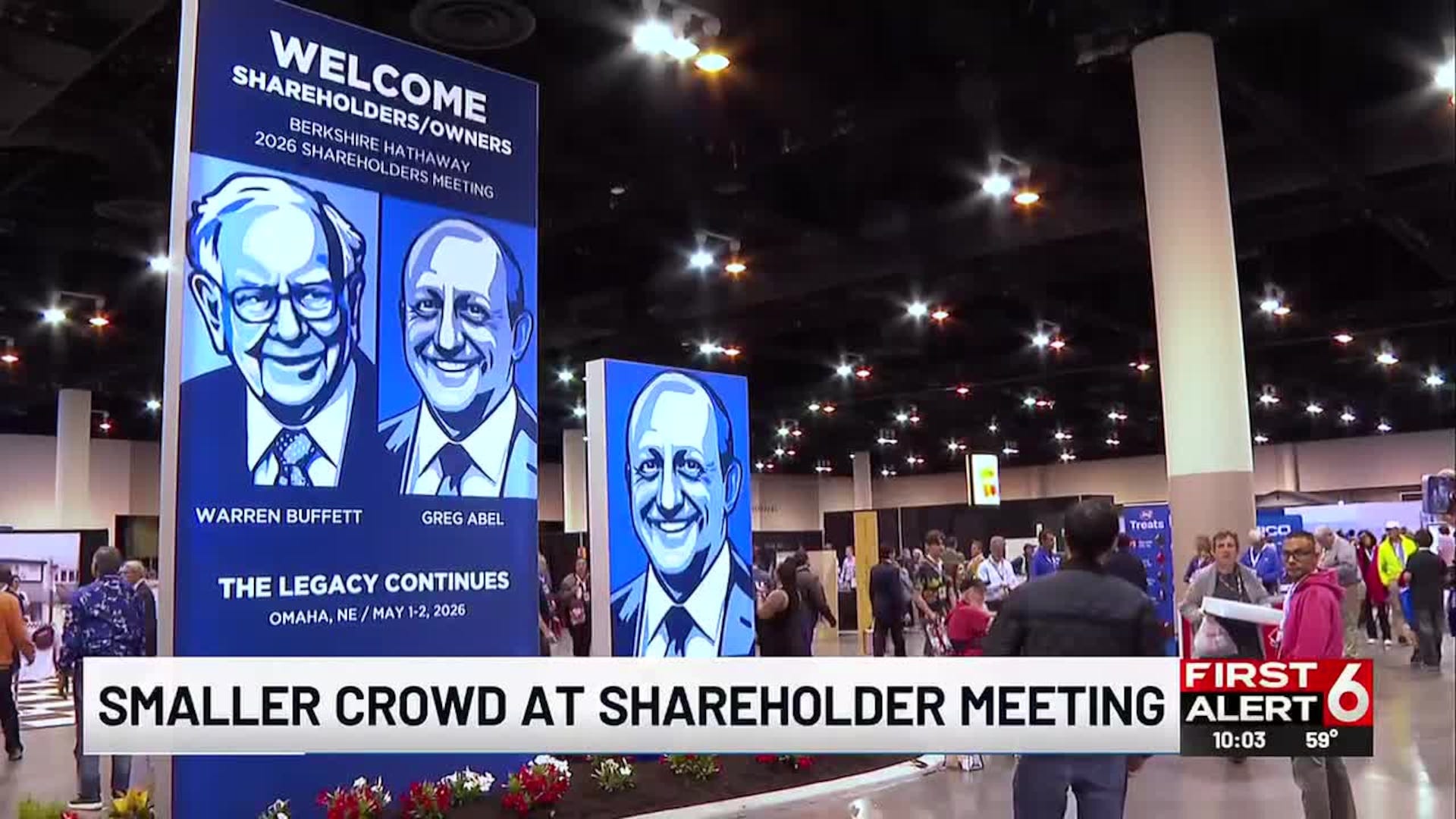
Reuters counted roughly 12,000 of the 18,000 seats occupied, down from the 40,000-plus that Buffett used to draw. See’s Candies had hundreds of unsold boxes of Berkshire-branded chocolates by the time the registers closed Saturday evening. Dairy Queen had leftover ice cream bars. Fechheimer had a rack of Andy Warhol-style Buffett-and-Abel T-shirts that nobody bought.
The whole weekend had this gentle, transitional quality to it.
Greg Abel as a Squishmallow.
Greg Abel on the windshield of a Pilot semitruck, in the driver’s seat now.
A See’s Candies commemorative tin with Abel playing hockey while Warren and Mrs. See watched in matching gear.
You could feel the franchise trying very hard to make the new guy stick, and you could also feel that nobody outside the value-investing diehards quite knows who Greg Abel is yet. He’s good. He’s smart. He’s been at Berkshire for 25 years.
He’s also not Warren Buffett, and you can’t merch your way around that.
The actual show, though, was excellent. Buffett did a 25-minute interview with Becky Quick during the lunch break that I’d recommend to anyone.
The line that’s been echoing in my head all weekend was this one:
He compared markets to a church with a casino attached, and said that while there are still more people in the church than the casino, the casino has gotten very attractive.
Then he added, plainly:
“We’ve never had people in a more gambling mood than now.”
Warren Buffett, Berkshire Hathaway Annual Meeting, May 2, 2026
Saturday afternoon, that was a rhetorical flourish from a 95-year-old at a quieter-than-usual annual meeting.
Monday morning, it was the entire market.
The Casino Opens Early
GameStop CEO Ryan Cohen went on Squawk Box at the open with an unsolicited, hostile, $55.5 billion offer for eBay. Half cash, half stock, a $20 billion financing letter from TD, and no prior conversation with eBay’s board. GameStop’s market cap on Monday morning sat around $11 billion. The offer is roughly five times the size of the acquirer.
Andrew Ross Sorkin asked the obvious question, which is how the math works. Cohen’s answer should be required viewing for anyone who still thinks the meme stock era is over. He said the deal is half cash, half stock, that there’s a $20 billion financing letter from TD, that the company has the ability to issue stock to get the deal done. When pressed for any further detail, his actual answer was: “the details are on our website.”
I’d embed the full clip here if email allowed me to, and you should watch it on Substack where I can. I’m not exaggerating when I say it’s one of the craziest CEO interviews I’ve seen on CNBC in years. Top five, easy. Cohen looked annoyed that anyone was asking him to explain how a company worth eleven billion dollars plans to buy one worth fifty-five.
(the first 2 mins are DEFINITELY worth a watch)👇🏻
Here’s the structural problem.
If you split the offer in half, that’s roughly $27.75 billion in cash and $27.75 billion in stock. The TD financing letter covers $20 billion of the cash, which leaves about $8 billion still to find. The stock half is the bigger issue.
Issuing $27.75 billion of GameStop equity against an $11 billion market cap is a roughly 2.5x dilution event before you even get to the missing cash.
Add the gap in financing and you’re looking at something closer to a 3x to 4x dilution to clear the deal. Cohen’s hand-wave about the combined company being “more efficient” doesn’t fix that. There’s no version of this transaction where existing GameStop shareholders are not catastrophically diluted.
GameStop traded down roughly 10 percent on the news. EBay traded up around 6 percent. The market did the math even if Cohen wouldn’t.
Burry Walks Out
The most interesting part of the story isn’t Cohen, it’s Michael Burry.
Burry took a position in GameStop in January, after years of skepticism, on the bet that Cohen was finally serious about turning the company into a real cash-flow business.
On Monday, he posted to Substack that he wouldn’t be holding the position past the week.
By the afternoon, the Wall Street Journal reported he’d already exited entirely. His public reasoning was simple: he supports Cohen’s vision, but the price is too high and there are better targets if you genuinely want to compete with Amazon.
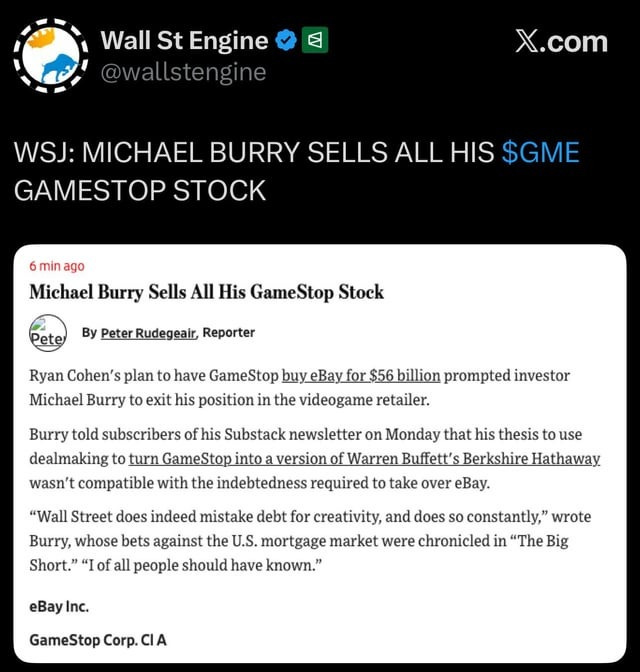
Burry isn’t a meme trader.
He’s a value investor who briefly tried to underwrite a thesis that Cohen had become a value-creating capital allocator.
The eBay bid invalidated that thesis in a single weekend. When the data changes, the value investor leaves the position. That’s the whole job.
If you’re building a Buffett-style framework for evaluating management, the lesson here writes itself. You can be patient with a CEO who is patient with capital. You cannot be patient with a CEO who tries to use his stock as currency to acquire a business five times his size and then refuses to walk through the math on television. Those are two different people, and Burry recognized which one he was actually invested in.
The Church Opens Quietly
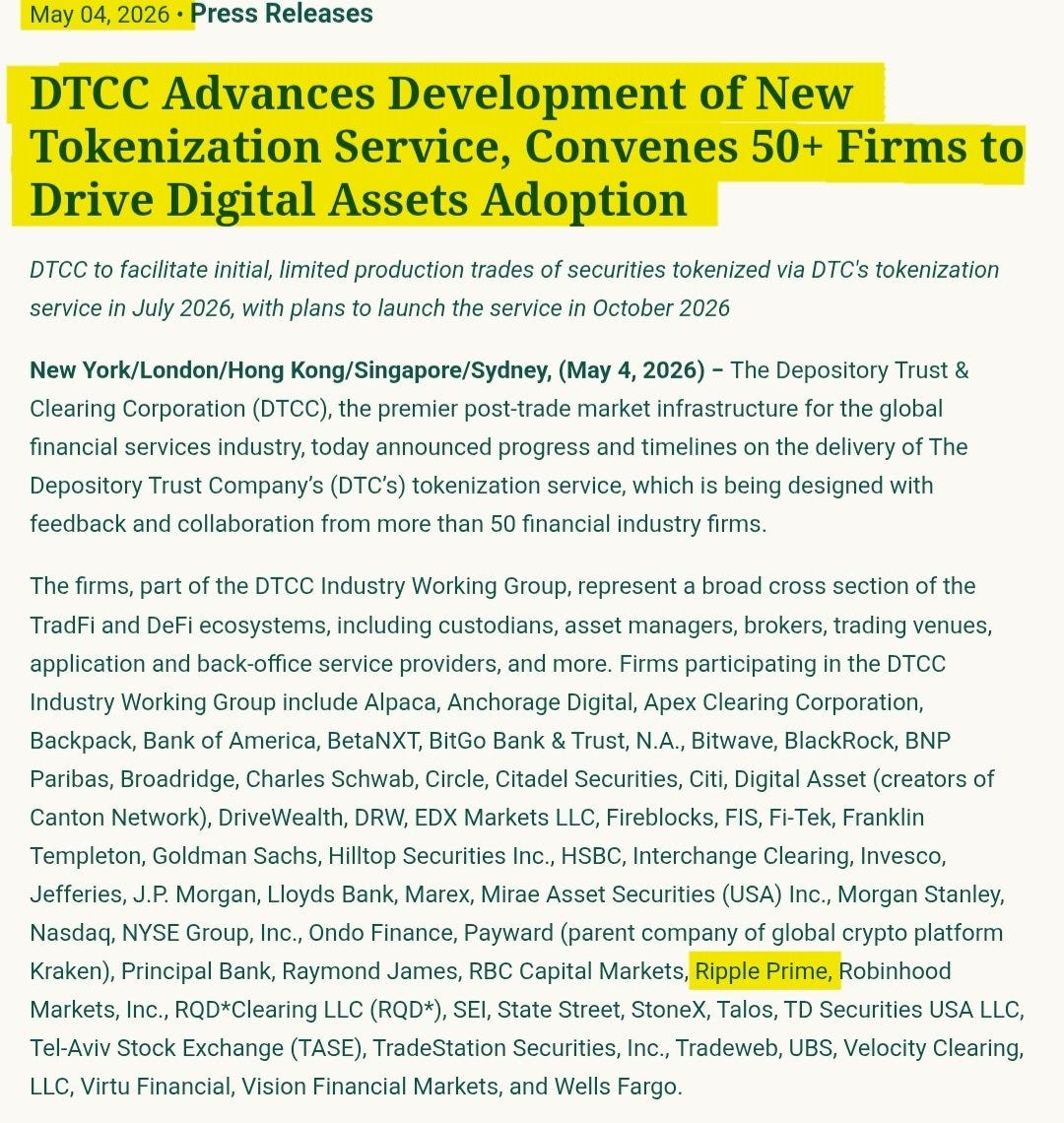
While Cohen was on CNBC and Burry was drafting his exit note, the Depository Trust & Clearing Corporation put out the dullest press release of the day.
DTCC announced that it has now convened more than 50 financial firms in a working group to deliver its tokenization service, with limited production trades targeted for July 2026 and a full launch in October. The service will tokenize Russell 1000 constituents, ETFs tracking major indices, and U.S. Treasury bills, bonds, and notes. It runs on top of the No-Action Letter the SEC granted DTC in December 2025, which authorized the program for three years.
DTC currently custodies real-world assets valued at over $114 trillion.
I want you to sit with that number for a moment.
One hundred fourteen trillion dollars.
$114,000,000,000,000
The post-trade utility that clears and settles essentially every U.S. equity, bond, and Treasury you’ve ever owned has just confirmed timelines to put a meaningful slice of that on-chain inside the next six months, with the largest custodians, asset managers, and brokers in the industry as design partners.
There was no CNBC interview, no CEO standoff, no meme. Just a press release that quietly said the rails are getting rebuilt, the regulators have signed off, and the launch is on a calendar.
This is what the church looks like when it’s actually working. It’s genuinely, profoundly boring, and the boredom is the point.
What the Two Stories Tell Us
If you stack the two announcements next to each other, you get a clean picture of where capital is moving and where attention is moving, and the gap between the two has rarely been wider.
The casino had every camera in the building on Monday. Cohen, Burry, the financing letter, the awkward dodges, the meme stock energy that never fully went away. There’s a reason the GameStop story will get fifty times the social media engagement that DTCC will. Drama travels faster than plumbing.
The church had 50 firms, $114 trillion in custody, a regulatory pathway, and a launch date. No drama at all. You will not see Brian Steele or Nadine Chakar trending on X this week.
A few honest observations about how I’m thinking about portfolio construction in light of all this.
First, the structural incentive in retail markets right now is to be loud. Cohen knows that an eleven-billion-dollar company doesn’t get to bid on a fifty-five-billion-dollar company without a Squawk Box appearance to manufacture the social proof. The casino rewards spectacle. None of that changes the underlying math.
Second, the structural incentive in institutional markets is the opposite. DTCC doesn’t need anyone’s attention. They need the No-Action Letter, the working group, and the operational readiness checklist. The church rewards process. The fact that retail rarely notices a $114 trillion plumbing upgrade is a feature of how serious infrastructure gets built, not a bug in the announcement.
Third, Burry’s exit is the single best case study I’ve seen in months for what it actually looks like to be a disciplined value investor in a casino-heavy market. He took the swing. He got new information. He left. No regret, no defense of the original thesis, no waiting around for sunk-cost validation. That’s the discipline. It isn’t flashy, but it also isn’t optional.
Buffett’s line on Saturday wasn’t a complaint but a description. The casino is genuinely attractive right now. People are genuinely in a more gambling mood than they’ve ever been.
The job, if you take Buffett seriously, isn’t to pretend the casino doesn’t exist, but to know which side of the building you’re standing on and to be honest with yourself about why.
I’m watching the church side this week.
🛑 REMINDER 🛑
Quick reminder of what we’re building. Live indicators. The research behind them. The methodology taught alongside the signal. A small room where you leave knowing how the work actually gets done
I’m building the early cohort for when the Discord opens and the first indicators ship. If you want a seat, this is where to claim one.
Interested? Fill out the 30-second interest form here. 👈
Matthew Snider is the founder of Block3 Strategy Group, author of “Warren Buffett in a Web3 World,” and publisher of the BitFinance newsletter. He holds a Series 65 and MBA, and has been an active participant in digital asset markets since 2015. This article is for educational purposes only and should not be considered financial advice. Always consult with a qualified professional before making investment decisions.