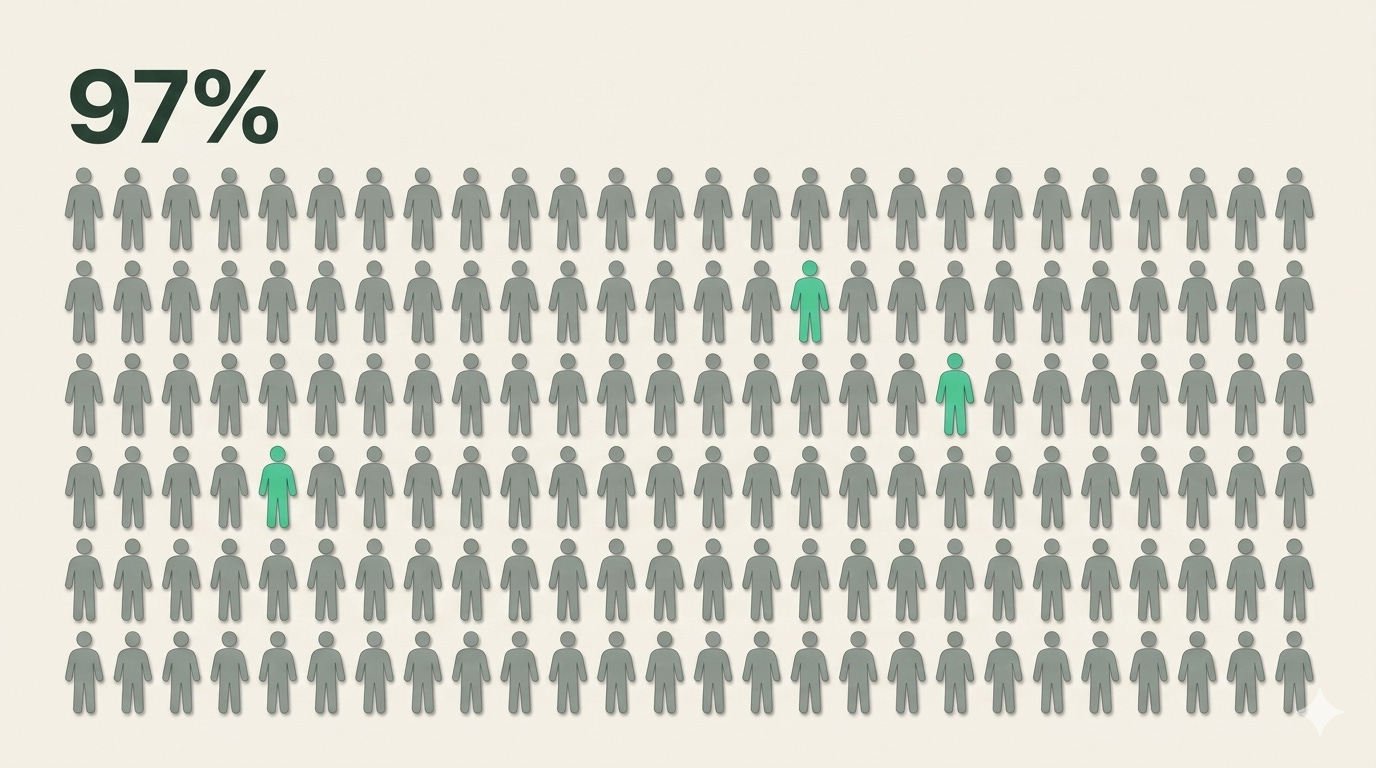
97% of Day Traders Lose Money and The SEC Just Invited More of Them In.
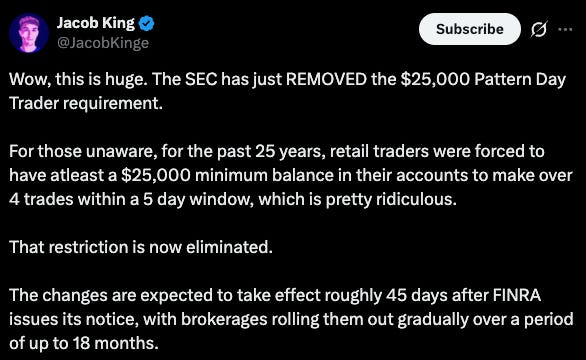
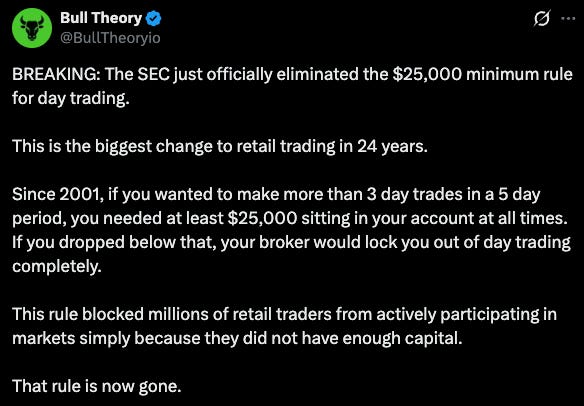
On April 14, 2026, the SEC issued an order granting accelerated approval to FINRA’s proposed rule change, formally eliminating the Pattern Day Trader designation and the $25,000 minimum equity requirement that had governed retail day trading since 2001.
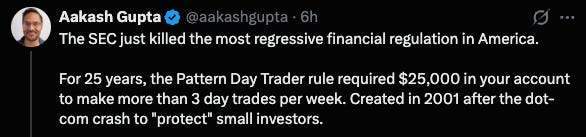
For 24 years, if you wanted to make more than three day trades in a five-day window, you needed at least $25,000 sitting in your brokerage account. Drop below that number, even by a dollar, and your broker locked you out. The rule blocked millions of retail traders from active participation in markets based on a single, arbitrary threshold.
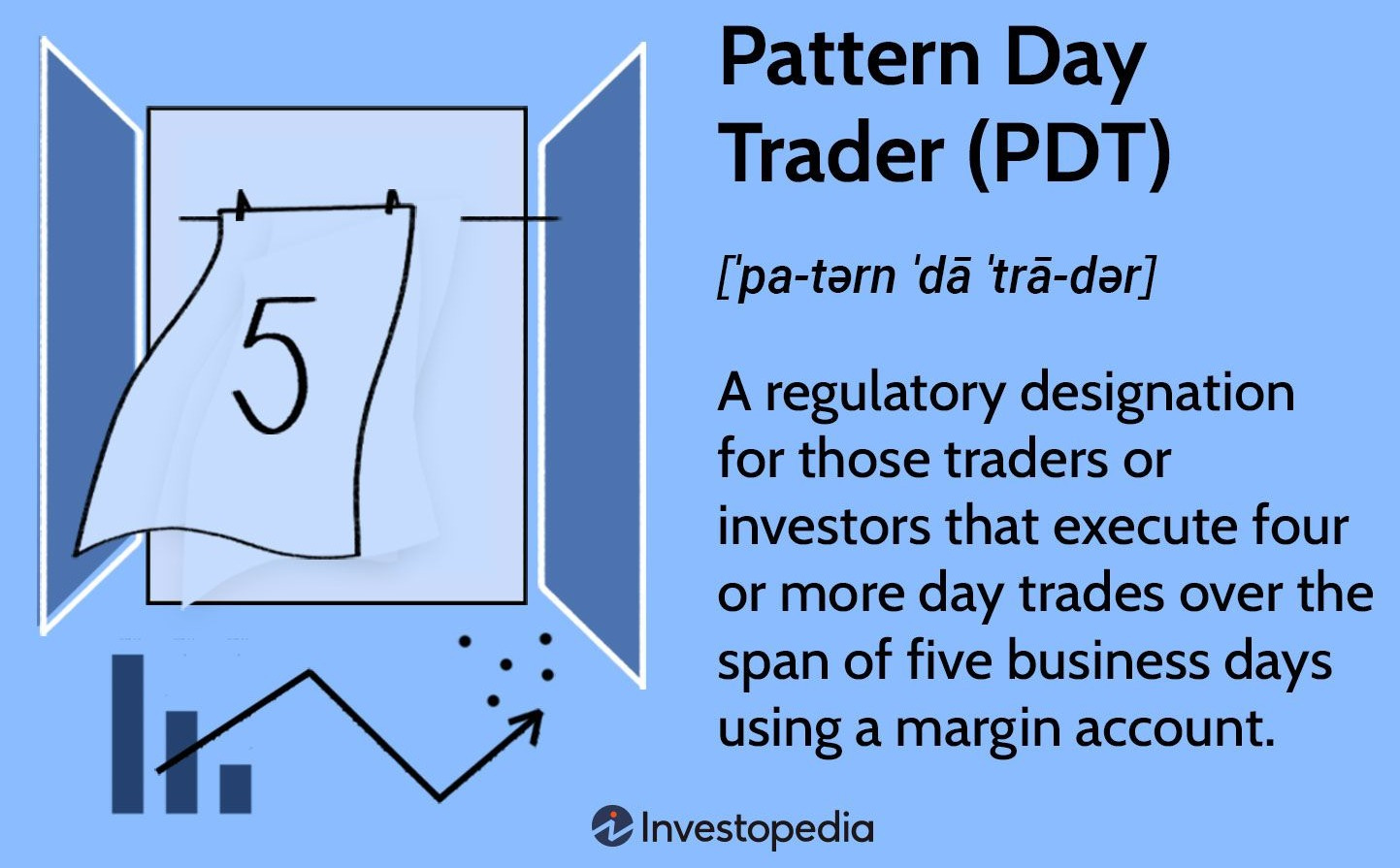
That threshold is now gone. In its place, FINRA has introduced a real-time intraday margin system. Brokers will monitor your actual risk exposure throughout the day and adjust your buying power based on the positions you hold, not a fixed dollar amount. The new system is expected to roll out over the coming months as brokerages update their infrastructure.
The Celebration Has Already Started
Social media lit up within minutes. Trading influencers called it the biggest moment for retail investors since commission-free trading. Reddit threads exploded with plans to finally go full-time. The narrative is familiar, and it writes itself: the little guy won, the gatekeepers lost, and now anyone with a brokerage account and a dream can trade their way to financial freedom.

Sure, that framing feels good, but the data behind it is devastating.
What the Research Actually Shows
The academic literature on retail day trading outcomes is remarkably consistent across countries, time periods, and asset classes. The overwhelming majority of individual day traders lose money, and the losses compound over time.
Start with the United States.
Professors Brad Barber and Terrance Odean at UC Davis and UC Berkeley conducted the most widely cited study of individual investor behavior, tracking 66,465 households through a large discount brokerage between 1991 and 1996.
The most active traders, those in the top 20% by frequency, earned an annual return of 11.4% while the broader market returned 17.9%. That’s a 6.5 percentage point annual drag from overtrading alone.
Over a decade, that gap turns a $100,000 portfolio into roughly $60,000 less than what a passive index investor would have earned.
The survival numbers are just as stark.
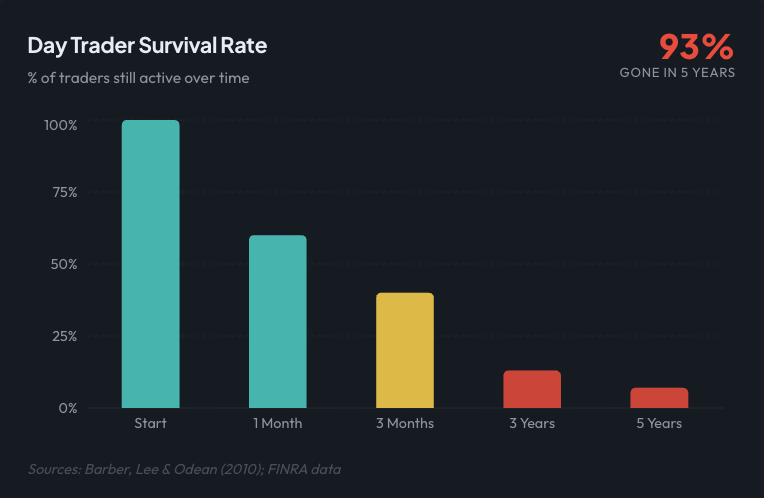
Research from Barber, Lee, and Odean (2010) found that:
80% of all day traders quit within the first two years.
Nearly 40% quit within the first month.
After three years, only 13% are still active.
After five years, just 7% remain.
Those numbers don’t tell you how many of the survivors are actually profitable. They just tell you how many haven’t given up yet.
The most granular study comes from Brazil. Chague, De-Losso, and Giovannetti (2020) tracked every individual who began day trading equity index futures between 2013 and 2015 on the Brazilian exchange, the third-largest futures market by volume in the world.
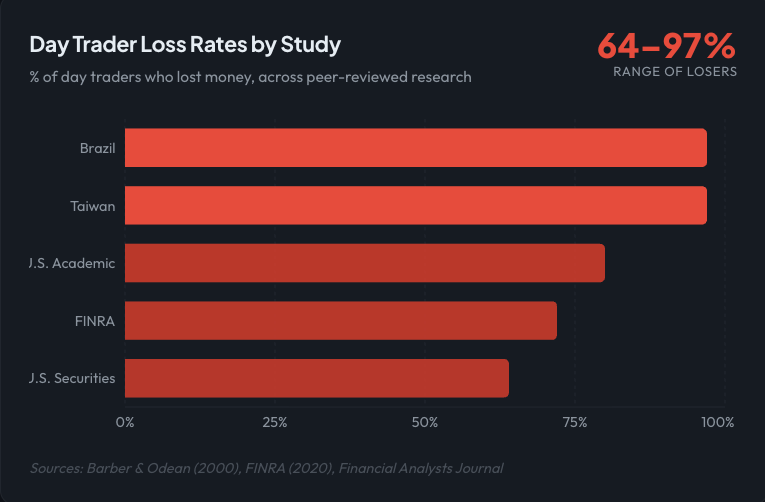
Among those who persisted for more than 300 trading days, 97% lost money.
Only 1.1% earned more than Brazil’s minimum wage. Only 0.5% earned more than the starting salary of a bank teller. The top individual earner averaged $310 per day, but with a standard deviation of $2,560, meaning the volatility of their returns dwarfed their average gains.
Perhaps the most important finding from the Brazil study: the researchers found no evidence of learning. Traders did not improve over time. The ones who kept going simply kept losing.
Taiwan offers 15 years of market-wide data. Barber, Lee, Liu, and Odean (2009) analyzed every trade on the Taiwan Stock Exchange from 1992 to 2006 and found that less than 1% of day traders earned persistent, statistically significant positive returns after fees.
A longitudinal analysis published in late 2025 by PiP World, drawing on 8 million traders making 295 million trades across 27 years, concluded that between 74% and 89% of retail traders lose money in every measured period. The failure rate hasn’t changed despite advances in technology, education, or platform design.
Buffett Framework: “The stock market is a device for transferring money from the impatient to the patient.” The data across every major study confirms exactly this. Day trading is the most expensive form of impatience in finance.
Follow the Incentives
If day traders overwhelmingly lose, the question worth asking is who profits from their participation.
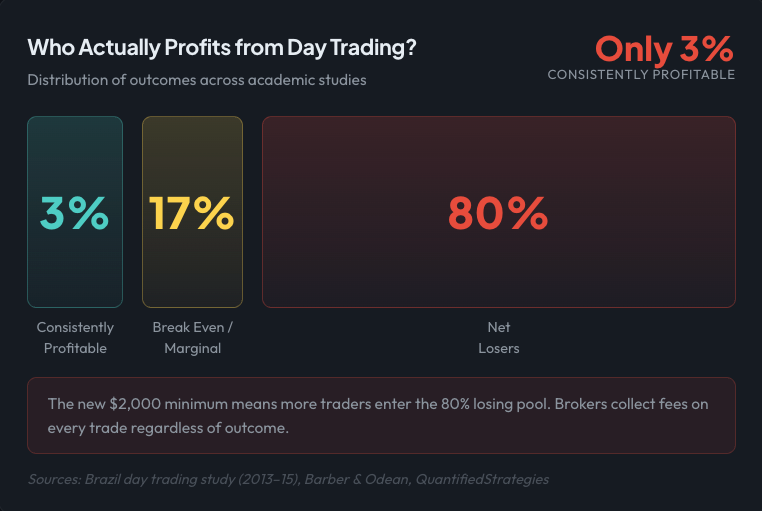
Robinhood generates roughly 70% of its revenue through payment for order flow, a practice where the company routes customer trades to market makers in exchange for rebates. More trades mean more revenue. The company reported net income of $1.9 billion in 2025. Payments for order flow across the brokerage industry reached approximately $953 million in a single quarter in mid-2025.
The PDT rule elimination is, for brokerages, the most favorable regulatory development in a generation.
Every account that was previously locked out of active trading is now a potential revenue source. Every trader who makes four, five, or ten trades a day instead of holding positions generates incrementally more order flow, more margin interest, and more premium subscription revenue.
Robinhood, Webull, and others have already signaled they’re prepared to roll out the new system quickly. The marketing campaigns will follow. You can predict the messaging without seeing it: “Trade freely. No minimums. Your money, your rules.”
The incentive structure hasn’t changed, but the guardrails around it have.
Two Rules in Two Weeks
The PDT elimination didn’t happen in a vacuum. Two weeks earlier, the Department of Labor proposed a rule that would make it easier for 401(k) plans to include alternative assets like cryptocurrencies, private equity, and real estate. The proposal responds to an executive order President Trump signed in August 2025 titled “Democratizing Access to Alternative Assets for 401(k) Investors.”
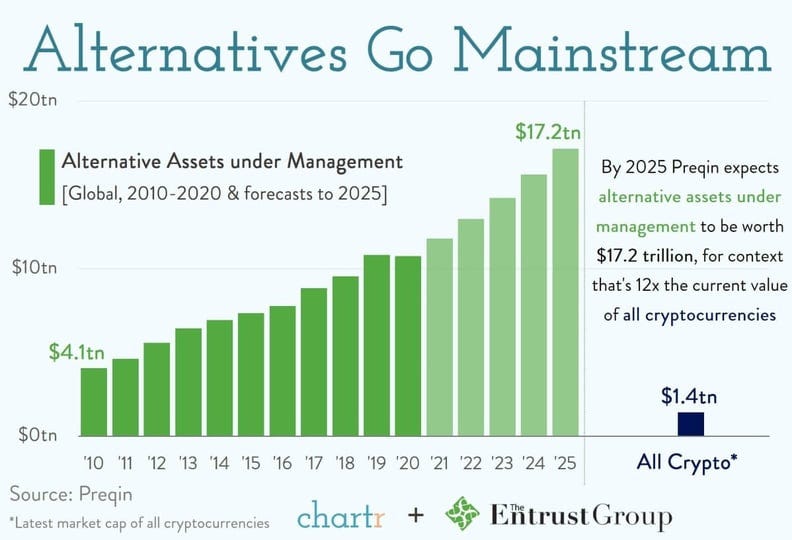
American 401(k) plans hold more than $10 trillion in retirement savings. The proposed rule creates a process-based safe harbor for plan fiduciaries who add alternative investments, reducing the litigation risk that has historically kept plan sponsors away from anything unconventional. It’s a reasonable policy on paper: give fiduciaries a documented framework, protect them from lawsuits if they follow it, and let the market evolve.
In practice, the immediate impact will likely be modest. Mayer Brown partner Erin Cho noted that participants aren’t going to find standalone crypto funds on their 401(k) menu overnight. The more likely path is a small allocation inside target-date funds, managed through regulated ETFs. TD Cowen analyst Jaret Seiberg expressed skepticism that the rule will encourage fiduciaries to act until courts have confirmed the litigation protections hold up.
But the direction of travel matters more than the speed. In May 2025, the Labor Department rescinded Biden-era guidance that had urged employers to exercise “extreme care” before adding crypto to retirement plans. Now comes the safe harbor framework. The trend line points in one direction: more access to riskier positions for a broader population of investors.
Two deregulatory moves in two weeks. Both lower the barriers between everyday investors and higher-risk assets. The question is whether expanded access, absent expanded education, creates wealth or destroys it.
We’ve Seen This Movie Before…
When commission-free options trading arrived, millions of retail investors flooded into a product most of them didn’t fully understand. The mechanics were accessible. The knowledge required to use them responsibly wasn’t. The results were predictable for anyone who’d studied the data, and painful for those who hadn’t.
The PDT rule change follows the same pattern. The friction is being removed, but the underlying challenge remains identical. Day trading is a negative-sum game for most participants after accounting for spreads, fees, slippage, and taxes. Making it easier to play doesn’t change the math. It just changes the number of people exposed to it.
The old PDT rule deserved to go. A wealth gate that treated someone with $24,999 as unqualified and someone with $25,001 as competent was never a rational approach to risk management. FINRA’s own analysis acknowledged that the rule created perverse incentives, including traders holding positions overnight specifically to avoid the day trading designation, which often introduced more risk than the rule was designed to prevent.
What Buffett Would Say
Warren Buffett has addressed this dynamic across multiple shareholder letters, and two quotes in particular capture the core problem with what just happened.
“Inactivity strikes us as intelligent behavior.” (1990)
“Hyperactivity is the pickpocket of enterprise.” (1983)
He said these on two different occasions, in two different shareholder letters, but the message is the same.
The most expensive habit in investing is the compulsion to do something. To trade. To react. To feel like you’re participating.
The SEC just made it easier for millions of people to act on that compulsion, with real money, on margin, in a game where 97% of persistent players lose. The old rule was clumsy, but it slowed people down. The new system is smarter, but the incentive structure surrounding it, the marketing, the platforms, the influencer culture, is designed to speed them up.
Access is a good thing. Nobody should be locked out of markets because of an arbitrary dollar threshold. But access without education, without process, without discipline, is just a faster way to learn an expensive lesson.
The guardrails are coming off. The data hasn’t changed.
- Matthew
Matthew Snider is the founder of BitFinance and a principal at Block3 Strategy Group. He holds a Series 65 and an MBA. This article is for educational purposes only and should not be considered financial advice. Always consult with a qualified professional before making investment decisions.
Sources
Barber, B. M., & Odean, T. (2000). “Trading Is Hazardous to Your Wealth: The Common Stock Investment Performance of Individual Investors.” Journal of Finance, 55(2), 773-806.
Barber, B. M., Lee, Y. T., Liu, Y. J., & Odean, T. (2010). “Do Day Traders Rationally Learn About Their Ability?” Working paper, University of California.
Barber, B. M., Lee, Y. T., Liu, Y. J., & Odean, T. (2009). “Just How Much Do Individual Investors Lose by Trading?” Review of Financial Studies, 22(2), 609-632.
Chague, F., De-Losso, R., & Giovannetti, B. (2020). “Day Trading for a Living?” Working paper, University of São Paulo (FEA-USP). Available at SSRN.
PiP World (2025). Longitudinal study of 8 million retail traders, 295 million trades, 1998-2025.
SEC Release No. 34-105226, File No. SR-FINRA-2025-017 (April 14, 2026).
U.S. Department of Labor, Employee Benefits Security Administration. Proposed Rule: “Fiduciary Duties in Selecting Designated Investment Alternatives” (March 30, 2026).