I Published 75 Articles in 6 Months. Here’s What It Taught Me About Building a Personal Brand.
Six months ago I came back to writing.
I had drifted away from it, the way you do when life gets loud. Work was busy, the calendar was full, and the writing habit that used to anchor my thinking had quietly gone missing.
But I knew one thing about content from watching everyone who had ever built anything with it: the whole game is consistency.
Talent helps, timing helps, but consistency is the only variable you fully control.
So I made myself a deal:
Publish on a schedule for six months, three pieces a week, no missed weeks, and see what happens. No growth hacks, no paid promotion, no expectations beyond showing up.
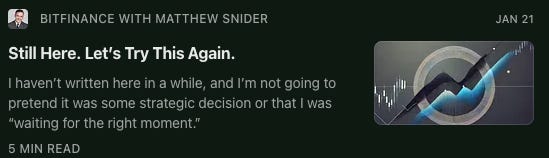
The first post went up on January 21. I titled it “Still Here. Let’s Try This Again” because that’s exactly what it was. Piece number one of a restart I wasn’t sure would stick.
Seventy-five pieces later, it stuck.
This letter is what those 6+ dozen pieces taught me, what the numbers ended up looking like, and mostly a thank-you note to the people reading it.
What 75 published pieces taught me
1. You cannot predict what lands, so stop trying.
My best-performing post of the half was a short take on Michael Saylor’s Strategy selling 32 bitcoin to make a payment. I was candidly astonished to see if reach nearly 22,000 impressions, 21 comments; more than 2x my previous best.
Here’s the strange part: the engagement lived almost entirely on the post itself. People reacted to Saylor the character, debated in the comments, and largely never clicked through to the article. High noise, low readership.
Now flip it…I wrote a piece about running an AI workshop for a nonprofit; a piece I thought would really resonate. By every dashboard metric it was a total dud, fewer impressions, fewer reads, no comment thread to speak of.
Then 3 separate people sent me direct emails thanking me for the work. Personal notes, thoughtful ones. That piece moved actual humans, and no analytics panel captured it.
Which of those two articles “worked”? I’ve stopped pretending I know. The dashboard measures attention, but attention and impact turn out to be different currencies. Publish enough and you get to collect both.
2. Volume is emotional armor.
When you’ve published five things, each one feels like a referendum on you. When you’ve published 75 in six months, a piece that sinks is Tuesday. You develop a useful numbness to the reaction cycle, and it stops being personal in either direction. The flop doesn’t wound you and the hit doesn’t convince you you’re a genius. Both are data points. Consistency is a growth strategy, but it’s also how you protect your own head.
3. Writing compounds into things that aren’t writing.
The newsletter was supposed to be the product.
Instead it turned into the front door for everything else.
Articles became conversations, conversations became opportunities, and documenting my experiments in public pushed me to run better experiments.
In January I had never written a line of code. Because I kept writing about what I was building, I kept building: pricing models, research loops, a prediction market tracker that turned $580 into a March Madness case study, and an autonomous agent that now emails me proposed options trades every morning with reasoning and projected profit and loss.
The publishing schedule became a build schedule. I didn’t see that coming.
4. The invisible stuff is learnable.
Six months ago I couldn’t have told you what a URL slug was.
I didn’t know a search-optimized title and an email subject line should be two different things doing two different jobs, or that a meta description is a 160-character ad you write for Google.
Nobody teaches this; you learn it because you finally have enough published pages to measure. Seventy-one of my pages are now indexed by Google, each one a small fishing line in the water, and the search traffic curve bends upward a little more every month. The writing gets the attention, but the plumbing underneath it is what makes the attention findable. More articles means more data, and more data means the tweaks stop being guesses.
5. Your audience will tell you where they live.
I assumed finance content meant X. My readers had other plans. The conversation formed on Substack and LinkedIn instead, and once I stopped fighting that and started feeding the platforms where people were engaging, everything moved faster.
Build where your readers are, not where the conventional wisdom says they should be.
The Results 👀
Here’s what six months of showing up added up to, with the screenshots to prove it.
On LinkedIn:
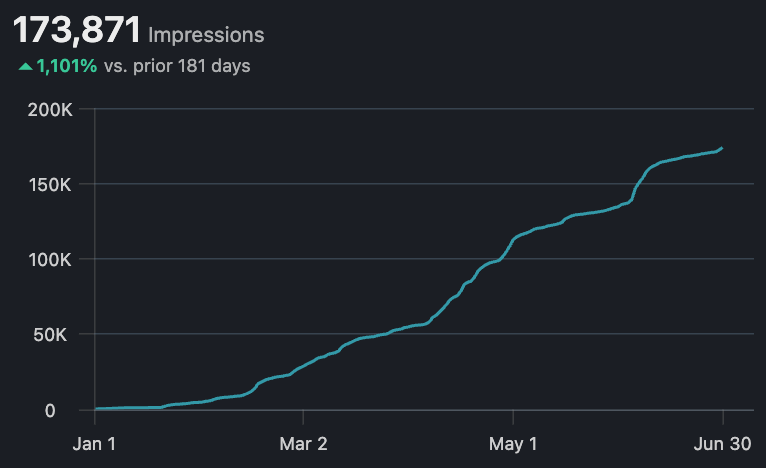
173,871 impressions, up 1,101% from the prior six months.
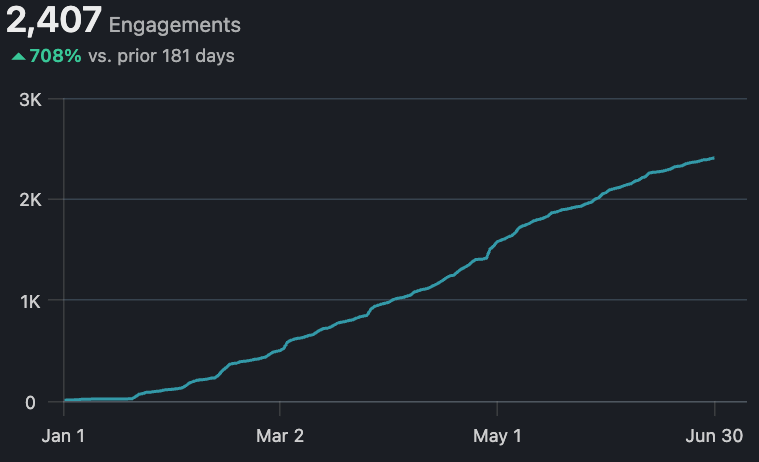
Engagements grew 708%.
Nearly a thousand new followers.
On Substack:
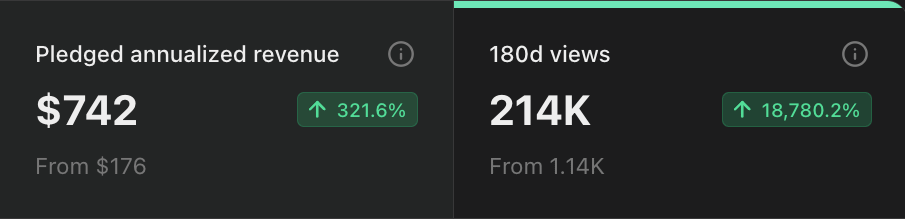
Articles were viewed over 214,000 times, against about 1,100 views in the six months before.
I was even more humbled that almost a dozen individuals pledged their hard-earned dollars to the publication.
On Google:
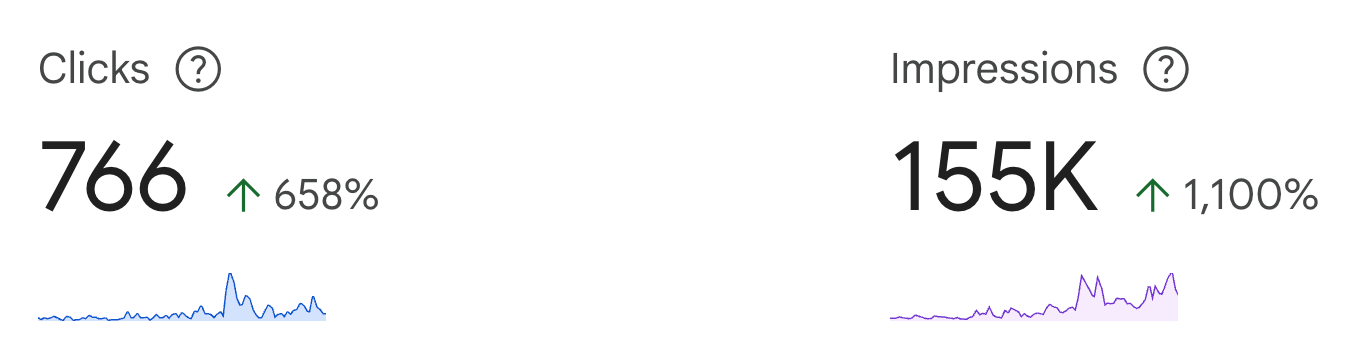
The BitFinance site went from invisible to 766 search clicks, up 658%, with 155,000 search impressions along the way.
I’m sharing the numbers not to flex but because they represent something I didn’t expect: people showing up.
Commenting. Pushing back. Sharing pieces with colleagues. Sending messages that start with “have you looked at” and end with me down a research rabbit hole for three days.
So thank you.
Genuinely. Every comment, every restack, every skeptical reply that made an argument sharper. A newsletter without readers is a diary. You turned this one into a conversation, and the conversation is the whole reward.
If you’re thinking about doing this
You can. I mean that plainly, without a course to sell you.
Pick the intersection of what you love and what you know better than most people in the room. Show up on a schedule your audience can set a clock by. Build things in public, including the failures, because the failures are where readers learn to trust you.
Six months ago I was a busy person with a dormant writing habit and zero coding experience. The only thing I changed was refusing to skip a publishing day. Everything in this letter followed from that one decision.
Consistency is boring right up until you look at the chart.
The Buffett Framework Question: Buffett has said the best investment you can make is in yourself, because nobody can take it away from you. Capital compounds in an account. Skills and audience compound in you. If consistency is the deposit, what did you put in this week?
What’s in Store for the Rest of ‘26?
Here’s what I’m committing to between now and December, in writing, because you all have a way of holding me to things.
Continued writing and alpha sharing! Obvs
Building and monetizing an AI product. The agent that emails me trade proposals every morning gets stress-tested and pushed toward something worth offering to others, whether that’s an investment-related product or the tooling underneath one. I don’t know yet exactly what shape it takes, and I’ll document the figuring-out here at every step.
The licenses. The Series 7 first, then the Series 63 and the Series 3. The study window opens now, and I built a custom question bank to drill the math because apparently that’s a thing I do these days.
The book. The revised and expanded edition of Warren Buffett in a Web3 World is in motion. The first edition was written before I could build any of this. The next one gets to include what the machines taught me.
Video. This is the commitment that scares me, which is how I know it’s the right one. It’s been the thing holding me back the most, and enough of you have asked that I’ve run out of excuses. Expect me on camera talking through builds and frameworks in the second half.
Half the year is gone. The half I’m more excited about is still ahead. In January I wrote “let’s try this again” to an audience of almost nobody.
This time I get to write it to you.
Wishing y’all a happy and healthy 4th of July weekend! 🦅🇺🇸
This Week In 2 Minutes

Michael Saylor's "Never Sell" Bitcoin Strategy Just Got Edited (June 30)
Strategy's preferred stock STRC, the $100 slip that funds the whole machine, broke to an all-time low near $74 this month, and the company answered with a five-part rescue kit: a $2.55 billion reserve, a dividend hike to 12%, two buyback programs, and the part that changes the story, a written policy authorizing Bitcoin sales to pay for all of it.
The company that spent five years preaching "never sell" now holds 4% of all Bitcoin ever with a programmed seller's playbook attached. The market bought the package hard. I walked through what it means depending on whether you hold STRC, MSTR, or Bitcoin itself.

Elon Is Paying 6% on Your Cash. The Math Says He Can't. (July 3)
Every legitimate savings account in America prices below the Fed's 3.50% to 3.75% target ceiling, because that's how deposit economics work. X Money pays 6%, above the line, which means the product loses money on every dollar it gathers unless the yield comes from somewhere conventional banking can't reach.
I laid out the three candidates for where that 6% originates, why the banks spent their political capital fighting the wrong threat, and the single tell I'm watching: the first rate cut.
WINNERS 🏆
The Dow, and everything that isn’t a chip. The Dow closed Thursday at a record 52,900, up 1.14% on the day, while the Nasdaq sank. Apple, McDonald’s, healthcare, and financials led as money rotated out of the AI trade and into everything it had ignored for six months. The Russell 2000 gained 22% in the second quarter, and June was the best month for active managers in ages as market breadth finally returned. When a rotation this size starts, the question isn’t whether the leaders change but how long the new ones hold the baton.
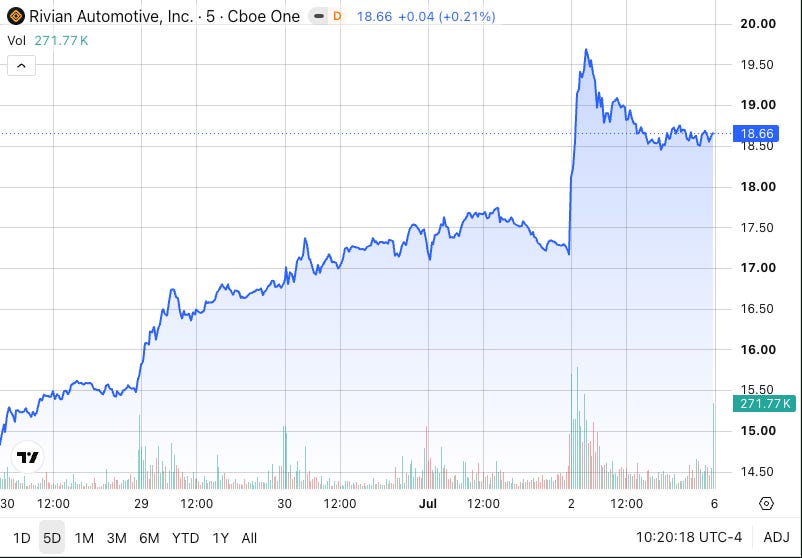
Rivian (RIVN). Surged nearly 13% Thursday after raising 2026 delivery guidance to 65,000 to 70,000 vehicles on stronger than expected demand. In a market that punished Tesla for merely meeting expectations earlier this year, an EV maker raising its own bar stands out.
Bitcoin’s relative strength. The most interesting winner isn’t a stock. While semiconductors dragged the Nasdaq down and South Korea’s Kospi fell nearly 8%, Bitcoin climbed back above $61,000, up about 4% Thursday. Crypto decoupling from the AI trade, even for a week, is the kind of behavior that was missing all through a quarter of steady rotation out of digital assets. More below in Crypto Corner.
LOSERS 📉
Memory and semiconductor stocks. The week’s clearest casualty. The SOX index lost 6.7% on Wednesday alone after roughly doubling in the second quarter. SanDisk fell more than 20% over two days, Micron dropped over 12% for the week, and the Roundhill Memory ETF (DRAM) shed almost 15%. Nothing broke fundamentally; the trade got crowded, and profit-taking in a holiday week has no bid on the other side.
AI cloud infrastructure. Nebius fell 17% Wednesday and CoreWeave dropped 14%, both extending losses into Thursday. Investors are asking the uncomfortable question about whether massive AI capital expenditure translates into returns, and this group is where the question lands first.
The Japanese yen. At a 40-year low against the dollar, and the market remembers what happened last time. In July 2024, with the yen near these same levels, a surprise intervention rally knocked 25% off the Nikkei and 8% off the S&P in four weeks. The carry trade is crowded again, which makes this a loser worth watching rather than fading.
WHAT TO WATCH NEXT WEEK 👀

USA vs. Belgium, Monday night, July 6. 🇺🇸🇺🇸🇺🇸
The USMNT plays Belgium in the Round of 16 at 8 PM ET in Seattle, a rematch of the 2014 heartbreaker, and this time on home soil. Wednesday's win over Bosnia was the most-watched soccer telecast in U.S. history, and the economics around this tournament keep compounding: host-city spending, record Fox ad rates, and a consumer that shows up for events even while cutting back elsewhere. A win Monday means a quarterfinal in Los Angeles on Friday, July 10, against the Spain-Portugal winner, and another leg higher for every business attached to this run.
FOMC minutes, Wednesday July 9. The first minutes of the Warsh era, and unusually important because Warsh refuses to participate in the dot plot or telegraph moves in advance. With no fresh projections until September, these minutes are the only window into how the committee is weighing hot inflation against last week’s weak 57,000-job payrolls print.
Earnings season warm-up. Delta kicks off the unofficial start of Q2 reporting late in the week, with the big banks the following Monday. After the best quarter for stocks since 2020, management commentary on the second half carries more weight than the backward-looking numbers.
Matthew Snider is the founder of Block3 Strategy Group, author of “Warren Buffett in a Web3 World,” and publisher of the BitFinance newsletter. He holds a Series 65 and MBA, and has been an active participant in digital asset markets since 2015. This article is for educational purposes only and should not be considered financial advice. Always consult with a qualified professional before making investment decisions.