A $500 Gaming Card Is Beating $500 Million AI Trading Models
For the past eight months or so, I’ve been deep in a single question: what happens to markets when AI does the forecasting?
I’ve gone far enough down the rabbit hole to build my own agentic trader, the Buffett Bot that readers of this series know, which proposes options trades from my desk and waits for my sign-off before touching even paper money. So when the story that follows crossed my screen, I read it as a builder, and it made me sit up.
Three researchers from DeepMind spent years building DeepStack, the first AI to beat professional players at no-limit Texas hold ‘em.

Then they asked what would happen if they pointed the same technology at markets.
Today they run EquiLibre Technologies, a Prague company that points the same technology at markets. TechCrunch profiled them in June: valued above $500 million, with AI agents trading billions of dollars a day across the S&P 500 and Nasdaq in partnership with quant giant Tower Research.
Their CEO, Martin Schmid, says markets appealed to his team because the scoring is simple: How much money did the agent make?
Simple scoring only works if you can see the score, though, and this one is invisible to everyone outside the building. EquiLibre reports a perfect record of zero negative months since inception, and the rest of us have no way to check it.
In their case, there’s no fund vehicle here with outside investors, which means:
no auditor,
no administrator striking a monthly net asset value (NAV),
no filing anyone can request;
The claim lives in a press interview.
Even at funds that do get audited, the paperwork travels only to the investors already inside and to allocators deep in diligence, under NDA. This is no fault of anyone’s, since the industry has always run this way. Verification exists, but it’s a private good.
Track records live behind closed doors, backtests are homework graded by the student, and allocators decide who to believe based on pedigree, polish, and pitch decks.
Golf solved this problem a century ago.
The U.S. Open is called “open” because a club pro or a scratch amateur can enter qualifying on Monday, tee it up two groups behind the world number one, and let the scorecard do the talking. Nobody has to vouch for you. Finance never built its Monday qualifier, and I’ve spent enough time reading unverifiable pitch decks to understand why that absence matters.
Well somebody finally built one, and a company I advise just walked onto the course.
The Tournament Nobody Can Rig
Imagine a forecasting contest that never closes.
Anyone in the world can enter a model, with no invitation required and no gatekeeper deciding who’s credible enough to compete. Every entrant answers the same question on the same schedule: where might this asset’s price go over the next hour, or the next day? Each answer is a full range of outcomes with probabilities attached rather than a single number, the way a good weather forecast says 70% chance of rain instead of “it will rain.”
Then reality arrives. A neutral referee scores every forecast against what happened, using the same yardstick for everyone. That yardstick is a statistical measure called a Continuous Ranked Probability Score (CRPS), which rewards forecasts that put high probability near the outcome that occurred.
Nobody can delete their bad rounds, and nobody can inflate their good ones, because the entrants never touch the scoring.
That contest exists with the team over at Synth, and it runs as a subnet on Bittensor, a decentralized network, which matters for one specific reason: no single company controls the referee.
The scoring rules are open.
The results are public.
The apparatus keeps running whether any participant likes their standing or not.
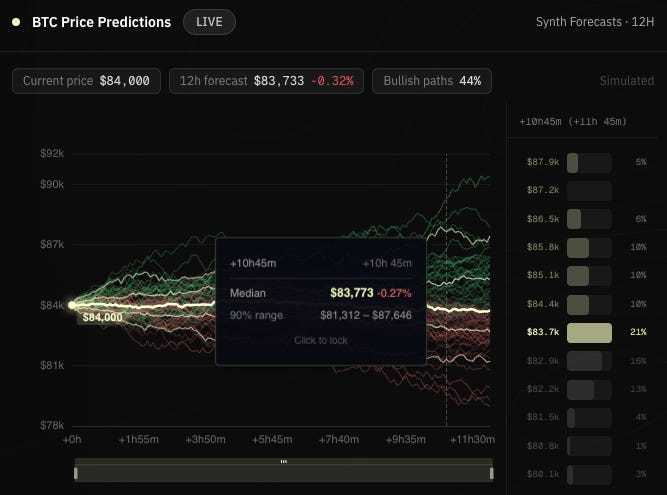
Roughly 256 models compete there today across 12 assets: Bitcoin, Ethereum, Solana, XRP, and HYPE on the crypto side, tokenized versions of the S&P 500, Nvidia, Tesla, Apple, and Google in equities, plus gold and oil.
Three separate contests run in parallel: one for crypto at a one-hour horizon, one for crypto at a daily horizon, and one for commodities and equities at a daily horizon.
The open door is real, and Synth published the proof this month. A research note dated July 8 profiles one competing miner that runs entirely on a single NVIDIA RTX 3070, a consumer graphics card that retails for around $500.
As of July 6, that setup ranked first on XRP in the daily crypto contest and first on both Apple and oil among the commodities and equities it covers.
Hold those two numbers side by side.
The private world’s ticket to credibility was a $500 million valuation and a DeepMind pedigree. The open scoreboard accepted an entry powered by a $500 gaming card, and that entry is beating well-funded rivals on three assets.
The new world of permissionless capital competitions provides any entrant access to open entry, continuous scoring, and public results.
Finance has mostly avoided it for its core product, and the incentives explain why. Show me an industry that grades its own homework, and I’ll show you an industry where the grades tell you very little.
A new challenger enters the arena

Duon Labs, the AI research company I’ve written about before and that Block 3 Strategy Group advises, entered Synth under a numbered identity like every other competitor.
Voyons, the forecasting engine that powers everything Duon Labs builds, is now answering the hourly question alongside 255 rivals, with no badge, no pedigree discount, and no way to hide a bad round.
The tournament’s cumulative scoreboard takes weeks to accrue, so any rank I typed this morning would be a snapshot dressed up as a track record, and I’d be grading exactly the way I just criticized. Check back in the August edition of this series, where I’ll report on progress.
Notice what changed anyway. “Our model forecasts well” used to be a claim you took on faith, backed by materials the company itself prepared. Today it’s a claim with a referee. You won’t have to trust Duon Lab’s telemetry, or mine. The scoreboard is public, updated continuously, and scored by validators with no stake in Duon Lab’s story.
Buffett Framework Question: Buffett has spent decades urging investors to judge managers on verifiable results, measured over long periods, against a yardstick stated in advance. Apply that to any AI trading claim you hear this year: is the yardstick public, is the record long enough, and who’s holding the tape measure?
Why Investors should Care
Three things about this format deserve your attention, whatever you think of any individual competitor.
Fast feedback compounds. A research lab that gets exam results every hour learns at a different rate than one that waits for quarterly performance letters. The tournament works as a billboard, but it’s more durable value is as a training ground, where weak spots surface in days instead of quarters and fixes get tested against live reality instead of curated history.
Verification beats narrative. Every allocator has sat through a beautiful deck stapled to an unverifiable track record. A public, third-party scoreboard doesn’t replace diligence, but it moves the opening question from “believe us” to “check for yourself.” A firm that chooses the open format is revealing something about its incentives, and a firm that avoids it forever reveals something as well.
Talent gets a new front door. EquiLibre’s founders needed DeepMind on the resume and Tower Research on the term sheet before anyone took the claim seriously. An open tournament inverts that. Capital can watch the leaderboard and find forecasting skill wherever it lives, whether that’s a Prague research lab or an anonymous entrant running a $500 graphics card out of a spare bedroom. That’s a meaningfully wider funnel than the industry has ever had.
The Scoreboard Era
The skeptics are half right. Public competition means public bad stretches, and a leaderboard doesn’t pay for slippage or manage risk, so treat it as an input to your diligence rather than a substitute for it. The trade every entrant accepts is credibility for comfort, and plenty of firms will keep choosing comfort.
History says they’re on borrowed time. Audited financials were a radical demand before the 1930s made them table stakes. Mutual funds once hid their holdings; now they publish on a schedule. Transparency in markets follows the same arc every time: curiosity, then edge, then minimum standard. Open scoreboards for trading models look like the next lap, and that’s my thesis, so hold me to it.
What it means for you is simple.
The next time someone pitches you a strategy that “uses AI”, you have a new question to ask: “where’s your public score?”
Firms with real skill will increasingly have an answer. The ones selling polish won’t, and that sorting does half your diligence for you.
None of this is finished. But when the best AI researchers in the world are moving into markets, and a neutral arena exists where their models prove it in public, the sensible move hasn’t changed since the first Monday qualifier: watch the scorecard, not the swing.
Moving right along…
This Week In 2 Mins
Buffett’s Favorite Business Is Coming On-Chain (July 7)
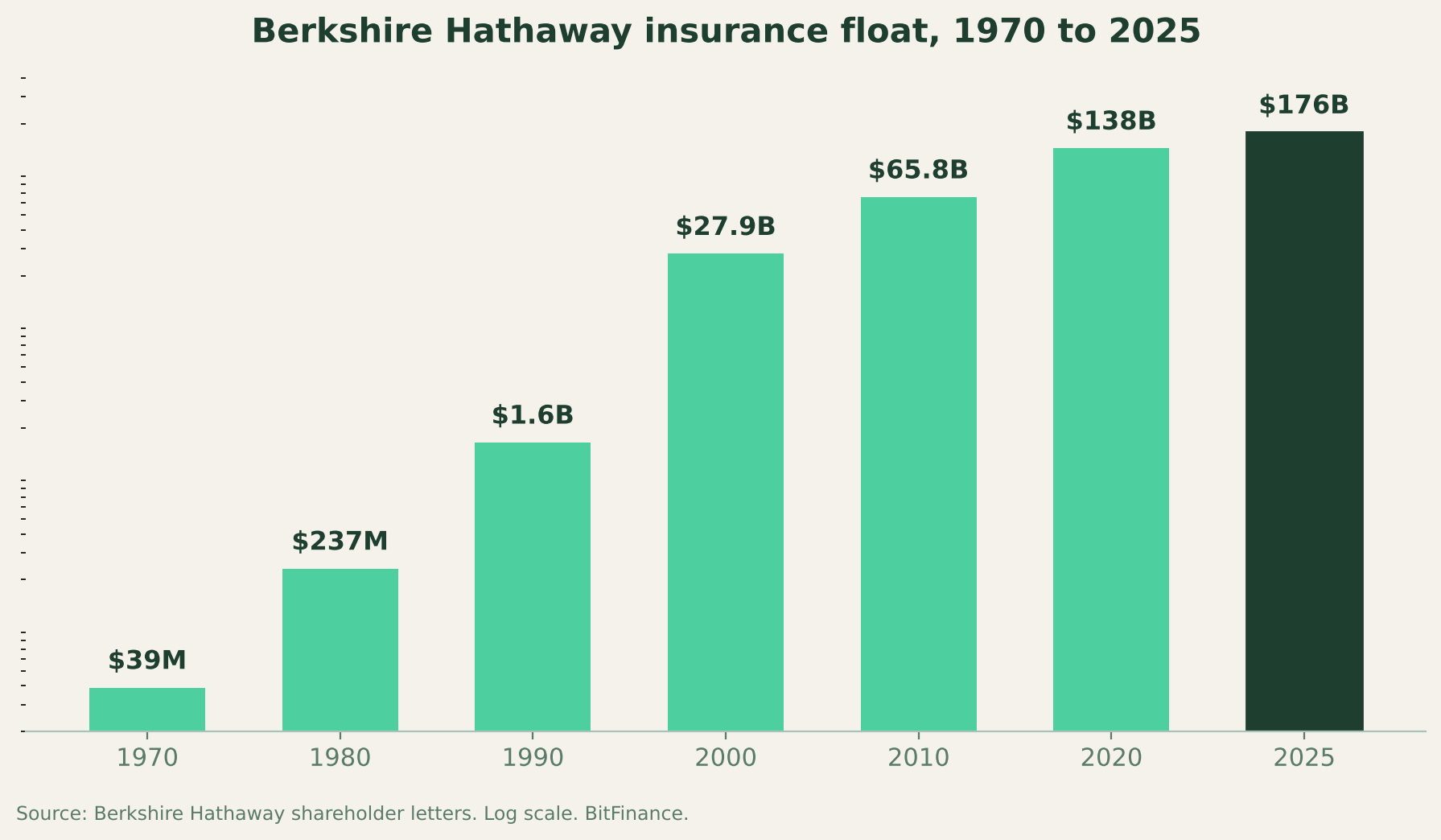
Warren Buffett built Berkshire Hathaway on float, the money an insurer holds between collecting premiums and paying claims, and gets to invest in the meantime. Picture a coffee shop selling gift cards: cash arrives today, lattes go out over the next year, and the shop invests the pile in between. Berkshire’s pile grew from $39 million in 1970 to $176 billion at the end of 2025, and for that entire stretch individuals could only ever sit on the buying side of the insurance table.
Tokenization is starting to open the seller’s seat. The article maps four doors into the market, from Re’s tranched reinsurance pools to Oxbridge Re’s tokenized hurricane contracts with $5,000 minimums, and explains the order in which losses land when a storm actually arrives.
The caution deserves equal billing: selling insurance means a bad hurricane season becomes your personal problem, so understand the line you’re standing in before you join it.

The Company That Tokenized Itself (July 9)
Securitize became the first public company to put its own stock on-chain the same day it listed on the NYSE, issuing roughly $295 million of tokenized SECZ equity on Solana and Avalanche with the same voting rights and dividends as the exchange-traded shares. The company raised about $400 million at a $1.25 billion valuation, then proved its thesis with its own cap table.
From there the piece runs a value investor’s checklist on a two-week-old ticker: four businesses under one roof, $19.5 million in quarterly revenue growing 39% a year, and fee income that keeps arriving whether or not crypto prices cooperate.
Early SPAC price action gets set aside as noise, since small floats swing hard while the market decides what a business deserves.
Market Winners 🏆
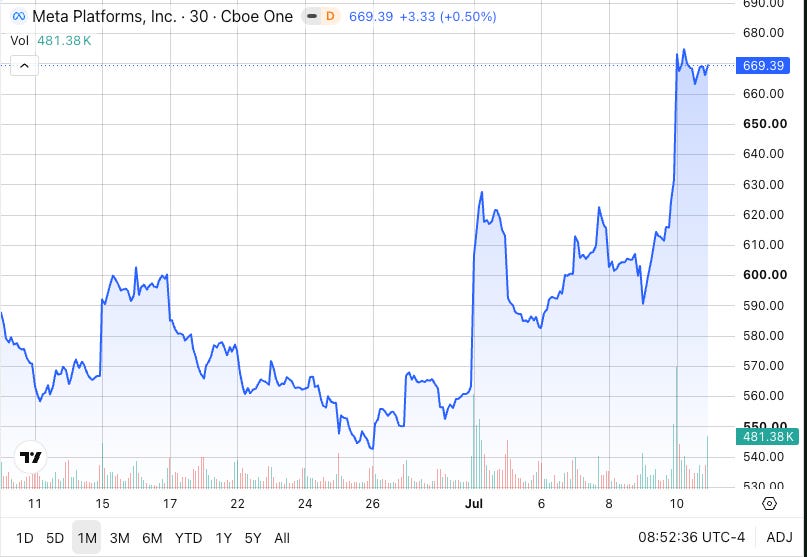
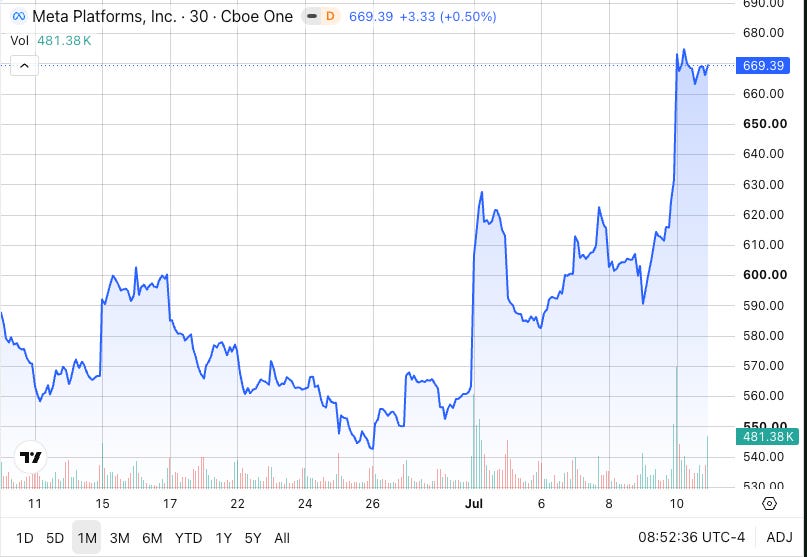
Meta Platforms (META). Meta posted its best week since early 2024, climbing roughly 15% and erasing its loss for the year. The move followed a run of AI announcements: two new Muse models, plans for a “Meta Compute” cloud business that would compete directly with AWS and Azure, and reports of an in-house AI chip entering production in September. Investors are repricing Meta from AI spender to AI infrastructure seller, the same shift that carried Microsoft and Amazon to premium multiples.
SK Hynix (SKHY). The Korean memory-chip maker raised $26.5 billion in the largest US listing ever by a foreign company, and the shares jumped more than 13% in Friday’s Nasdaq debut. Demand ran better than seven times the offering, powered by the high-bandwidth memory that feeds Nvidia’s AI processors. Regular trading starts Monday, and the listing gives US investors their first direct seat on the AI memory trade, a corner of the boom that until now required buying in Seoul.
Bitcoin (BTC). Bitcoin rose nearly 3% over the past seven days to trade around $64,000, defending the low $60,000s after touching a 21-month low earlier this month. The story sits in the fund flows: a $221.7 million single-day inflow into the spot ETFs ended a ten-day, $2.73 billion outflow streak, and roughly $510 million more followed over three days. Sentiment remains in Extreme Fear territory, so the question for the coming weeks is whether these inflows mark a turn or just a pause in a bear phase.
Market Losers 📉
Strategy (MSTR). Strategy disclosed its largest bitcoin sale ever, roughly $216 million worth (3,588 BTC), to fund preferred-stock dividends, and the shares opened more than 4% lower Monday to extend a decline that now tops 75% over the past year. The company also formalized a framework authorizing sales of up to 20,800 BTC for dividends and debt service. The market’s largest corporate accumulator of bitcoin has become a structural seller, and every leveraged bitcoin-treasury company gets repriced against that precedent.
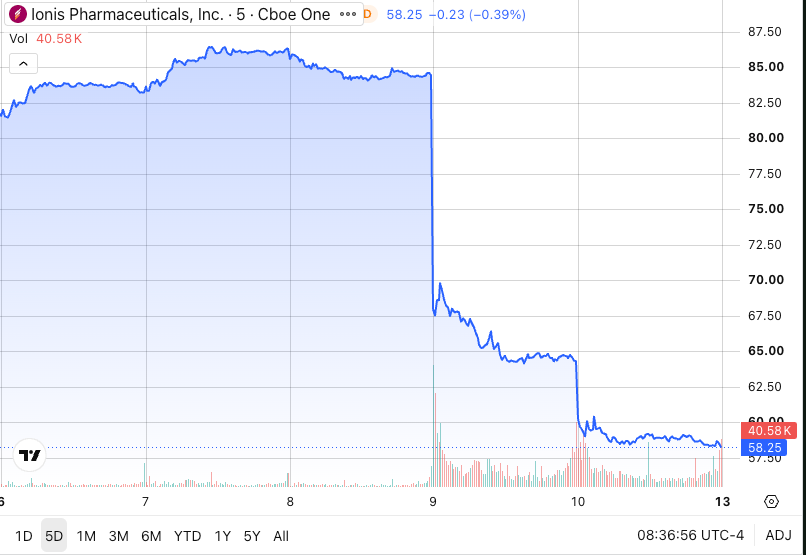
Ionis Pharmaceuticals (IONS) and AstraZeneca (AZN). Ionis fell more than 20% in a single session, its worst day in over five years, after its heart drug eplontersen missed the primary endpoint in a 1,432-patient Phase 3 trial, and partner AstraZeneca sank nearly 10% on the same news. The failure wipes out royalty and milestone economics in a multibillion-dollar market where rival drugs now look entrenched. Late-stage trials stay binary no matter how large the partner, a reminder to size biotech positions for the miss rather than the hope.
Healthcare Sector. Healthcare was among the week’s weakest groups as investors took profits after the sector’s run to all-time highs, with weakness spanning large-cap pharma, biotech, and managed care. Bausch + Lomb added to the mood by disclosing a failed Phase 2 glaucoma study. Johnson & Johnson and UnitedHealth report next week, which should show whether this was routine profit-taking or the start of a rotation back toward the AI trade at defensives’ expense.
What to Watch Next Week
June CPI (Tuesday, July 14, 8:30 a.m. ET). Consensus looks for headline prices to fall 0.1% on the month, easing the annual rate to 3.7% from 4.2%, with core running at 0.3%. The complication is oil: this week’s 6% jump in crude arrived too late for the June data but hangs over every forecast after it. PPI follows Wednesday and June retail sales land Thursday, so by Friday we’ll know whether the disinflation story survived the month.
Fed Chair Kevin Warsh Testifies (starting Tuesday, July 14). Warsh delivers his first congressional monetary-policy testimony as Chair, on the same day as CPI and the bank earnings. Markets will parse how he weighs a fresh oil shock against cooling headline inflation, and with three major catalysts stacked on one date, Tuesday is the pivot point for the week.
A New CLARITY Act Draft (as soon as this week). CoinDesk reports the newest version of the crypto market-structure bill could drop during the week of July 13, with floor action targeted for late July. Prediction markets put passage odds at just 39% after an ethics dispute flared, so any sign the three open disagreements are resolving would be a genuine catalyst for bitcoin, ether, and the exchange stocks.
Matthew Snider is the founder of Block3 Strategy Group, author of “Warren Buffett in a Web3 World,” and publisher of the BitFinance newsletter. He holds a Series 65 and MBA, and has been an active participant in digital asset markets since 2015. This article is for educational purposes only and should not be considered financial advice. Always consult with a qualified professional before making investment decisions.
Sources: (Article: A $500 Gaming Card Just Outforecast Wall Street’s AI Elite)
Sources: (Highlights)
Yahoo Finance: Dow, S&P 500, Nasdaq rise to cap choppy week
The Motley Fool: Stocks Slide and Dow Drops 1.5% as Middle East Tensions Spike
CNN Business: SK Hynix IPO: largest US listing by a foreign company
TechCrunch: SK Hynix raises $26.5B in the biggest foreign IPO in US history
CNBC: Oil prices post weekly gain as Middle East supply risks persist
The National: Oil prices set weekly gain amid renewed US-Iran hostilities
Yahoo Finance: Bitcoin and ethereum prices, Friday, July 10, 2026
CoinDesk: Bitcoin ETFs draw in $221 million
TechTimes: Bitcoin ETF Inflows Hit $510M Over 3 Days
Fortune: Strategy sheds $216 million in Bitcoin in its largest sale ever
CoinDesk: Strategy selling raises questions about its capital-allocation playbook
BioPharma Dive: AstraZeneca, Ionis drug fails big heart disease study
Endpoints News: AstraZeneca sinks on unexpected heart drug trial failure
Investrade: Market Review: July 10, 2026
MarketScreener: Healthcare Stocks Fall as Markets Rotate Back to Tech
CNBC: Next week = earnings + inflation data amid resumption US/Iran hostilities