$4.4 Billion in 12 Months. The Investment Vehicle You Haven't Heard Of (Yet!)

There’s a question I’ve been hearing more often from advisors and allocators over the past few months. It doesn’t come in a pitch deck or during a panel. It comes up during the honest conversations, the ones that happen after the conference sessions end.
The question is simple: “If I’m going to put client capital into digital asset yield, how do I actually know what’s happening with it?”
I absolutely think it’s the right question, but for most of the history of decentralized finance, there hasn’t been a good answer.
Sure the yield was there but the transparency wasn’t.
The operational complexity was brutal. The compliance story was thin. And the idea of telling a client to interact with a lending protocol directly? Not realistic.
That’s changing right in front of our eyes. Not in theory. Not in some future roadmap. Right now.
The vehicle driving that change is called a vault. And whether you’ve heard the term or not, you’ll want to understand what it means for your practice, your clients, and the investment landscape that’s taking shape around it.
What Changes for You as an Investor
Let me skip the technical architecture for a moment and start with what matters: what vaults actually give you that you don’t have today.
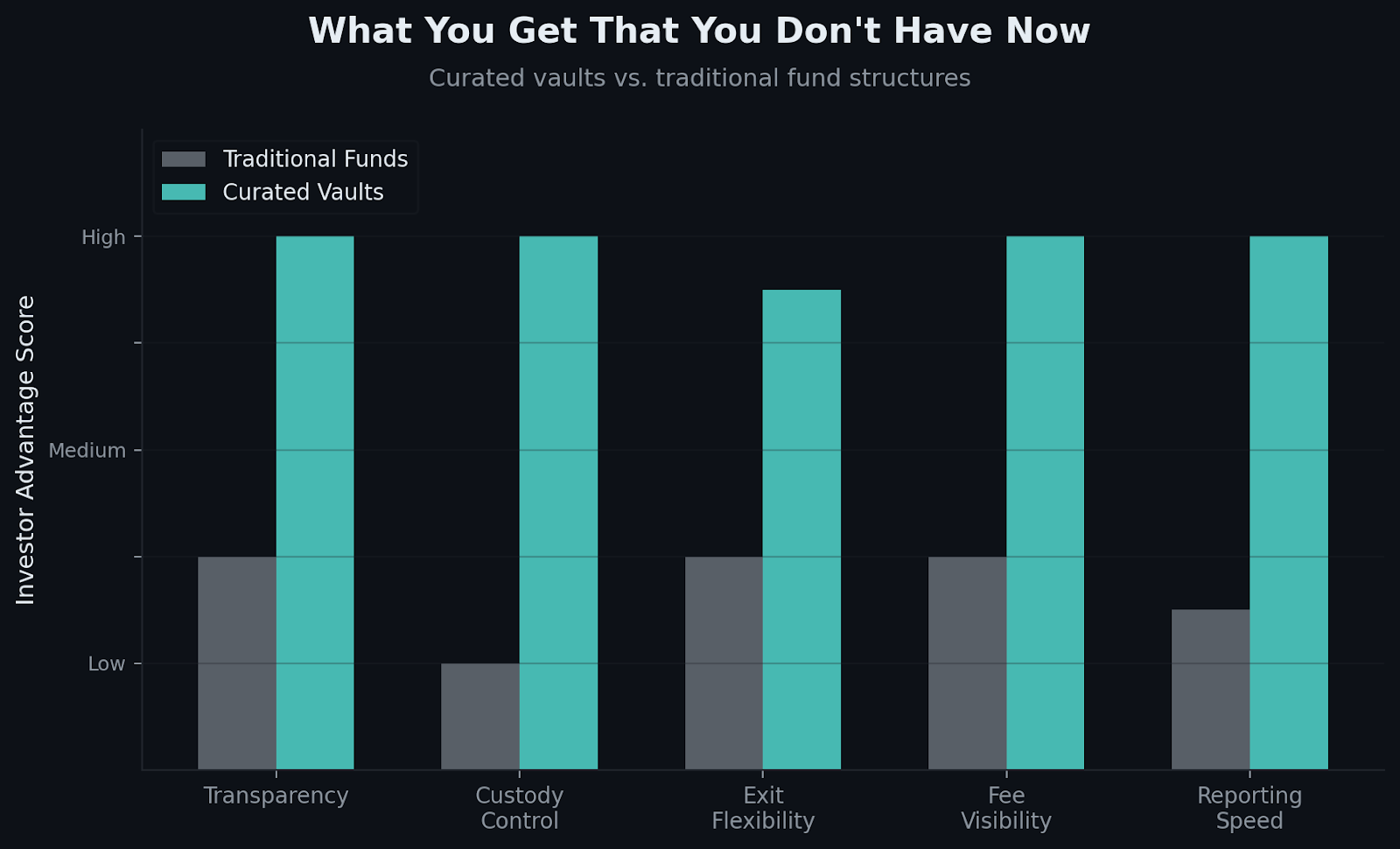
You can see everything, all the time. Traditional fund structures give you quarterly statements. Maybe monthly if you’re lucky. A vault runs on a public blockchain. Every deposit, every allocation, every fee is recorded in real time. You don’t have to ask your fund administrator what happened last quarter. You can check yourself at any moment in time and see real results. That’s not just a nice-to-have feature. For anyone who’s sat across from a client asking where their money is, it’s a structural advantage.
You keep control of your capital. In a traditional fund, your assets are held by a custodian. You’re trusting that custodian, the administrator, and the entire chain of counterparties. In a vault, you hold share tokens that represent your proportional claim. You can redeem directly from the protocol which means there’s no gatekeeper or lockup surprises. After the custody failures of the last cycle, this isn’t just a philosophical preference. It’s a fiduciary consideration.
The yield source is visible, not just disclosed. When a vault earns 6% through overcollateralized stablecoin lending, you can trace the actual lending activity onchain. It’s not a number on a fact sheet because it’s verifiable. That matters for diligence. It matters for compliance. And it matters for the conversation you have with your client about where returns come from.
Buffett Framework Question:
“Do I understand where the yield comes from?”
This is the single most important question for any advisor evaluating a vault. If the yield source is clear, the collateral is transparent, and the risk management is professional, the vault model may be more auditable than many traditional alternatives. If the yield source is opaque, walk away.
The Money Is Already Moving
This isn’t a concept paper. Institutional capital is flowing into vault infrastructure at a pace that’s hard to ignore.
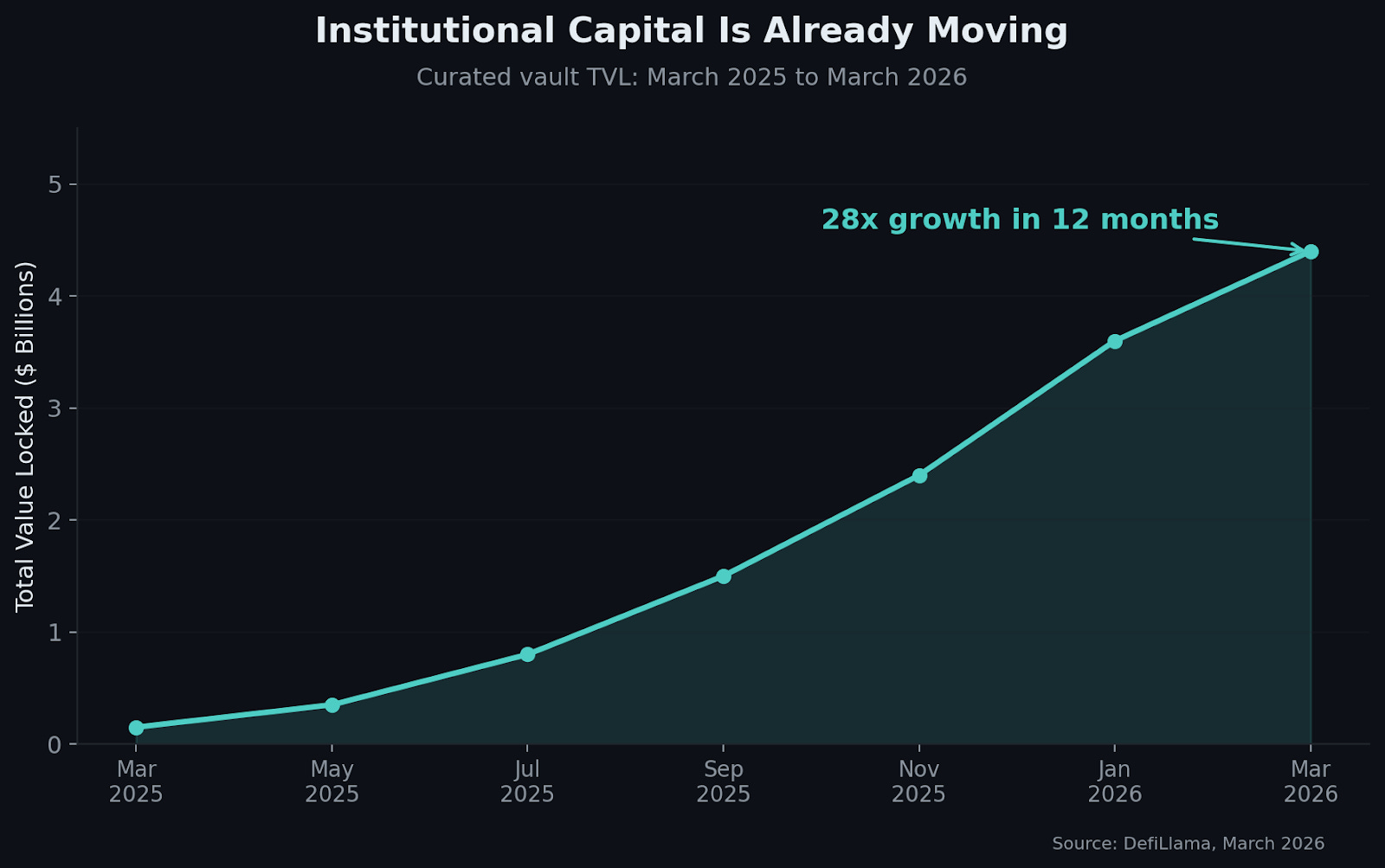
Curated vaults, the institutional-grade layer managed by professional risk teams, grew from under $150 million to over $4.4 billion in total value locked over the past 12 months.
For those who care about math…that’s 28x growth.
Onchain vaults collectively hold over $15 billion. Tokenized real-world assets on public blockchains hit $23.6 billion in March 2026, up 66% year-to-date.
Still skeptical? Look who’s building…
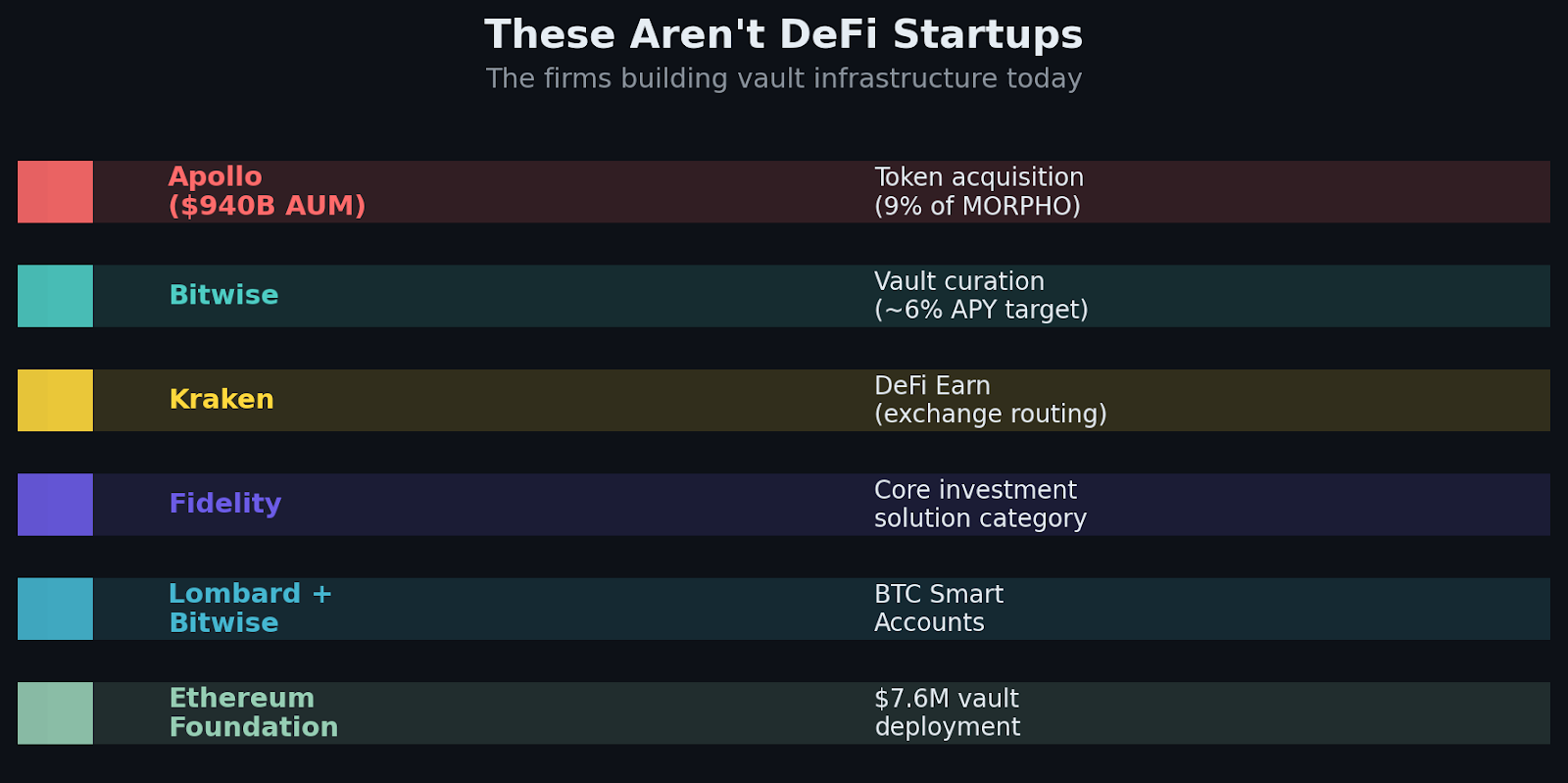
Bitwise launched vault curation on Morpho targeting roughly 6% APY for institutional depositors.
Kraken’s DeFi Earn routes exchange deposits into onchain vaults managed by professional risk teams.
Apollo committed to acquiring 9% of Morpho’s token supply over four years.
Fidelity put vaults on a slide alongside funds and tokenized products as a core investment solution category.
When a $940 billion traditional asset manager makes a four-year commitment to DeFi protocol infrastructure, that’s not an experiment. When Fidelity categorizes vaults as a core investment vehicle, that’s a signal about where the product landscape is heading.
What the World Looks Like with Vaults
Here’s where I think it’s worth stepping back and imagining the practical reality that’s taking shape.
For advisors: Picture a world where your client’s stablecoin allocation earns 5-8% through overcollateralized lending, and you can verify every position in real time from a dashboard. No quarterly lag. No reconciliation headaches. No custody counterparty risk. The diligence framework is the same one you’d apply to any yield product: what’s the source, what’s the collateral quality, what are the liquidation mechanics, who’s managing the risk. The wrapper is different. The discipline isn’t.
For allocators: Imagine evaluating fund managers not by their quarterly reports, but by their live, onchain track record. Every allocation decision, every rebalance, every fee is visible to anyone who knows where to look. The best managers won’t just welcome that transparency. They’ll compete on it.
For the broader market: Vaults are the infrastructure that connects tokenization to actual investment utility. Tokenized Treasuries, tokenized private credit, tokenized real estate, none of it matters unless there’s a vehicle that puts those assets to work for investors. Vaults are that vehicle. Bitwise has called them “ETF 2.0,” and the comparison captures something real. ETFs democratized access to diversified strategies. Vaults do something similar for onchain yield, with structural transparency that ETFs never offered.
Buffett Framework Question:
“Is this more like an ETF, a managed account, or a mutual fund?”
The answer is elements of all three, with a critical distinction: the transparency isn’t enforced by a reporting requirement. It’s enforced by the technology itself. Buffett has always favored businesses where you can see exactly what’s happening with your capital. Vaults make that visibility the default.
Not All Vaults Are the Same
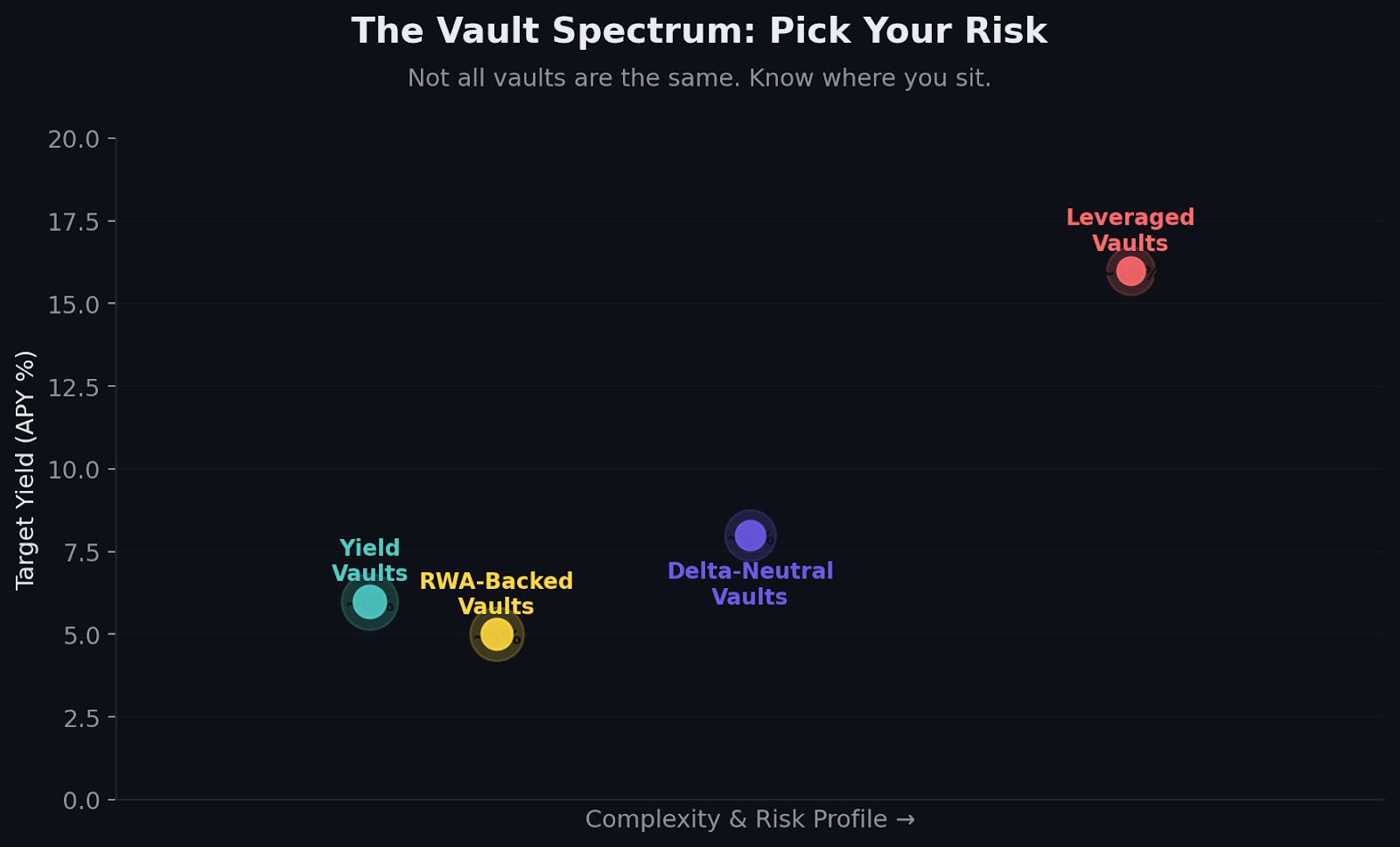
The strategy inside the vault determines the risk profile, the yield, and who it’s designed for. Four categories matter most for investors.
Yield vaults are the simplest. Deposit stablecoins, earn yield through overcollateralized lending. Think of it as the money market fund equivalent. Bitwise’s Morpho vault targets around 6% APY. The risk is low, the mechanics are transparent, and it’s the entry point for most institutional allocators.
RWA-backed vaults hold tokenized real-world assets like Treasury bills, private credit, or invoice financing. They stream predictable yield while maintaining onchain visibility. Tokenized Treasuries alone hit $11 billion in March 2026. This is where vault infrastructure and the tokenization trend converge.
Delta-neutral vaults use hedging to generate income without directional market exposure. They’re designed for investors who want yield without the volatility of holding the underlying asset. If you’re looking for something that separates return generation from price speculation, this is the category.
Leveraged vaults borrow against collateral and redeploy to amplify returns. Apollo launched a vault delivering a reported 16% yield through looped private credit. These carry meaningfully higher risk. Leverage in any form can be a killer, and any advisor considering these for client capital needs to understand the liquidation mechanics and the conditions under which they can unwind.
Buffett Framework Question:
“Could I explain this strategy to a client in a single paragraph?”
If the answer is no, the strategy is probably too complex for most advisory relationships. Buffett’s circle of competence framework applies directly. Stick to vaults where you understand the yield source.
The Risks That Come with the Opportunity
I wouldn’t be doing my job if I only talked about the upside. Vaults carry real risks, and they deserve the same scrutiny you’d apply to any investment vehicle.
Smart contract risk is the most fundamental. Vaults are code, and code can have vulnerabilities. Auditing standards have improved significantly, but the risk hasn’t been eliminated. Protocol maturity matters. The battle-tested platforms with billions in deposits and multiple audits are meaningfully different from newer protocols without that track record.
Curator concentration is an emerging concern. Research shows a small set of curators manages a disproportionate share of system TVL with clustered risk profiles. The ecosystem is more concentrated than it looks, and problems at one major curator could ripple across the system.
Liquidity risk applies especially to RWA-backed vaults. If the underlying assets settle on T+1 or T+2 timelines, instant redemption isn’t always possible. Newer technical standards handle this through a request-then-claim pattern, but depositors should understand the tradeoff.
Regulatory risk is real. Vaults sit in an evolving landscape. As implementation of the Clarity Act and GENIUS Act unfolds, compliance requirements could shift. Advisors should track this closely.
Where This Goes from Here…
The vault market today is roughly where ETFs were in their first decade. The technology works. The early adopters are in. The product taxonomy is expanding. But most of the market hasn’t caught up yet.
For anyone who remembers what happened when ETFs went mainstream, the parallels are worth paying attention to. The firms that moved early built the franchises. The ones that waited spent years playing catch-up.
I don’t think the question is whether vaults become a standard part of the institutional investment toolkit. The question is how quickly, and which firms will be positioned to offer them when clients start asking.
I’ll continue tracking this space and sharing what I find. If you’re an advisor, fund manager, or allocator who wants to explore how vaults fit into your digital asset strategy, that’s exactly the kind of conversation we have at Block3.
Until next time!
- Matthew
Matthew Snider is the founder of Block3 Strategy Group, author of “Warren Buffett in a Web3 World,” and publisher of the BitFinance newsletter. He holds a Series 65 and MBA, and has been an active participant in digital asset markets since 2015. This article is for educational purposes only and should not be considered financial advice. Always consult with a qualified professional before making investment decisions.